
Peter Simon, n.d.

Baird combatted the law by many angles, but the argument appealed to the Supreme Court concerned the Fourteenth Amendment, and the clear violation of the Equal Protection Clause on the basis of unequal treatment between married and unmarried individuals. Furthermore, the case questioned the right to privacy established in Griswold v. Connecticut, and whether the Massachusetts law intruded on this.
"The Massachusetts Supreme Judicial Court unanimously set aside the conviction for exhibiting contraceptives on the ground that it violated Baird's First Amendment rights, but, by a four-to-three vote, sustained the conviction for giving away the foam." ~ JUSTIA, Eisenstadt v. Baird
"Now, there are two questions that I think are addressed to this Court, and the first is... whether or not the Massachusetts statute prohibiting it, the giving away of admittedly contraceptive substance, whether or not that is constitutional.
And secondly, whether or not the Massachusetts statute is unconstitutional as applied to William Baird, who was admittedly a married man and who was admittedly also not a physician nor a Nurse nor a Registered Pharmacist or clearly not a Public Health Agency." ~ Joseph R. Dolan, advocate for appellant
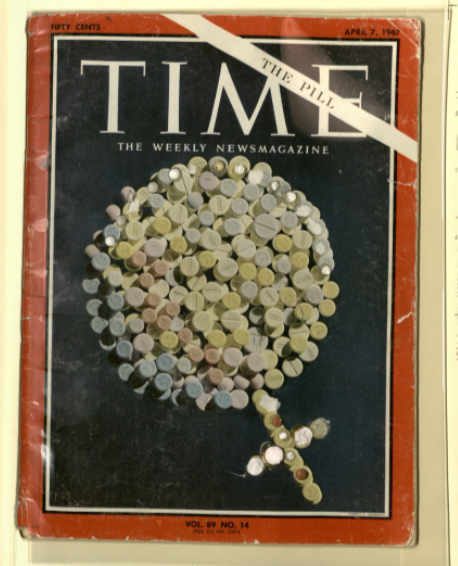
1967, Schlesinger Library.
"April the 6th, the day of my arrest, 1967, was a montage of pictures of the birth control pill. Now, the law said you cannot exhibit, print, publish any means of birth control or abortion. So I said, this is against the law. And what I did very carefully, I pasted on the cover the real birth control pill and St. Joseph's baby aspirin. Why? Because it looked like the pill. So I said to the police, will you jail me for showing the real pill, the photographs of the pill, or something that looks like the pill? They looked at me and they laughed, faces, but did nothing. So I said, wow, in order to get arrested, you've got to be able to provide the ammunition to prove you violated the law." ~ Bill Baird, Personal Interview
"Repeatedly doing the lecture, the appellee, Mr. Baird, invited the police to arrest him. He said, 'Why do you not arrest me officers, I am violating your Massachusetts Law?' Finally, when he handed this can of Emko to this particular young lady, the police complied with his wishes." ~ Joseph R. Nolan, advocate for appellant

Mary Beth Edelson, 1994, Fort Wayne Museum of Art.
Peter Simon, n.d.
At the state level, "The Massachusetts Attorney General filed suit under the states' right 'to protect the purity and the chastity of American women'" (Bill Baird, 1972). However, at the Supreme Court, the plaintiff's argument was on behalf of Massachusetts; and despite widespread moral opposition to contraception, it lacked legal weight. The dissenting opinion disregarded previous moral concerns and Fourteenth Amendment violations, instead, the Justice in opposition said it was a health and safety issue. Justice Warren Burger argued "...if Massachusetts has validly required, as a health measure, that all contraceptives be dispensed by a physician or pursuant to a physician's prescription, then the statutory distinction based on marital status has no bearing on this case." (Warren Burger, 1972). The plaintiff was not concerned with personal beliefs equal protections to privacy, only that Baird was distributing medication, no matter marital status, without a physician license.
The Supreme Court found, in a 6-1 decision that “the law's distinction between single and married individuals failed to satisfy the "rational basis test" of the Fourteenth Amendment's Equal Protection Clause.” (Case Brief, 1972). The court decided that although under the equal protections clause citizens can be treated unequally if it serves a legitimate state interest, however they decided a distinction between married and unmarried persons does not have rational basis to provide different treatment. In addition to this decision, they also set aside Baird’s convictions of lecturing and distributing information on birth control on the foundation that it violates his first amendment right to freedom of speech. Supreme Court Justice William J. Brennan Jr. wrote that “If the right of privacy means anything, it is the right of the the individual, married or single, to be free from unwarranted government intrusion into into matters so fundamentally affecting a person as the decision whether to bear or beget a child.” (William Brennan Jr., 1972).
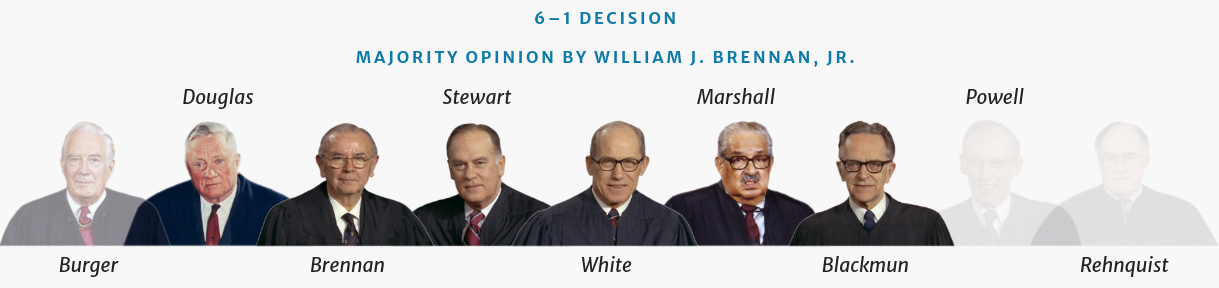
Oyez.org, Eisenstadt v. Baird
“Here, we are not only talking about the dignity and the personality of the individual, we are talking about the very rights, the life and health, not only of the individual mother herself, but to the possible unborn child that she may have or she may have some day. And for these reasons, I would hope that the Court would find the Massachusetts statute unconstitutional.” ~ Warren Burger, Supreme Court Chief Justice
“Now, what happens if this statute is held constitutional? You are going to mean that in the State of Massachusetts and all the nine hospitals involved for low income mothers, you are going to say sorry to the unmarried mother who might have had four or five illegitimate children already? The next birth may cause grave physical injury, even death you can say, I am sorry, but we can not prescribe you because you are unmarried. I mean, that is patently against the best interest of the State of Massachusetts, it is against the whole trust of federal legislation. It is an outdated anachronism from a Comstockian statute back in 1870's which has no business being on the statute books today.” ~ Joseph Tidings, argued for appellee in Eisenstadt v. Baird
Freedom is not liberal or conservative. Freedom is an absolute. You have a right to make your own decisions over your own body." ~ Bill Baird, Yours in Freedom