Perspective
As Japanese Americans transitioned into relocation camps, there were many different perspectives on the situation. The Japanese Americans mainly opposed the decision of internment, while many U.S. groups, citizens, and media were divided by the decision.
Japanese Internees
In the camps, many Japanese Americans often wrote about their experiences. However, letter delivery was heavily restricted during this time. The following excerpt comes from a letter written by Kenji Okuda.
“But how futile and hypocritical this all sounds... in concentration camps in a democracy... to be kept herein at the sole discretion of the military....and yet to be willing to do our best to insure the defeat of a nation with which so many of us are connected only by facial and racial characteristics” (Okuda).
Kenji Okuda was a 19 year-old student before terror struck on his family as orders for internment of Japanese Americans were issued. He would often exchange letters criticizing the reason for internment with people from neighboring camps. Letter delivery was a common occurrence, but often were tossed away. Letters that made it through often described the harsh and poor conditions in the camps. It was clear that Japanese Americans were discontent with the decision.
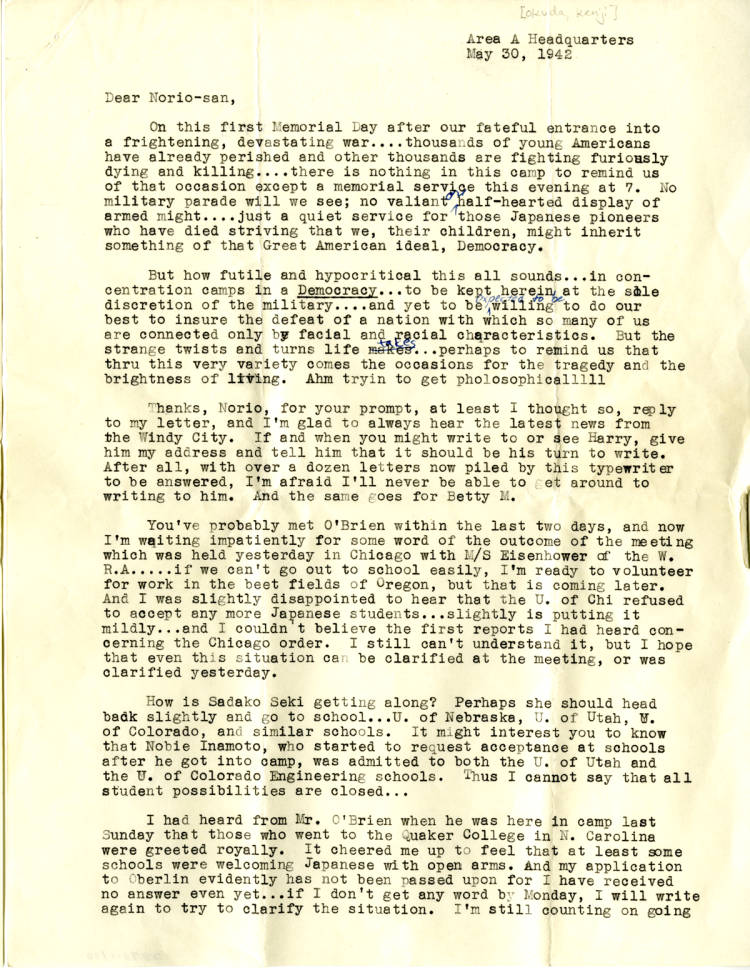
"Kenji Okuda letter to Norio Higano from Camp Harmony the Puyallup assembly center regarding his feelings on internment on Memorial Day", May 30, 1942, University Libraries | University of Washington.
Media & Groups
Contrasting the solidified view of the internees, people from groups and media had a mixed opinion. From Manzanar Free Press, one of the leading internment newspaper providers, they document many perspectives of U.S. citizens.
“San Francisco Examiner-Constant Reader thought ‘Jap visiting and gift giving to people who are waiting to cut all our throats is disgusting’ and should be stopped” (Manzanar Free Press).
Although heavily restricted, families and friends would visit known interned members and give gifts such as food or necessities. These items were gratefully cherished as internment camps provided very few resources. Maintaining bonds between friends and families was also crucial. As isolation and developing mental health issues such as trauma and fear become more common. However, there were people who opposed gift giving and visiting, claiming people’s behaviors were unpatriotic and they sided with the “enemy”, highlighting the split views on internment.
“Baptist group criticizes expulsion: Protesting that the evacuation of the Japanese on the west coast has violated "Christian principles of racial non-discrimination and respect, of justice and fair play…” (Manzanar Free Press).
Religious groups had various outlooks on the situation. Many religious groups argued that internment was unjust and contrasted their beliefs and fought to support interned families and legal challenges. However, not all communities came together to oppose internment, some supported the idea of internment and labeled it as a patriotic duty necessary to protect the nation. The beliefs and morals individuals had led to support one side or the other, and shows the conflict between what was right or wrong.
Government
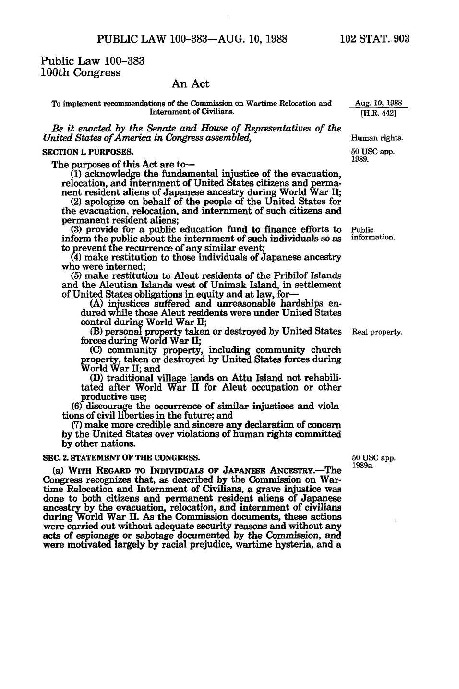
"Civil Liberties Act of 1988", August 10, 1988, Digital Public Library of America.
While people were debating whether internment was justified, the U.S. Congress fully acknowledges their wrongdoing. Their apology was made when the Civil Liberties Act of 1988 was enacted.
“The purposes of this Act are to— (1) acknowledge the fundamental injustice of the evacuation, relocation, and internment of United States citizens and permanent resident aliens of Japanese ancestry during World War II” (Civil Liberties Act of 1988 1).
It was only decades after WWII, when the U.S. Congress readdressed the wronging of their actions. The U.S. had earlier apologized after the release of interned citizens, but they readdress this years later formally in the form of an act of Congress. The Civil Liberties Act of 1988 focuses on admitting and apologizing for their actions and providing compensation for internees. The U.S. promised with this act not to allow any further violations of civil liberties and to understand and spread awareness toward issues involving civil rights. The U.S. was able to grow and develop from their previous mistakes and wrongdoings.