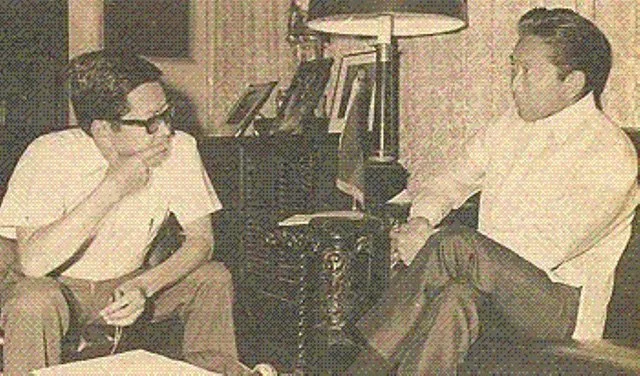
(Sen. Benigno Aquino, Jr. and President Ferdinand Marcos)
"The funeral of Sen. Ninoy Aquino Jr. was held on Aug. 31 10 days after his assassination" (Zamora).
Suppression of Aquino
(Sen. Benigno Aquino, Jr. and President Ferdinand Marcos)
To remove opposition, Marcos charged Senator Benigno “Ninoy” Aquino, his main political rival “[with] giving firearms to Communist guerrillas.” Aquino was later pardoned in 1980 to receive medical treatment in the U.S., and he self-exiled in Massachusetts (Dunlap).
Return and Assassination
“[Aquino] stayed [in the U.S.] for three years, doing academic research on a formula for a return to democracy in his homeland that he said he would try carry out in the Philippines” (Mydens).
“Fifteen minutes after Ninoy Aquino returned to the country [on August 21, 1983]...he was dead on the tarmac of the Manila International Airport” ("A History of the Philippine Political Protest").
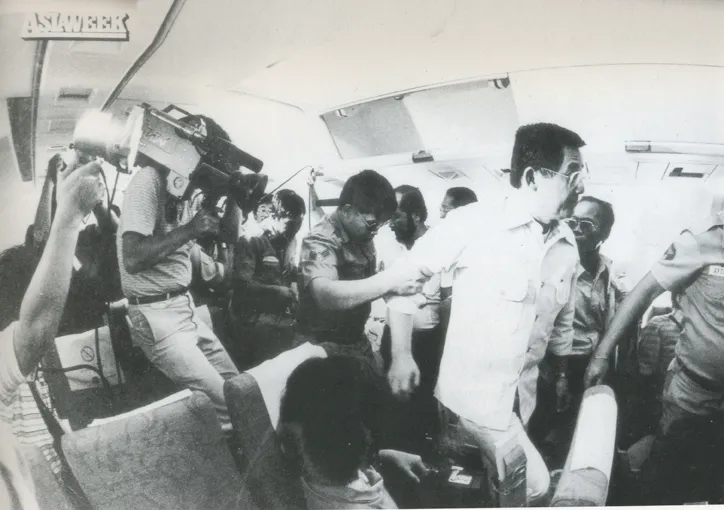
(Ninoy at the brink of death: Ninoy being led out of the China Airlines jet on Aug. 21, 1983)
Aquino kept insisting on returning to the Philippines despite risk of assassination:
“‘[I’d] rather choose to follow my conscience and accept a tyrant’s revenge’” (Dunlap).
- Aquino, 1973
“‘We’re racing against time. I must convince the President to help me bring democracy back to our country’” (Dunlap).
- Aquino, 1981
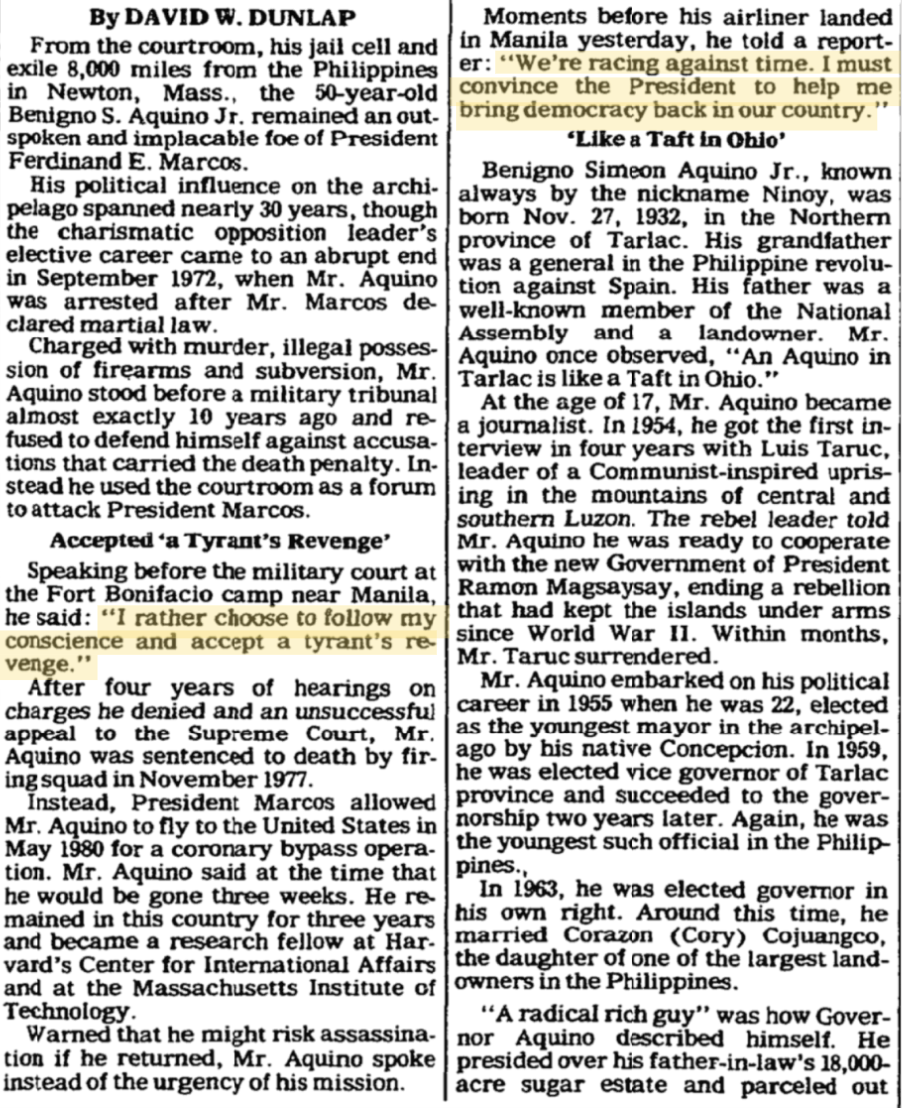
(BENIGNO AQUINO, BITTER FOE OF MARCOS. 22 Aug. 1983)
United Opposition Against Marcos
Investigations by the Agrava Commission, dedicated to uncovering the individuals linked to Aquino’s death, revealed that Marcos was involved (University of Central Arkansas).
“[His assassination] moved countless Filipinos, especially the once-timid middle class, to awaken and jointly fight the reality of dictatorship. For many it was, in the words of a Makati businessman ‘. . . the spark that gave us the courage to speak up’” ("A History of the Philippine Political Protest").
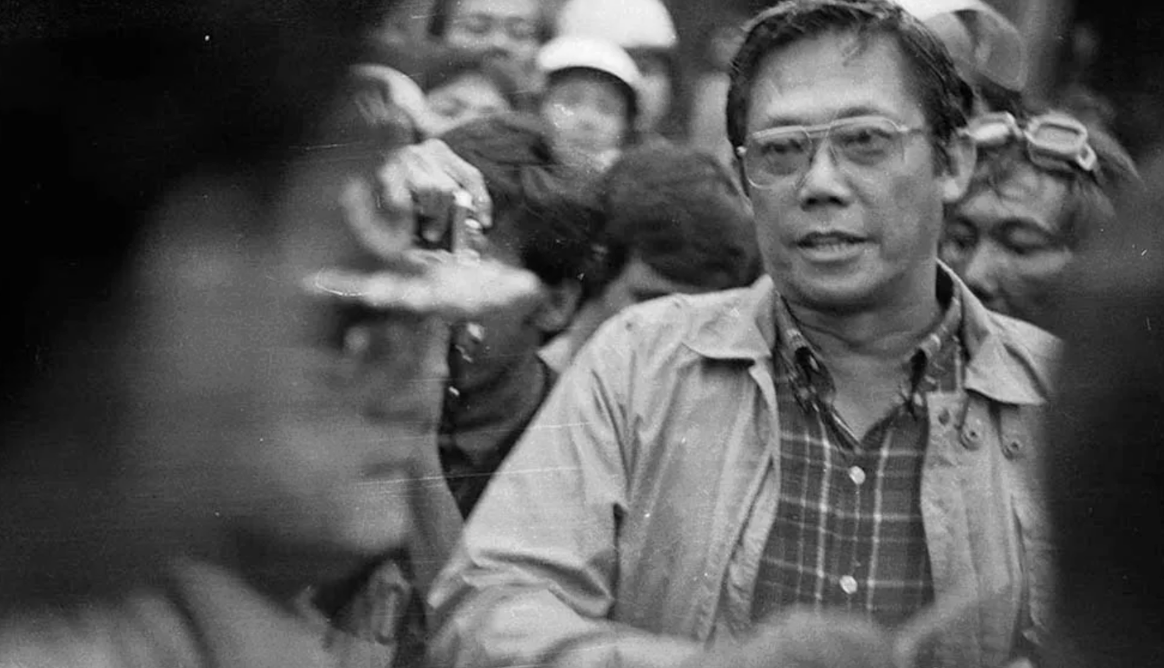
(Butz Aquino, Ninoy Aquino's brother, at the September 30 Tarlac to Tarmac march, Bantayog ng mg Bayani)
“165 rallies, marches, and other demonstrations took place between August 21 and September 30, 1983 [and] protest demonstrations continued into the following year, with more than 100 held between October 1983 and February 1984” (“A History of the Philippine Political Protest”).
One of the largest protests was “the 120-kilometer ‘Tarlac to Tarmac’ run (from Aquino’s home province to the international airport where he was murdered), [that was] attended by an estimated five hundred thousand people” on January 27, 1984 (“A History of the Philippine Political Protest”).
Yellow, a color symbolizing hope and peace, and the “L” hand sign representing fight, were chosen as uniting symbols for the protests (Philippine Daily Inquirer).
Following her husband’s death “[Corazon Aquino] said she would become a candidate for the presidency only if Marcos called a special election...Aquino’s supporters presented her with stacks of petitions bearing 1.2 million signatures” (Smolwe).
◄ ABUSED AUTHORITY

THE SNAP ELECTION ►