Insanity and Inspiration
Nellie Bly’s exposé on Blackwell’s Island brought much success for her up-and-coming career in journalism. Her articles on the insane asylum enlightened the public on the dangerous and disturbing conditions at the asylum and brought immediate change for the treatment of the patients.
"The story was so explosive that competing newspapers produced their own accounts of how Bly succeeded in her dangerous work, just to join in on the expose. The report on the madhouse welcomed a new way of newspaper writing and Nellie Bly was the one to thank." - Diane Bernard, 2019
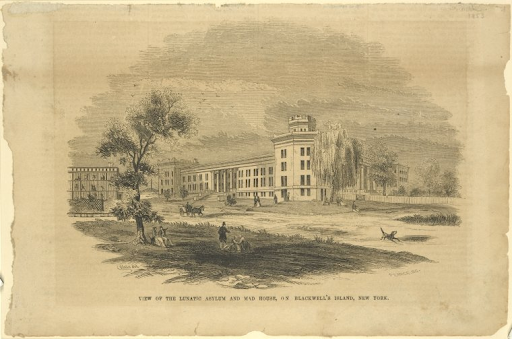
A print of Blackwell's Island.
"View of the lunatic asylum and mad house, on Blackwell's Island, New York," 1853, New York Public Library Digital Collections.
Porter, Edwin S., "Panorama of Blackwell's Island," Thomas A. Edison Incorporated.
Bly’s investigation of the madhouse helped to launch her career and bring her to fame before she set off to complete an even larger feat: to travel around the world in eighty days or less.
Panorama of Blackwell's Island (Left)
"It is easy to see how one thought followed another. The idea of a trip around the world pleased me and I added: 'If I could do it as quickly as Phineas Fogg did, I should go'"
- Nellie Bly, 1890
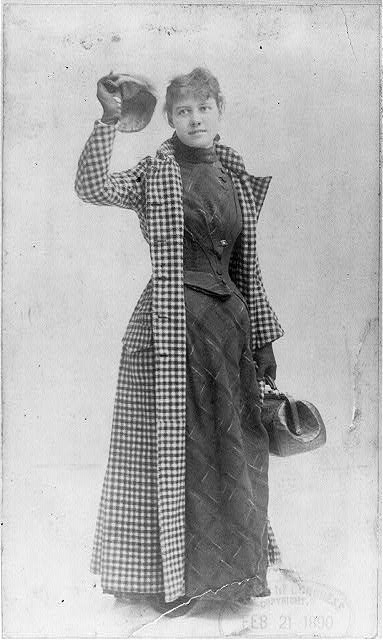
"Nellie Bly," 1890, Library of Congress.
Bly expressed her idea to the editors at The New York World, who had already considered the idea, but were more comfortable sending a man. Although Nellie Bly was confident in her ability, the ultimate verdict was that she could not go. Almost a year later, Bly was summoned to the office where she was asked to finally begin her journey. Nellie Bly set out to beat the record set by fictional character, Phineas Fogg.
“He looked up from the paper on which he was writing and asked quietly: ‘Can you start around the world day after tomorrow?’ ‘I can start this minute,’ I answered, quickly trying to stop the rapid beating of my heart.” - Nellie Bly, 1890