In 1860, Florence Nightingale established the St. Thomas Hospital in London, England. The school was built with the help of a £50,000 donation (which roughly is £7.9 million today) from her Nightingale Fund. Some people who helped Nightingale create the school were Sidney Herbert, Sarah Wardroper, and the St. Thomas' Hospital Court of Governors. This hospital would be where Florence Nightingale would teach nurses on how to keep personal cleanliness, the patient’s cleanliness, and the holistic approaches that she would make to patient-centered care. Nightingale believed in the ideals of patient confidentiality, building trust with the patient, observing the patient’s comfort and illness progression, how to effectively communicate with patients, and how to have a clean and positive environment for the sick.
Florence Nightingale: Her Reforms to Nursing, Military Medicine, and Preventitive Medicine
The Creation of St. Thomas Hospital and Nightingale's Nursing Program
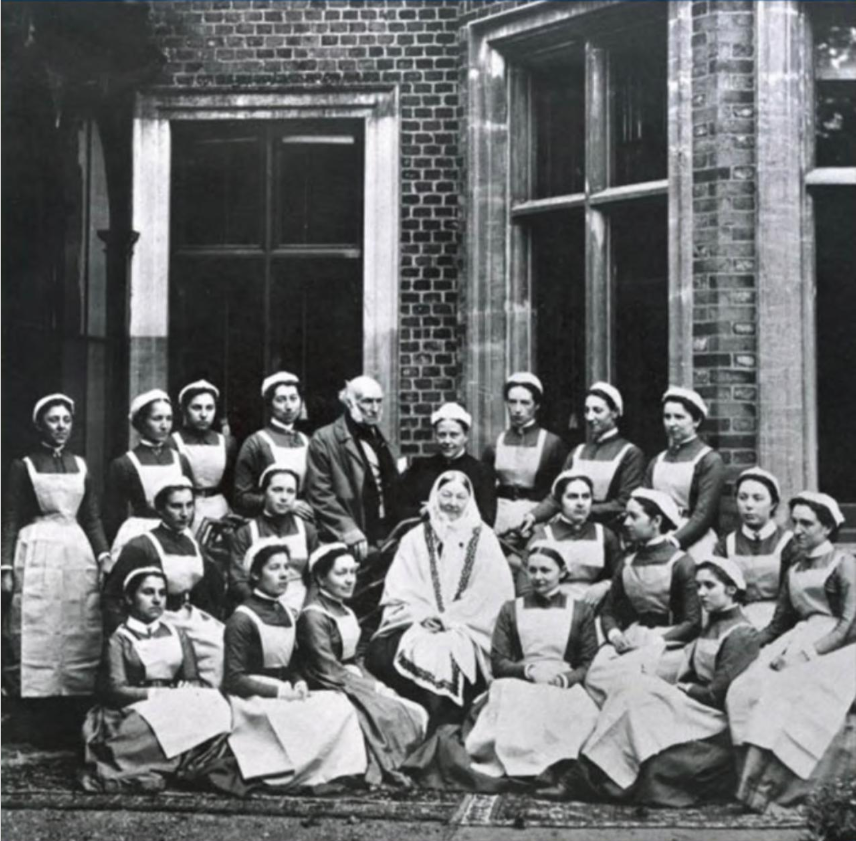
Photograph of Florence Nightingale with her students at St. James Hospital. Courtesy of McDonald, Lynn, Florence Nightingale: The Nightingale School, 2009.
"For us who Nurse, our Nursing is a thing, which, unless in it we are making progress every year, every month, every week, take my word for it, we are going back. The more experience we gain, the more progress we can make."
-Nightingale, Florence, Florence Nightingale to Her Nurses: A selection from Miss Nightingale's addresses to probationers and nurses of the Nightingale school at St. Thomas's hospital, 1914.
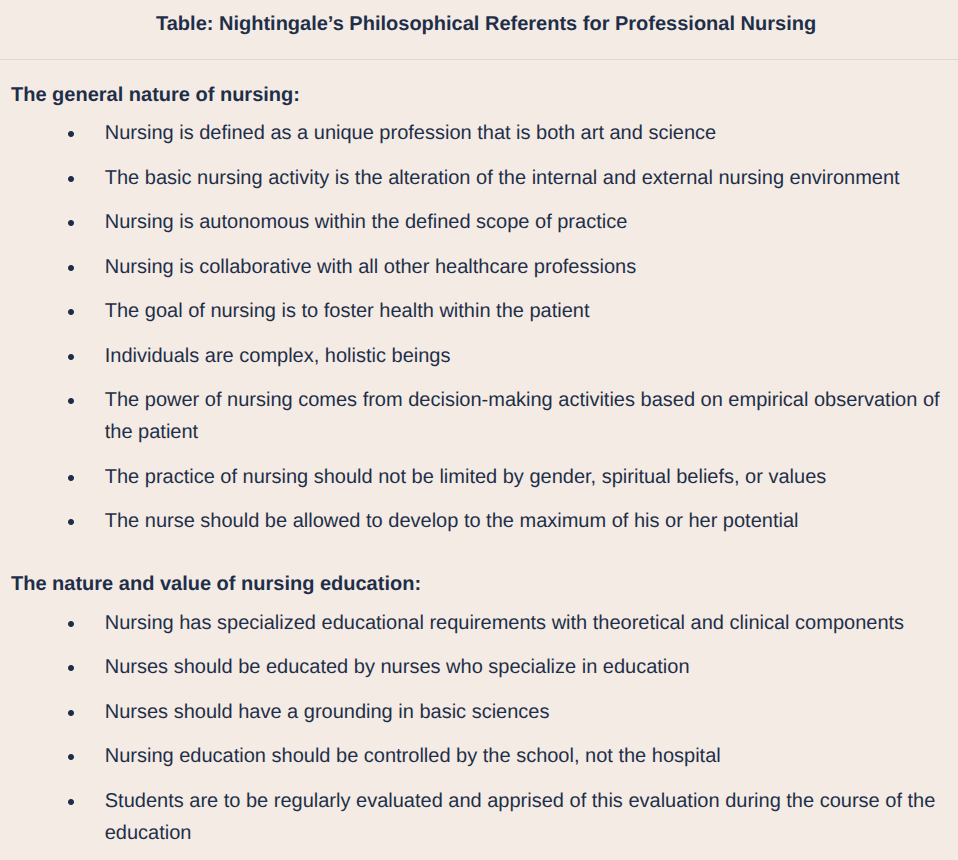
Florence Nightingale's philosophical beliefs for professional nursing and the nurse's ideals. Courtesy of Selanders, Louise and Patrick Crane, The voice of Florence Nightingale on advocacy, 2012.
Nightingale had a holistic idea of her patient care and believed that the main priority was the comfort and hospitality towards the patient. The patient deserved to be comfortable and confident with their safety regarding infection precautions, bedding, and the staff that would take care of them, which nurses play a heavy role in. Nightingale also proposed that nurses are just as important as anyother role in the healthcare system since they all follow the same goal, helping the patient with whatever injury and/or illness they have.
"With the establishment of this school, she changed nursing to a respectful profession."
-Karimi, Hosein and Masoudi Alavi, Negin, Florence Nightingale: The Mother of Nursing, 2015.
Nightingale's Nursing Legacy
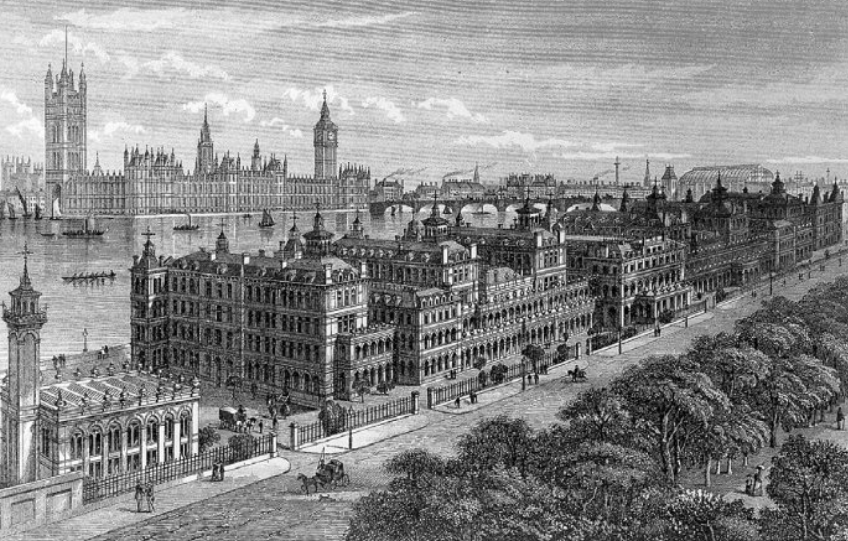
Drawing of St. Thomas Hospital in London, England, in the 1800s. Courtesy of Tunç, Uğurgül, Lessons from the Crimean war: How hospitals were transformed by Florence Nightingale and others, 2019.

Photo of St. Thomas Hospital in London, England, in the 2000s. Courtesy of Wikipedia, 2009.
St. Thomas Hospital ran until 1991, and while Nightingale was alive, she advocated for the school and was very involved in issues revolving around the teaching of nursing. Even when she was suffering from a chronic disease in her old age, she would still commit her life’s work to her teaching hospital. In 1991, St. Thomas Hospital merged with the Olive Haydon School of Midwifery and the Thomas Guy & Lewisham School of Nursing. The name changed from St. Thomas Hospital to the Nightingale College of Health. In 2001, the school became a part of King’s College London and, as of 2014, has been an independent faculty with specialties in nursing, child and family health, midwifery, and psychiatric nursing. With the integration of Cicely Saunders Institute, palliative care was added as a specialty, and the facility is now called the Florence Nightingale Faculty of Nursing, Midwifery & Palliative Care.
"There is a natural desire to understand the nature of a great man's or woman's influence, and we see in the addresses something at least of what constituted Miss Nightingale's power. Her earnest care for the nurses, her intense desire that they should be "perfect," speak in every line. "
- Nash, Rosalind, Florence Nightingale to Her Nurses: A selection from Miss Nightingale's addresses to probationers and nurses of the Nightingale school at St. Thomas's hospital, 1914.