After the war, Florence Nightingale was quick to start creating notes and criticisms on how current hospital sanitary conditions were and would often speak about the spread of infection. Nightingale’s goal was to mandate more protocols to try to prevent the spread of infection that caused more deaths in the Crimean War compared to the actual injuries soldiers would face. Many of these publications would include an interest in military health care, sanitary conditions of hospitals, and issues to help train nurses for tending to the ill.
Florence Nightingale: Her Reforms to Nursing, Military Medicine, and Preventitive Medicine
Publications and Hospital Reforms for Infection Control
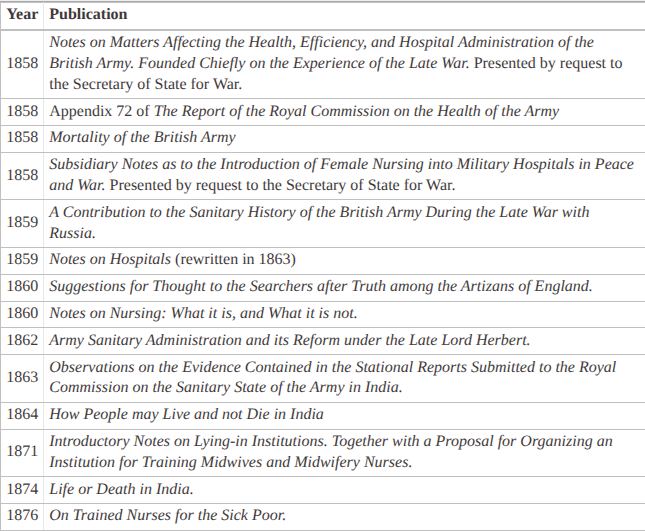
A list of all of Florence Nightingale's publications from 1858 to 1876. Courtesy Anderson, Rebecca, Florence Nightingale: The Biostatistician, 2011.
"It may seem a strange principle to enunciate as the very first requirement of a Hospital that it should do the sick no harm. It is quite necessary, nevertheless, to lay down such a principle, because the actual mortality in hospitals...is very much higher than any calculation founded on the mortality of the same class of diseases among patients treated out of hospital would lead us to expect. "
-Nightingale, Florence, Notes on Florence Nightingale, 1863.
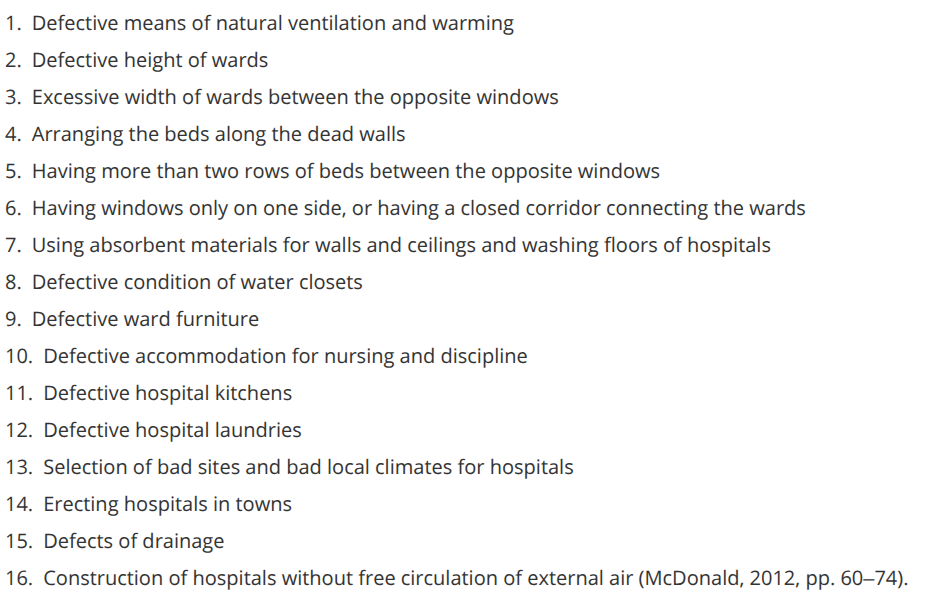
The many inefficiencies that Florence Nightingale noticed in hospitals after her experience in the war. Courtesy of McDonald, Lynn, et al, Florence Nightingale: The Making of a Hospital Reformer, 2020.
Nightingale believed that hospitals were one of the most common places to contract and die of infectious diseases. Due to her past experiences, she came up with different codes that hospitals should establish to not only have the best effect to prevent the spread of infection, but also create a comfortable and safe place for patients. Many of these new codes involved changes for ventilation and heat, noise reduction, appropriate bedding, lighting, cleanliness for patients, and cleanliness for staff.
"Infection acts through the air. Poison the air breathed by individuals, and there is infection. Shut up 150 healthy people... and in twenty-four hours an infection is produced so intense that it will, in that time, have destroyed nearly the whole of the inmates."
-Nightingale, Florence, Notes on Florence Nightingale, 1863.
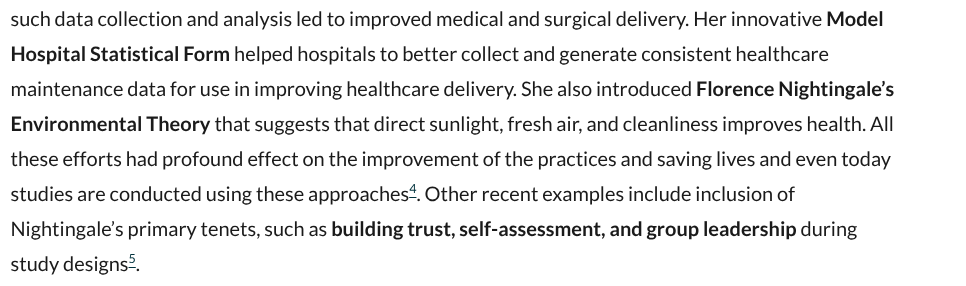
Writing about Florence Nightingale's Environmental Theory and Model Hospital Statistical Form, both used to help reform hospitals and provide hospitals with better results, and prevent disease. Courtesy of Gürler, Bülent, Holistic approach to infection control and healing: the Florence Nightingale story, 2014.
"Sick people are more suspectible than healthy people; and if they shut up without sufficient space and sufficient fresh air, there will be produced not only fever, but erysipelas (bacterial disease), pyaemia (blood poisoning), and the usual tribe of hospital-generated epidemic diseases."
-Nightingale, Florence, Notes on Florence Nightingale, 1863.
Florence Nightingale advocated for better facilities to prevent the spread of infection and bacterial diseases across hospitals. This type of medicine is known as preventative medicine and is commonly used today to make sure that hospitals have special precautions that allow no disease to be spread from patient-to-patient or patient-to-staff in the healthcare setting. People go to hospitals to be healed, not harmed.