Background
Satyagraha Origins
Prior to his work in India, Gandhi successfully fought discrimination with peaceful protests in South Africa where he developed Satyagraha, a revolutionary method of nonviolent resistance he believed would be universally effective against social evils.
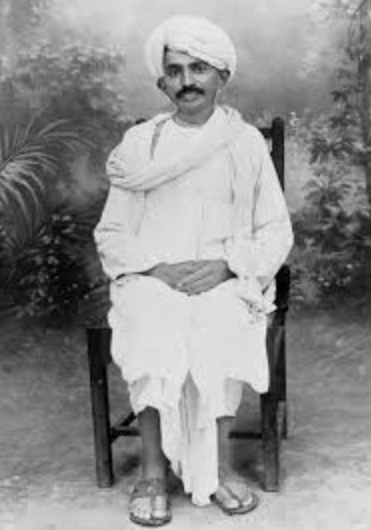
(Saxena)
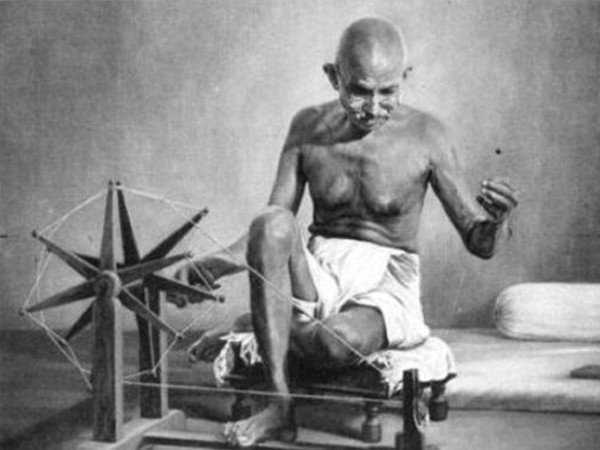
The wheel became a symbol of Satyagraha. ("Gandhi''s letter about spinning wheel sells for over $6,300 at auction")
"Satyagraha, then, it literally holding on to Truth, and it means, therefore, Truth-force... It excludes the use of violence because man is not capable of knowing the absolute truth and, therefore, not competent to punish" - Mahatma Gandhi (Terp)
"Truth (satya) implies love, and firmness (agraha) engenders and therefore serves as a synonym for force. I thus began to call the Indian movement Satyagraha, that is to say, the Force which is born of Truth and Love or nonviolence" - Mahatma Gandhi (Desāī 109)
"Non-violence is the greatest force at the disposal of mankind. It is mightier than the mightiest weapon of destruction devised by the ingenuity of man" -Mahatma Gandhi (“The Power of Non-violence”)
Work in South Africa
As a young man, Gandhi set up a law practice in Bombay where business was waning. He took an offer from a businessman to travel to South Africa and established a successful legal practice in Johannesburg (Wolpert).
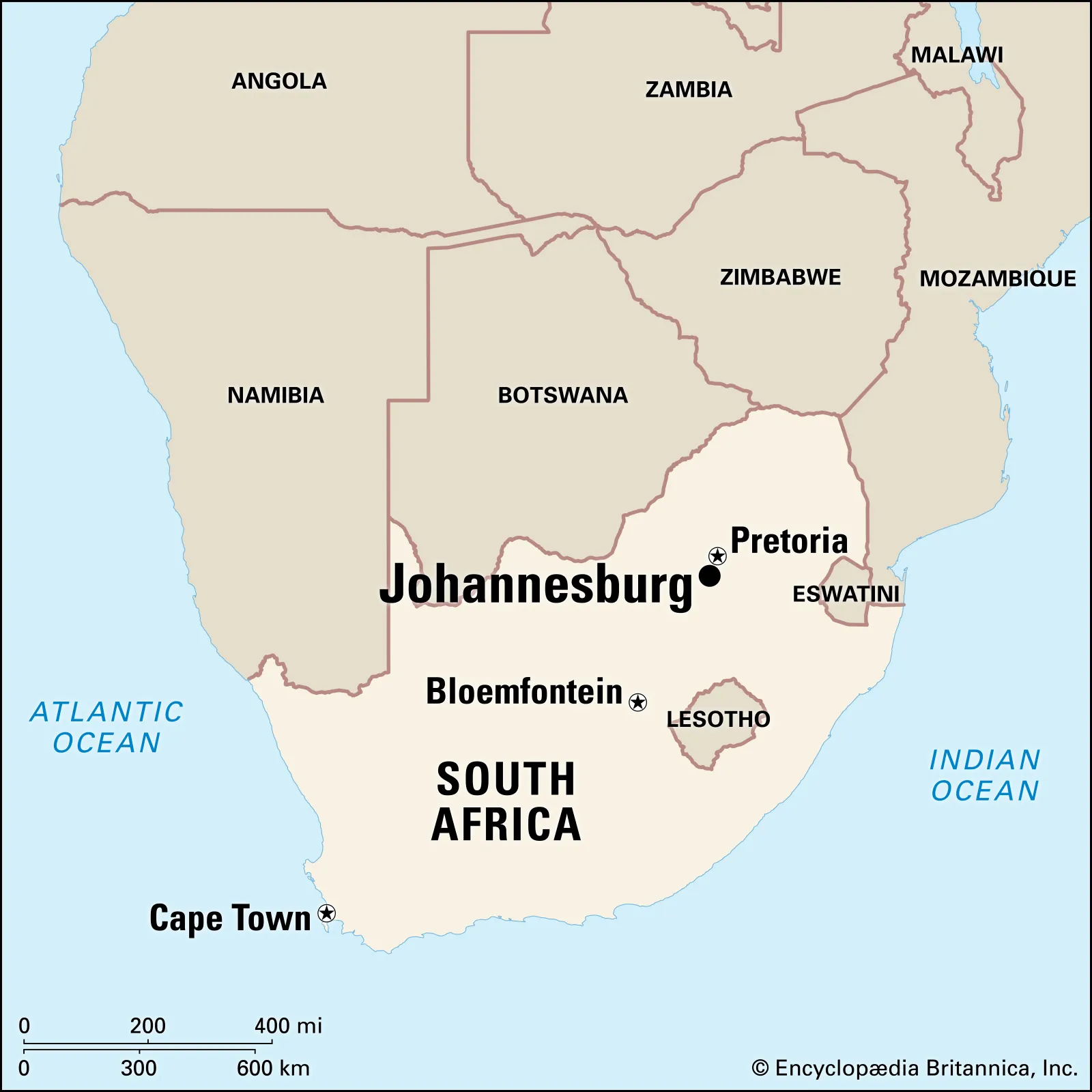
("Johannesburg")
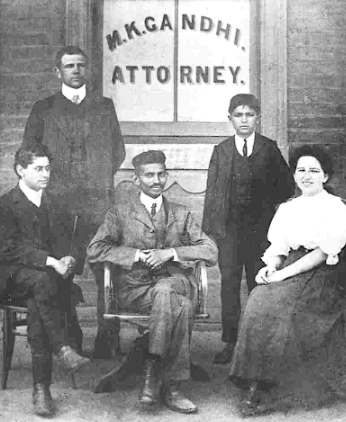
(Polak, Gandhi in front of his Johannesburg law office, 1905, with Henry Polak (left), Sonia Schlesin; others unidentified)
In 1903, while in South Africa, Gandhi founded the newspaper Indian Opinion that chronicled the birth of Satyagraha.
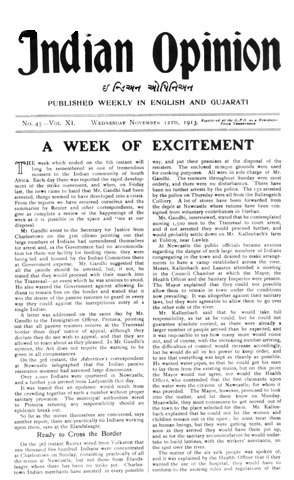
(King, The Cover of Indian Opinion, the Newspaper Published by Gandhi in South Africa, in 1913)
" Satyagraha would probably have been impossible without Indian Opinion. The readers looked forward to it for a trustworthy account of the Satyagraha campaign as also of the real condition of Indians in South Africa…Week after week I poured out my soul in its columns, and expounded the principles and practice of Satyagraha as I understood it" -Mahatma Gandhi (Desāī 321)
Gandhi began an anti-discrimination movement in British-controlled South Africa. He was first jailed in 1908 for refusing to be registered under the Transvaal government’s “Black Act”, which aimed to control and humiliate the Indian population. He emerged from prison as the Indian community’s foremost defender of human rights there (Wolpert).
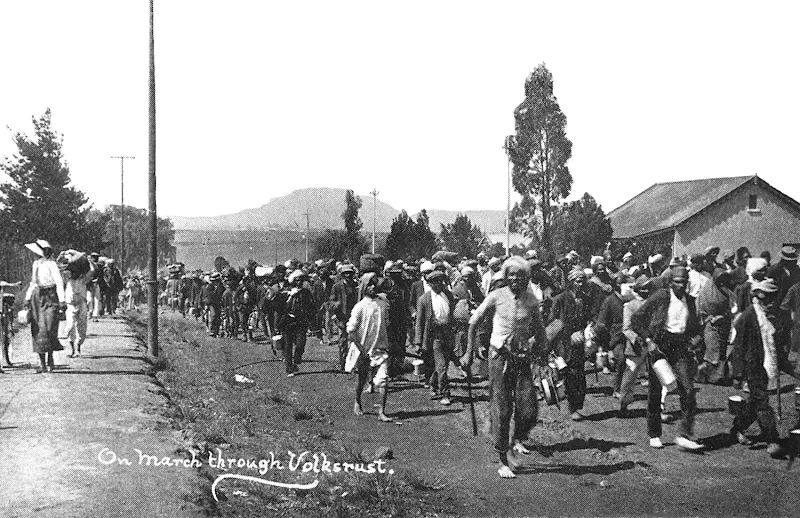
("Volksrust March Gandhi South Africa")
Gandhi was later imprisoned for leading marches against unjust laws, including the poll tax imposed on Indians.
"It was provided under the amended law that all Indians should pay a poll tax of £3 as fee for entry into the Transvaal. They might not own land except in locations set apart for them, and in practice even that was not to be ownership. They had no franchise" -Mahatma Gandhi (Desāī 153)