Reform
Gandhi’s investigation led to major reforms for the Champaran locals from the dismantling of the Tinkathia System to the reshaping of the schooling system. Along with these changes, the government’s acceptance of peasant grievances through inquiry marked a shift toward state accountability in agrarian disputes.
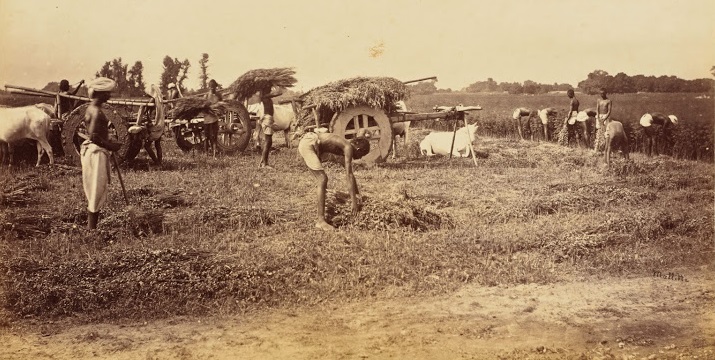
(Dutta, Under This System, the Tenant Farmers Were Forced to Grow Indigo (a Blue Dye) in Three Kathas of Every Bigha (Three out of Twenty Parts of Their Land))
Gandhi Creates the Report
In June of 1917, against the advice of the BPA, the Bihar Governor, Gait, agreed to form the Champaran Agrarian Enquiry Committee, which Gandhi led. Gandhi and his team visited villages, cross-examined 8,000 cultivators, and recorded statements to compile an official report.
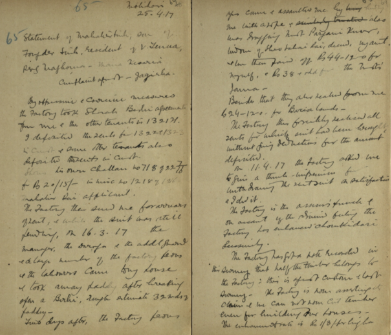
(Sajjad, Statement of Mahabir Sinh, of Village Tenua, Factory Jagirha Recorded on 25 April, 1917)
“The Directors of the Bihar Planters’ Association place on record its emphatic protest against the manner and methods of enquiry conducted by Mr. Gandhi and his assistants in the Champaran district, in as much as they are calculated to stir up feelings of animosity between landlords and tenants, planters and tenants…The Directors submit that this agitation for an investigation…has been fostered by agitators, and that no necessity for such an investigation exists” -Resolution passed at a meeting of Directors of the Bihar Planters Association Limited, held on 5 May, 1917 (Misra & Jha 119)
“The committee has overwhelming proof before it to know that tinkathia has bound the raiyat like the coil of a serpent from which…the raiyats have ever striven to get free and from which the Government have hitherto made unsuccessful attempts to free them” -Confidential note dated 29 July, 1917, recorded by M. K. Gandhi for circulation among the Members of Champaran Agrarian Enquiry Committee (Misra & Jha 290)
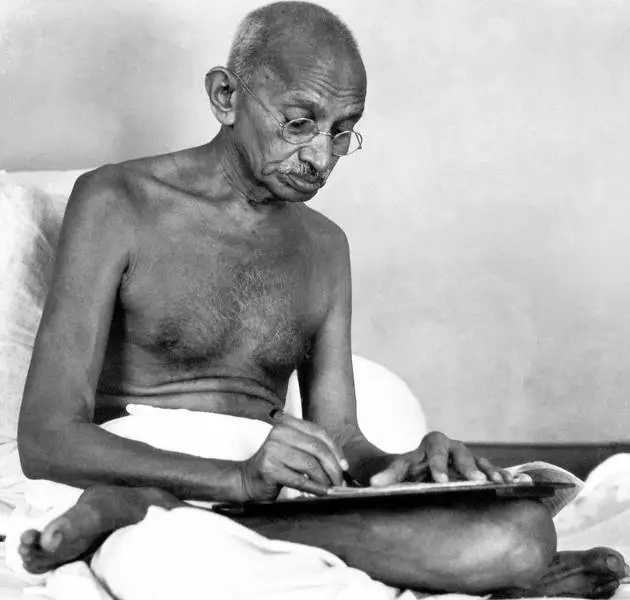
Mahatma Gandhi writes while seated on the floor (Youngblood)
Reactions to the Report
On October 3, Gandhi’s team submitted their report to the government.
"The Tinkathia System, whether for growing indigo or any other crop should be completely abolished" - Report on Condition of Ryots in Champaran (Prasad 135)
The BPA publishes complaints concerning the report:
“In the opinion of these members, the Champaran Agrarian Bill is both unnecessary and undesirable for the following reasons:
(a) …the information it acquired was not sufficient to show the general position in the district in its true light, and this fact combined with its biased attitude...render the Report and the Recommendations contained in it so grossly one-sided and unfair, that no weight should be given to them…this legislation…should be entirely dropped.
(b) Because it singles out one district for invidious and unnecessary legislation.
(c) Because it proposes to invalidate existing contracts and incidents of the raiyats tenancy, both of which have been proved to be perfectly legal…
(d) Because it proposes to abolish without compensation and for no adequate reason a system which has been in existence for over a hundred years and which is still carried on without friction in other districts…
(e) Because it proposes, without the consent of the landlord, to forcibly reduce rents which have been declared ...to be perfectly legal, fair and not excessive…
It is also obviously grossly unfair that…a system of cultivation which has been carried on for over a hundred years should be abolished without giving planters time to arrange for an alternative system to take its place” -Memorandum submitted by the Champaran Members of the Bihar Planters' Association enclosed with letter No. 20-507-12, dated 5 January 1918, from Board of Revenue, to Secretary, Revenue Department, Government of Bihar and Orissa (Misra & Jha 472-475 )
Government Response to BPA:
"With regard to the specific requests made by the Association, I am to say that the Government of India agree… no useful purpose would be served… by withdrawing or modifying the vernacular notice issued by the Local Government regarding the recommendations of the Committee of Enquiry.
2. The Local Government have agreed to meet representatives of the Planters’ Association… to discuss [how]
the decisions already arrived at can be carried out with the minimum of hardship and friction. In the circumstances,
it is unnecessary for them to pass any orders on this request of the Association”
-Letter No. 152-0., dated Delhi, 11 January, 1918, from B, A. Mant, Secretary to the Government of India, to the Chief Secretary to the Government of Bihar and Orissa (Misra & Jha 467)
On October 18, the Government published its resolution, accepting all of the report’s recommendations.
Legislative Reforms
On November 2, The Champaran Agrarian Bill made planters reimburse peasants 25% of unlawfully collected funds. The Champaran Agrarian Act of 1918 codified these reforms and abolished the Tinkathia System. All European planters left the area within a decade ("Champaran Satyagraha").
Gandhi's Construction Program
"The idea is to get hold of as many children as possible and to give them an all round education…I look upon our present system with horror and distrust" - Mahatma Gandhi (Prasad 198-199)
Gandhi’s report concluded that the farmers’ ignorance allowed the European planters to repress them, so he began repairing education in Champaran. Kasturba Gandhi helped him open schools to fight illiteracy and teach hygiene and vocational skills (Pathak).
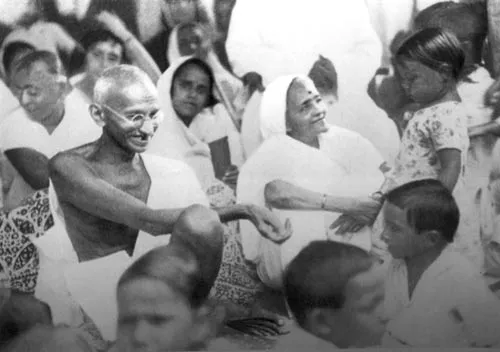
("Katsurba Gandhi")
When planters refused to give Gandhi land, he relied on the generosity of locals to open schools in independent places. A man named Babu Shivgulamlal donated his house for the first school, which opened on November 13th, in Baharwa, Champaran. A second school opened in Bhitha a week later, and more followed with the support of volunteers (Prasad).
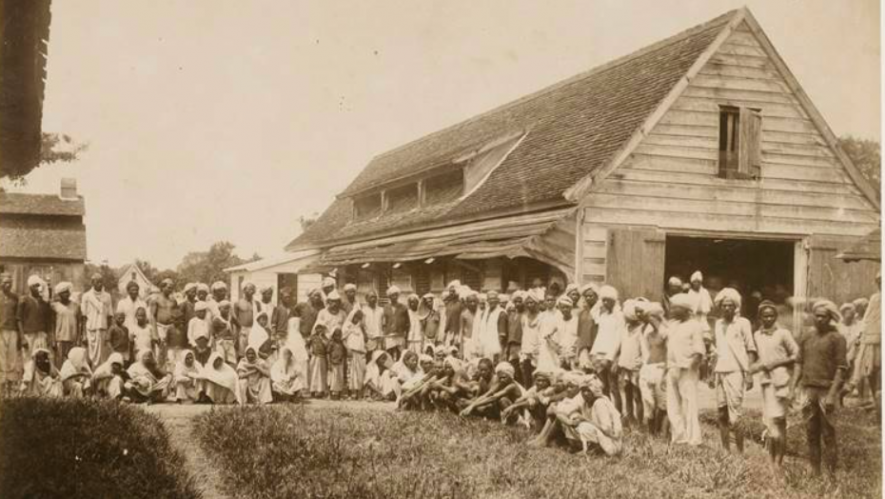
(Sahu, Students in front of a School in India)
" Their [volunteers'] work will be the most important and lasting and therefore it will be the final essential stage of the mission…Six months of such training cannot fail to do incalculable good to the ryots, the workers and the country at large" - Mahatma Gandhi (Prasad 195)