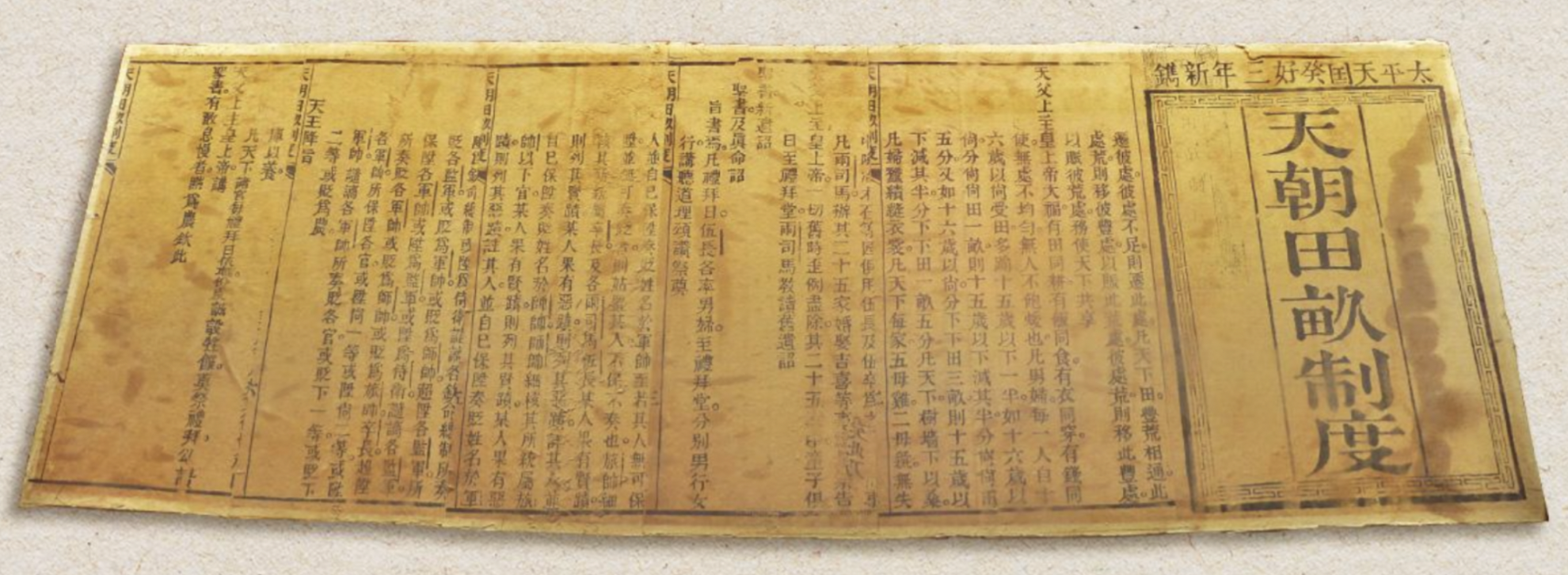
Traditionally
Traditionally, women couldn't own land because in Confucian idealogy, women were restricted to the household and could not make any financial decisions like owning property.
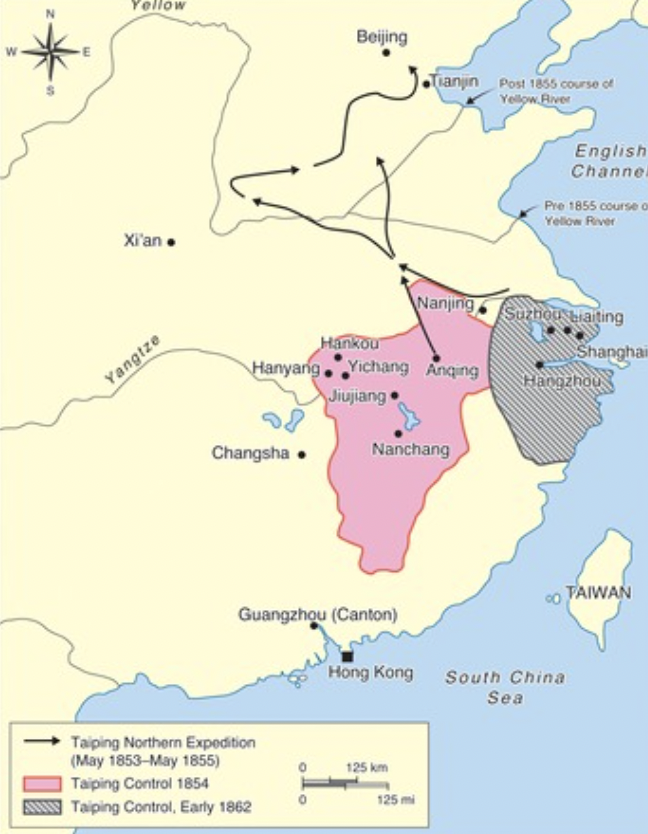
Charles Desnoyers, Map of the Taiping Rebellion Land, from The Killing Feilds of Jiangnan, June 23, 2023, Cambridge University
"For women to have equal rights in the distribution of of land was a new idea which had not appeared in Chinese history until Taiping."
Yuh-Chen, The Position of Women in Taip'ing Tien-kuo, 1971
Heavenly Kingdom reforms
Reforming the law so that women could own land was a major step towards gender equality during the Taiping Rebellion.
"The distribution of all land is to be based on the number of persons in each family, regardless of sex." Hong Xuiquan, The Land System of the Heavenly Kingdom : The Taiping Economic Program, 1853
"Men and women were to receive equal shares of land."
Hong Xuiquan, The Land System of the Heavenly Kingdom : The Taiping Economic Program, 1853
"For every person, male or female, of sixteen years of age or upward, a certian portion of land would be allotted."
Yuh-Chen, The Position of Women in Taip'ing Tien-kuo, 1971
"As to the land of China, all shall divide it up amongst themselves, with one full share for every man and woman."
Hong Xuiqan, The Land System of the Heavenly Kingdom, 1853, in Jonathan D. Spence, God's Chinese Son: The Taiping Heaveny Kingdom of Hong Xuiqan, W.W Norton & Company, 1996