By 1964, many Berkeley students returned from the Freedom Summer determined to keep organizing for minorities. When the university banned leaflets, debate, and tables, students saw it as a direct attack.
THE BACKLASH TO BERKELEY
Reagan’s War on Counterculture & the University of California System
THE FREE SPEECH MOVEMENT
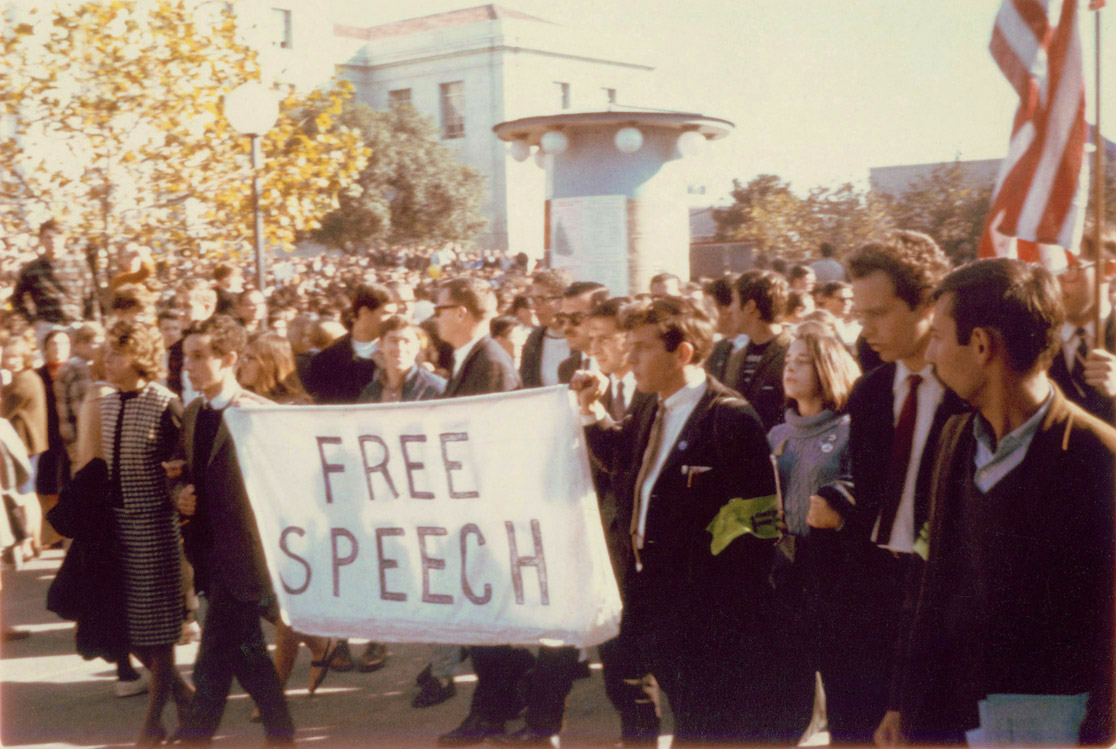
Courtesy of the Free Speech Movement Archives
"Significant numbers of young people came to believe… that social inequities are neither inevitable nor accidental but reflect the assumptions and beliefs and decisions of people who command enormous power, including the university administrators."
Leon Litwack, History Department, UC Berkeley Oral Histories
After a 32-hour protest involving students surrounding the car Jack Weinberg was arrested in for tabling, the Free Speech Movement was born, led by Mario Savio and Mettina Aptheker in reaction to the university’s actions, defying authority.
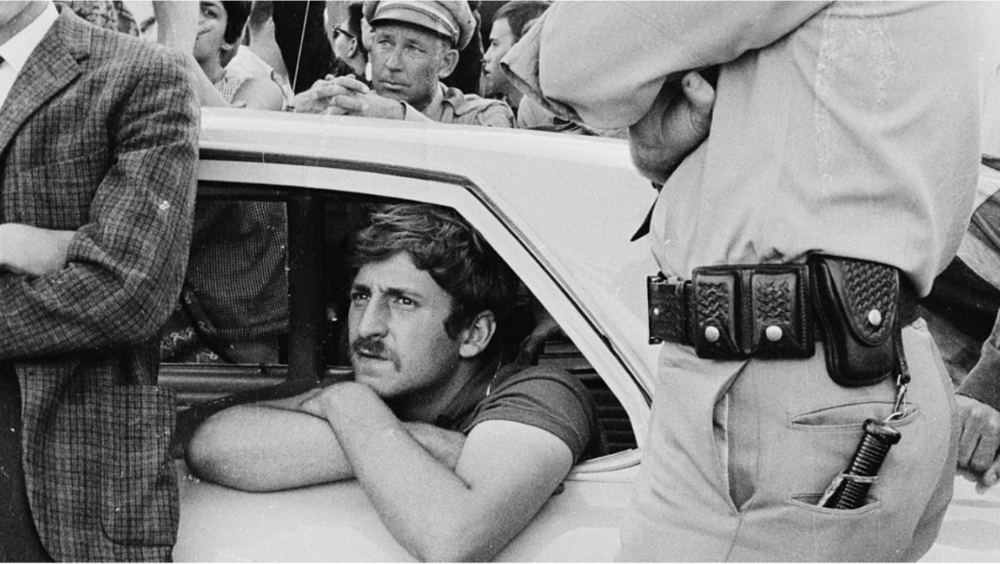
Courtesy of the UC Berkeley Digital Collections
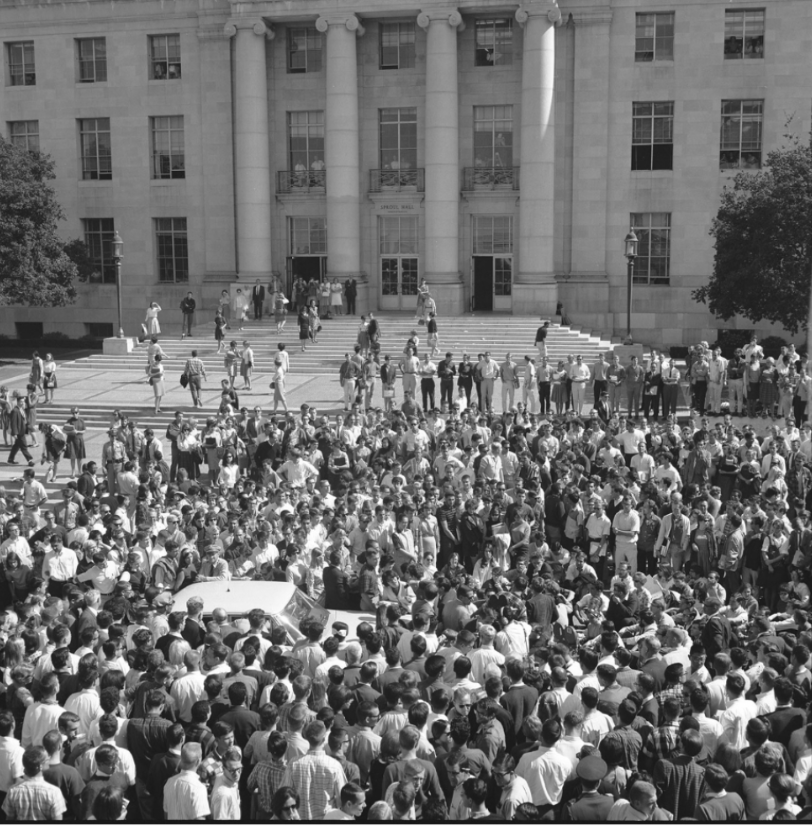
Courtesy of the UC Berkeley Digital Collections
"Thousands of students realized for the first time how many [speech] regulations there are. Many had never known that students cannot exercise their free speech without permits, hired policemen, and a host of other bureaucratic restrictions."
Mario Savio, Free Speech Movement Newsletter
"The only requirement for being in the free speech movement for any organization, or anybody, was agreement with the First Amendment."
Dr. Bettina Aptheker
The Free Speech Movement created poetry, writing, and songs to support their cause, representing a reform of earlier Beatnik expression. The FSM successfully transformed what had once been dismissed as fringe into a politically impactful form of countercultural activism.
"Battle of Berkeley Talking Blues"
Courtesy of the Free Speech Movement Archives
"Joy to U.C"
Courtesy of the Free Speech Movement Archives
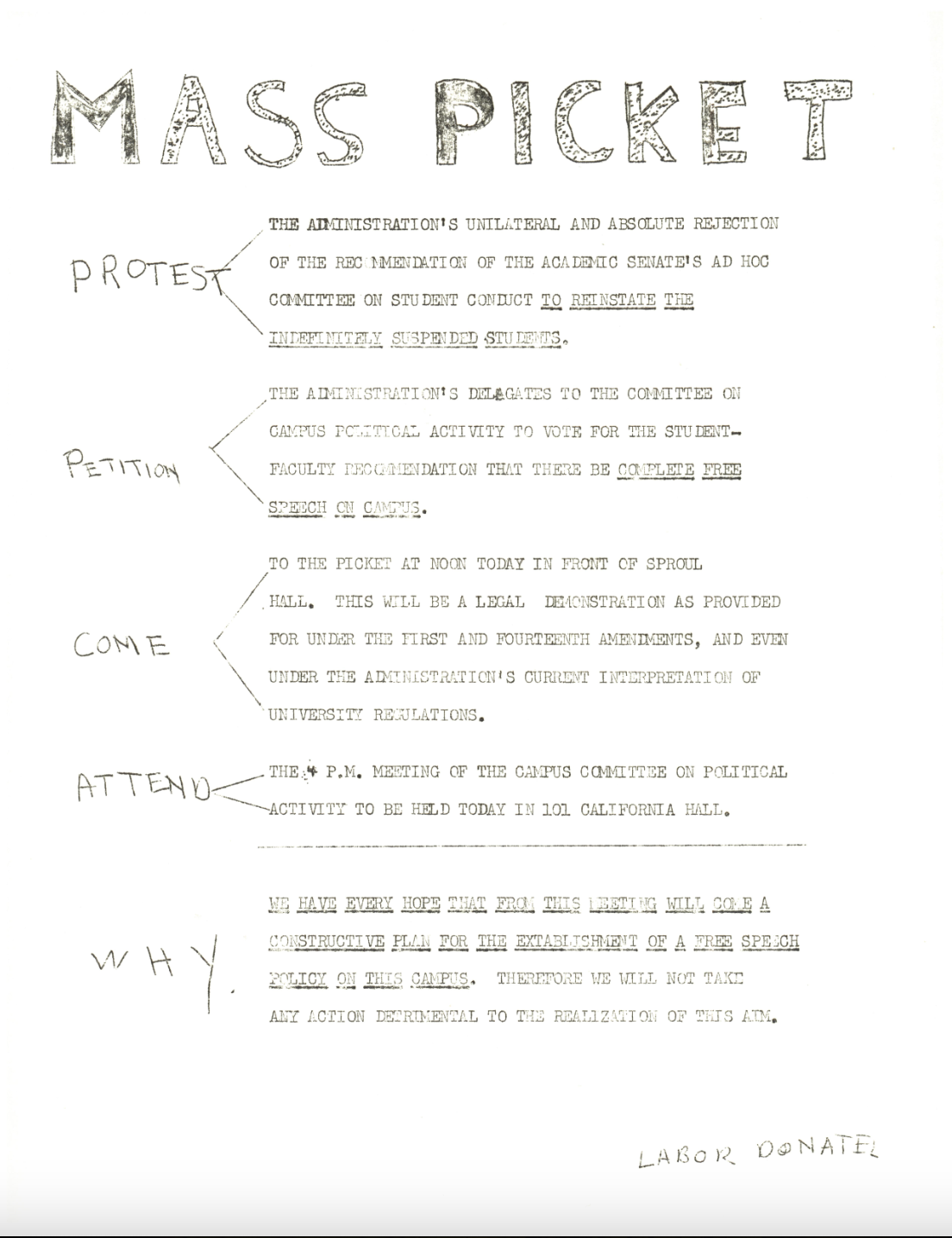
Courtesy of the Free Speech Movement Archives
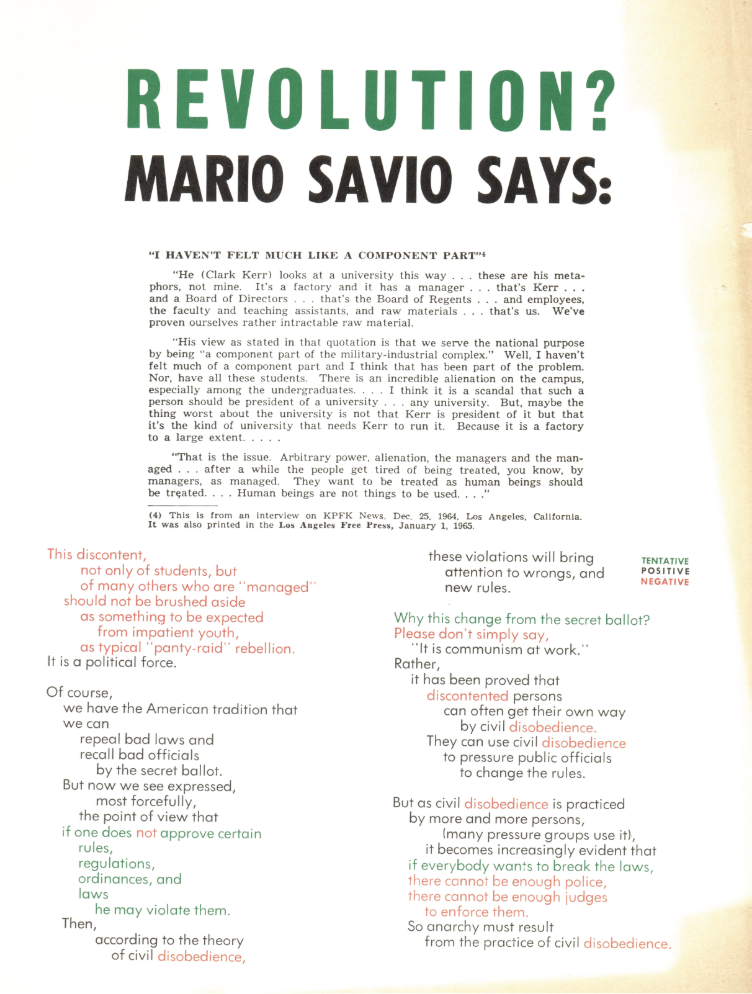
Courtesy of the Free Speech Movement Archives
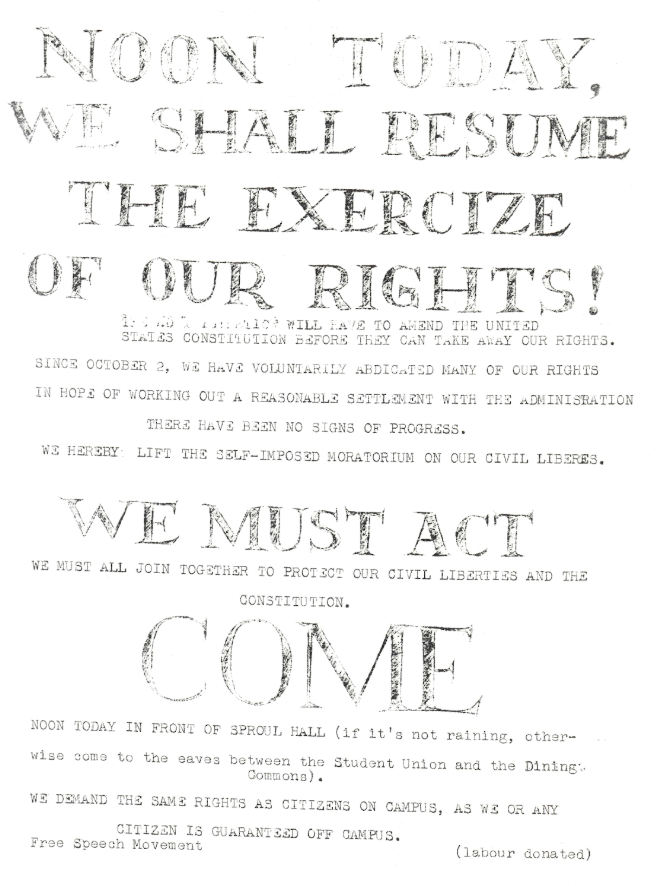
Courtesy of the Free Speech Movement Archives
However, some students saw the Free Speech Movements as purely a disruption of campus order, anarchical in nature, and lacking moral restraint.
"There is no need nor is there any excuse for civil disobedience on this campus. Those students involved demand protection of their rights while at the same time they are violating our rights."
R. F. Dussalt, Students for Law and Order
"Placards like 'Sproul Hall Will Fall' and constant heckling and disruption among an audience ... are ... unnecessary at this stage of the issue, and a reflection of student sentiment of which I can no longer be proud."
Charles Powell, Associated Students of the University of California (ASUC)
Many conservatives and students apart of YAF condemned the protesters’ tactics. The perceived “disruption” at Berkeley drew national attention, reinforcing Reagan's reactionary politics in shaping a negative narrative he would later mobilize in his campaign.
Mario Savio, "Bodies Upon the Gears"; Courtesy of the Freedom Archives
Although quitting the movement in 1965, Savio’s model built the groundwork for stronger, tactical Vietnam War protests that intensified perceptions of disorder—elevating hard-line reactions to claims of immorality that would soon be echoed at the nearby Republican National Convention in San Francisco.