Heart of the Story
In the Field of Battle
“In every battle -- from the frontline, beach command post, command ship, all other ships -- Code Talkers were used.”
(Peter MacDonald, November 27, 2017)
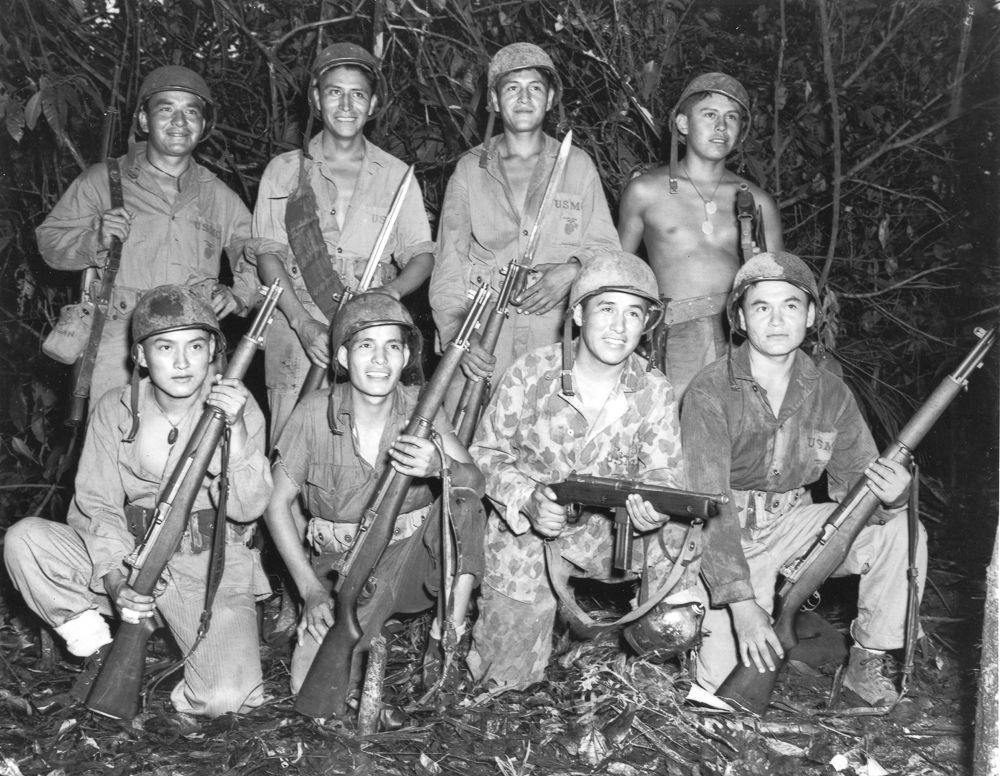
After demonstrating success during training, the Navajo Code Talkers were sent into combat. Their first mission was on the island of Guadalcanal. This battle was a test to see if the Code Talkers program should continue.
(Navajo Code Talkers with a Marine unit on Bougainville, Mashable.com, Alex Arbuckle)
“This was the first battle where the Navajo code was to be tested in actual battle to test [to] see how our memory would be under heavy enemy fire. Well, three weeks after the landing, General Van De Griff, Commander of the 1st Marine Division, sent word back to [the] United States saying, 'This Navajo code is terrific. The enemy never understood it,' he said. 'We don’t understand it either, but it works. Send us some more Navajos.'"
(Peter MacDonald, November 27, 2017)
As the war progressed, finding new Navajo men to serve became difficult because many did not qualify. Some Navajo went to other branches of the military although the Marines needed them vitally. This limited the Marines to enlisting only 25 Navajo men a month.
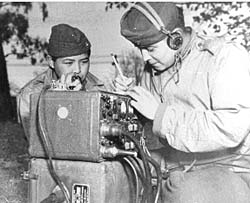
The Code Talkers' main job in WWII was to send messages on the radio and the telephone. They also served as messengers and performed basic Marine duties. What made the job of a Code Talker difficult was that they had to keep modifying the Navajo Code to make sure that it could not be cracked. Whether in or outside of combat, the Code Talkers gave their best. The Navajo language did not have words for objects like bomber and submarine. Those words were substituted with traditional Navajo words, like jeeshóó (Navajo for “Buzzard”) for “bomber" and béésh lóó (the Navajo word for iron fish) for “submarine.”
(Navajo Code Talkers in combat, cia.gov, November 6, 2008)
“Equipped with the only foolproof, unbreakable code in the history of warfare, the code talkers confused the enemy with an earful of sounds never before heard by code experts."
(Ronald Regan (1982), “National Navaho Code Talkers Day, A Proclamation,” 2008)
Throughout WWII, the Navajo Code Talkers were praised and respected for their skill. They participated in every operation in the Pacific. Some of their most famous work was on the island of Iwo Jima. During that battle, the Code Talkers sent more than 800 messages, and not once did they make an error.
(Navajo Code Talkers in combat, Robert Gardner, American History)
“In a declassified history of the Pacific campaign, one account is given of the Battle of Iwo Jima, in which the 5th Marine Division signals officer, Major Howard Connor, commanded six Navajo code talkers who kept going without a break during the first two days of the battle. The six code talkers encoded and decoded more than 800 messages, without a mistake. 'Were it not for the Navajos, the Marines would never have taken Iwo Jima,' Connor stated.”
("Navajo Code Talkers Play Instrumental Role in World War II," 2017)
Even the Japanese, who had some of the most skilled code breakers, could not understand what the Navajo were saying. Throughout the course of WWII, the Japanese were never able to crack the Navajo Code.
“The Japanese chief of intelligence, Lieutenant General Seizo Arisue, said that while they were able to decipher the codes used by the U.S. Army and Army Air Corps, they never cracked the code used by the Marines. The Navajo code talkers even stymied a Navajo soldier taken prisoner at Bataan. (About 20 Navajos served in the U.S. Army in the Philippines.) The Navajo soldier, forced to listen to the jumbled words of talker transmissions, said to a code talker after the war, 'I never figured out what you guys who got me into all that trouble were saying.'"
(“Navajo Code Talkers,” April 16, 2020)