"[The Boarding School system] was intended to do the damage that it resulted, but it wasn't necessarily done with malice."
(Mary Pavel)
"The Government, unfortunately, thought they knew what was good for the Indians."
--Father Vine Deloria
FAR FROM HOME
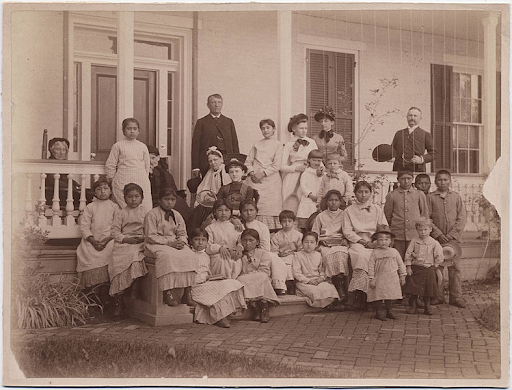
The Carlisle Indian Industrial school, founded in 1879 by Richard Henry Pratt, was the first off-reservation government-run boarding school.
"People thought Indians had to go into manual trades because they were good with their hands. They weren’t educated to be doctors or teachers or lawyers. And so Carlisle had this program where students would spend half the day in the classroom, and then students would be trained in vocational work during half the day. Other schools copied that."
--Brenda Child
"Richard Henry Pratt with students at the Carlisle Industrial School" (Smithsonian Magazine).
“Washington's policy was one of association, equality, amalgamation, — killing the Indian and saving the man. Jefferson 's plan was segregation, degradation, destruction. Washington ' s plan meant health, self help, economy, hope, increase in every way. Jefferson's plan meant and has proven destructive to the Indians, vastly expensive, hopeless, and productive of inertia, disease, and death."
--Richard Henry Pratt
Lt. Col. Pratt created the Carlisle School to help Native Americans assimilate into American society. As a former military officer, Pratt witnessed the military campaigns which drove Native Americans off their traditional lands and onto reservations, and leading to the deaths of thousands of Indigenous people.
“Having wronged the Indian by our driving out and segregating method, den[ying] that he is human and capable of development we, [...] and the man who will lead battalions against him and destroy him [...] publicly applaud, and reward with the gift of every office from President down. Governors, senators, representatives, generals, — all have reached place and fame through destroying Indians."
-- Richard Henry Pratt, 1892
RICHARD'S PERSPECTIVE
“[Natives were] born blank, like all the rest of us. Left in the surroundings of savagery, he grows to possess a savage language, superstition, and life. We, left in the surroundings of civilization, grow to possess a civilized language, life, and purpose. Transfer the infant white to the savage surroundings, he will grow to possess a savage language, superstition, and habit. Transfer the savage-born infant to the surroundings of civilization, and he will grow to possess a civilized language and habit. These results have been established over and over again beyond all question; and it is also well established that those advanced in life, even to maturity, of either class, lose already acquired qualities belonging to the side of their birth, and gradually take on those of the side to which they have been transferred.”
--Richard Henry Pratt