Impact

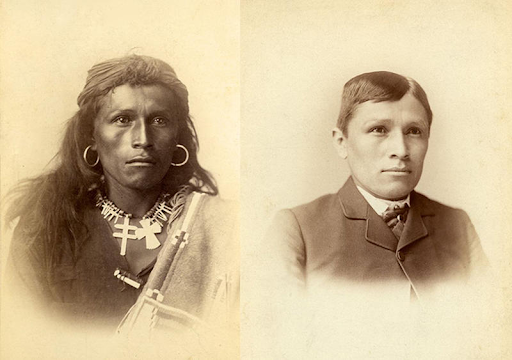
"Between 1900 and 1920 the case against off-reservation school was made along four lines: the belief that Indians, either because of inborn racial traits or sheer obstinacy, were incapable of rapid assimilation; the belief that boarding schools, however effective, were unjustifiably cruel to both parents and children; the belief that such institutions encouraged long-term governmental dependency; and finally, the belief that Native American life ways, rather than being condemned as universally worthless and thereby deserving of extinction, might serve instead as a fruitful foundation for educational growth."

--David Wallace Adams

“The consequences of federal indian boarding school policies—including the intergenerational trauma caused by the family separation and cultural eradication inflicted upon generations of children as young as 4 years old—are heartbreaking and undeniable.”

--Interior Department Secretary Deb Haaland
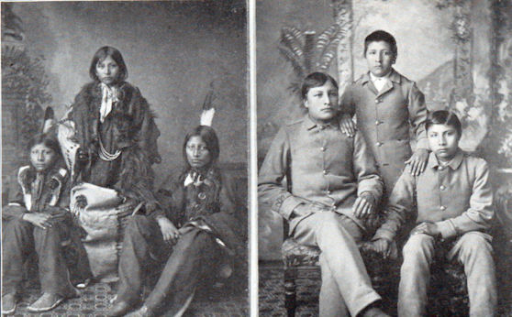
IMPACT

(Source: People’s World).

Indian boarding schools were founded all across the U.S. However, WWI and WWII saw many boarding school students sent to war, and schools continued to decline between the 1930s and 1960s as civil rights movements promoting Native rights changed mindsets across the U.S.  In addition, the Meriam Report of 1928 which "was the first government study to demonstrate with extensive data that federal Indian policy in the 19th century had resulted in a travesty of social justice to Native Americans," also helped shift public opinion in favor of closing the schools (Savages and Scoundrels, n.d.).

"The health of the Indians as compared with that of the general population is bad[...] The prevailing living conditions among the great majority of the Indians are conducive to the development and of disease[, and t]he income of the typical Indian family is low and the earned income extremely low."

--Meriam Report, Lewis Meriam

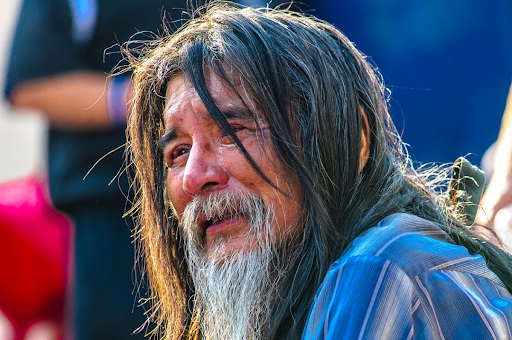
However, even after the closure of Indian boarding schools in the U.S., Native communities continued to struggle through the catastrophic effects, and families grappled to reconnect and understand each other. Many Native traditions and customs were also lost, and even while some were recovered, many would never resurface again.​​​​​​​

     “Coming home and my grandma asked me to talk [in] Indian to her and I said, 'Grandma, I don't understand you'... she said, 'Then who are you?”                                                                                                                    -- Bill Wright, 2008

(Source: IUPUI Exhibits).

“We're still one of the, you know, highest levels of poverty populations in the entire country. we're still struggling with basic needs in some areas. warm springs [are] still struggling with water. the infrastructure around their water systems is not there.”

--Tawna Sanchez

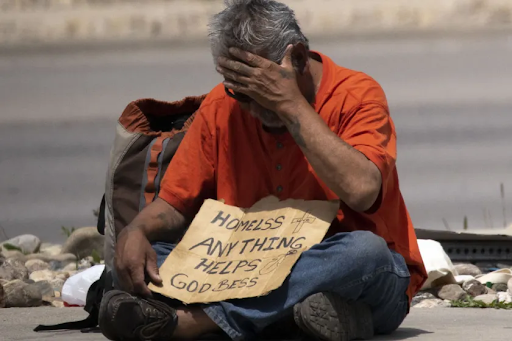
A study conducted to “explore substance use and mental health concerns among a community-based sample of 447 urban two-spirit American Indian/Alaska Native adults who had attended boarding school as children and/or who were raised by someone who attended boarding school,” (Evans-Campbell et al., 2017), found that Native Americans who have either gone to one of the boarding schools or have been raised by someone who has were more likely to develop mental illnesses, more likely to have attempted suicide or contemplated it, less likely to have stable living conditions, be employed, or have healthy relationships. 

(Source: Invisible People).

Source: Mitchell Republic).

INVESTIGATIVE REPORT

"I think that what people in the United States government or perhaps in the Department of Interior, certainly in the Bureau of Indian Affairs, wanted to know is, are there things that we need to be concerned about in the United States? Is there a hidden history that we’re not aware of in regard to the government? What they’ve done is to try to take a very comprehensive look at any institution that could be called a boarding school, whether it was run by the federal government or whether it was run by church organizations."

​​​​​​​--Brenda Child

“This report, as I see it, is only a first step to acknowledge the experiences of Federal Indian boarding school children."

--Assistant Secretary of the U.S. Department of the Interior, Bryan Newland

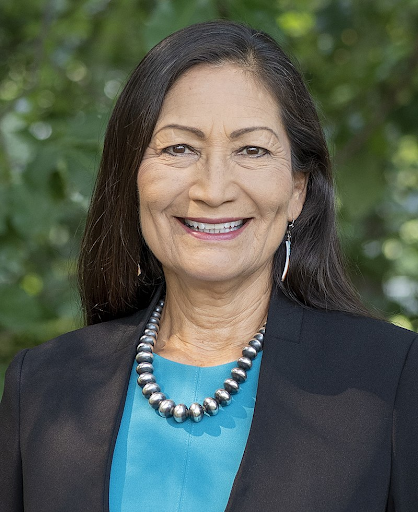
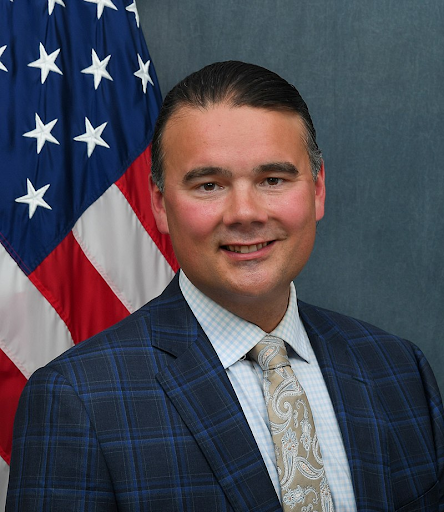
Secretary Deb Haaland and Assitant Secretary Bryan Newland From the U.S. Department of the Interior (U.S. Department of the Interior).

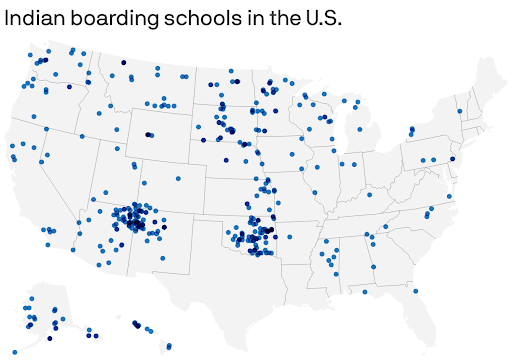
An investigative report published in 2021 led by the Interior Department’s secretary, Deb Haaland, and assistant secretary, Bryan Newland, was made to “address the intergenerational trauma created by historical federal Indian boarding school policies,” (U.S. Department of the Interior, n.d.). The report revealed that “[the] U.S. funded over 400 boarding schools to assimilate indigenous children… from 1819 to 1969” (Chatelain et al., 2022). It also found that a majority, if not all, of the schools abused the children in significant ways, such as using corporal punishment and abusive language.

“I come from ancestors who endured the horrors of the Indian boarding school assimilation policies carried out by the same department that I now lead. We are uniquely positioned to assist in the effort to recover the dark history of these institutions that have haunted our families for too long. As a Pueblo woman, it is my responsibility and frankly it's my legacy.”

--Interior Department secretary Deb Haaland

(Source: Axios).

“The list, which is expected to grow, includes 53 schools — 33 with marked graves, six with unmarked, and 14 with both marked and unmarked.”

--Ryan Chatelain and Reuben Jone

Many past schools across the U.S. had children's burial sites, and the Interior’s initial analysis “found that 19 boarding schools accounted for the deaths of more than 500 children — a number the department expects to increase as it continues its probe,” (Chatelain et al., 2022). 53 schools have identified as having burial sites at or near the school campuses.

     “The greatest concentration of boarding schools [...] were in present-day Oklahoma (76), Arizona (47) and New Mexico (43). Attendance at schools ranged from one just child to more than 1,000.”   

                                         -- Bryan Newland, 2022

Next Page