Kill the Indian

"It was recognized that ruthless destruction must stop. Instead, the Indian should be assimilated, gradually losing his identity until he became indistinguishable from a white man. This done successfully, the Indian problem would disappear."

--John Paul Stevens

“Between 1869 and the 1960s, hundreds of thousands of Native American children were removed from their homes and families and placed in boarding schools operated by the federal government and the churches.”

--National Native American Boarding School Healing Coalition

KILL THE INDIAN
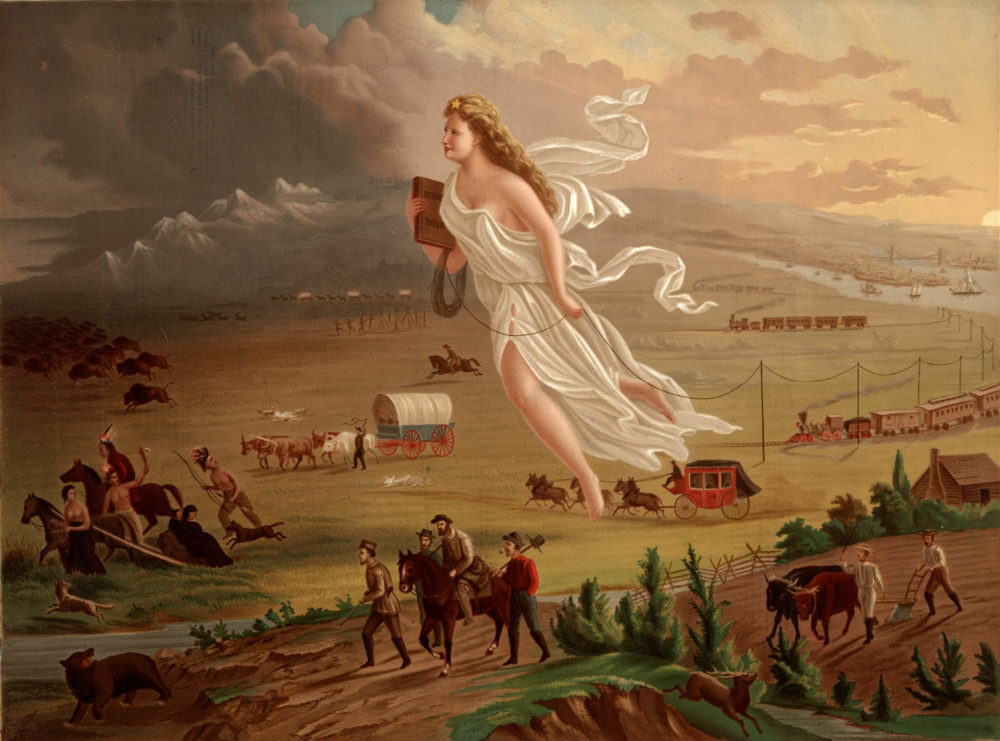
"Manifest Destiny Painting, 1872" (The American Yawp Reader).

         To assimilate Native Americans into American culture and reduce the total amount of Reservation land held by Natives, the U.S. government created federal Indian boarding schools. Their actions reflected many Americans' belief that it was their divine right, their Manifest Destiny, to expand westward and settle the entirety of North America. In 1845, John O’Sullivan’s essay "Annexation" declared that, “the fulfillment of our manifest destiny to overspread the continent allotted by Providence for the free development of our yearly multiplying millions,” (O'Sullivan, 1845).
“Beginning with President Washington, the stated policy of the Federal Government was to replace the Indian’s culture with our own. This was considered “advisable” as the cheapest and safest way of subduing the Indians, of providing a safe habitat for the country’s white inhabitants, of helping the whites acquire desirable land, and of changing the Indian’s economy so that he would be content with less land. Education was a weapon by which these goals were to be accomplished.” 

--Committee on Labor and Public Welfare, Indian Education

        Even before the American Revolution, colonial officials sought ways to deal with the "Indian problem." However, as the new nation evolved, different administrations had different approaches. 

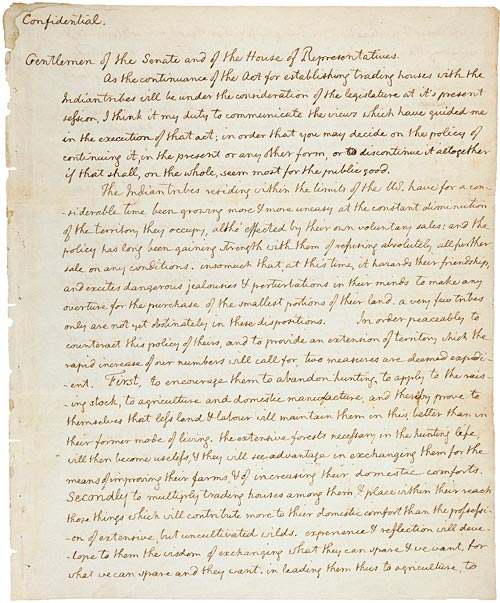
      "[W]e wish to draw them to agriculture, to spinning & weaving. … when they withdraw themselves to the culture of a small piece of land, they will perceive [sic] how useless to them are their extensive forests, and will be willing to pare them off from time to time in exchange for necessaries for their farms & families. to promote this disposition to exchange lands which they have to spare & we want, for necessaries, which we have to spare & they want, we shall push our trading houses, and be glad to see the good & influential individuals among them run in debt, because we observe that when these debts get beyond what the individuals can pay, they become willing to lop th[em off] by a cession of lands,"

                                     -- Thomas Jefferson, 1803

"Jefferson, Confidential Message to Congress Concerning Western Exploration and Relations with Native Americans, 1803," (Humanities Texas).

(Resources: National Archives).

“Back in the early 1800s […] there was this thing called the Civilization Fund Act, which essentially was, you know, a way to try to civilize the American Indian populations.”

--Tawna Sanchez

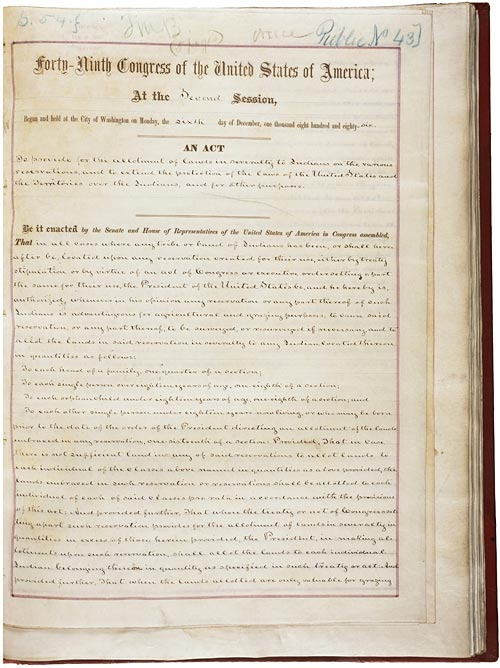
       The government made many laws and treaties to do this, such as the Civilization Fund Act in 1819 the Grant Peace Treaty of 1869, as well as the Dawes Act in 1887.

      "An Act to Provide for the Allotment of Lands in Severalty to Indians on the Various Reservations emphasized severalty – the treatment of Native Americans as individuals rather than as members of tribes authorized the President to break up reservation land, which was held in common by the members of a tribe, into small allotments to be parceled out to individuals."

                                                       -- National Archives 

"A great general has said that the only good Indian is a dead one. . . . In a sense, I agree with the sentiment, but only in this: that all the Indian there is in the race should be dead. Kill the Indian in him, and save the man."

--Richard Henry Pratt

         However, Richard Pratt, seeing this genocide of the "Indians," sought to find a different way of removing Native Americans from reservations and assimilation. Thus, Carlisle Indian Industrial School was born.