Environmental Responsibilities
Hetch Hetchy Project Rejection
In 1905, San Francisco’s petition to dam Hetch Hetchy Valley was originally rejected due to the valley’s location within the Yosemite National Park boundary, a preserved area.
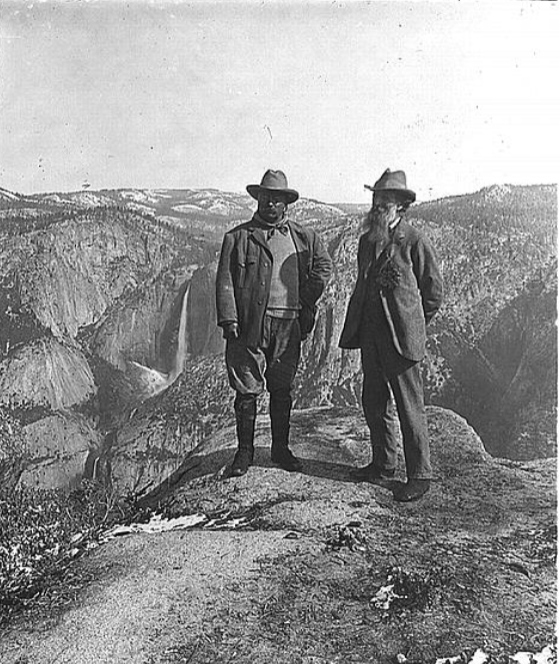
(Theodore Roosevelt and John Muir on Glacier Point,Yosemite Valley, California.1906, Library of Congress (93503130))
During this period, John Muir and President Roosevelt’s friendship strengthened, leading to the passage of the Yosemite Recession Bill in 1906, which removed areas of Yosemite from California’s control to prevent misuse of the land.
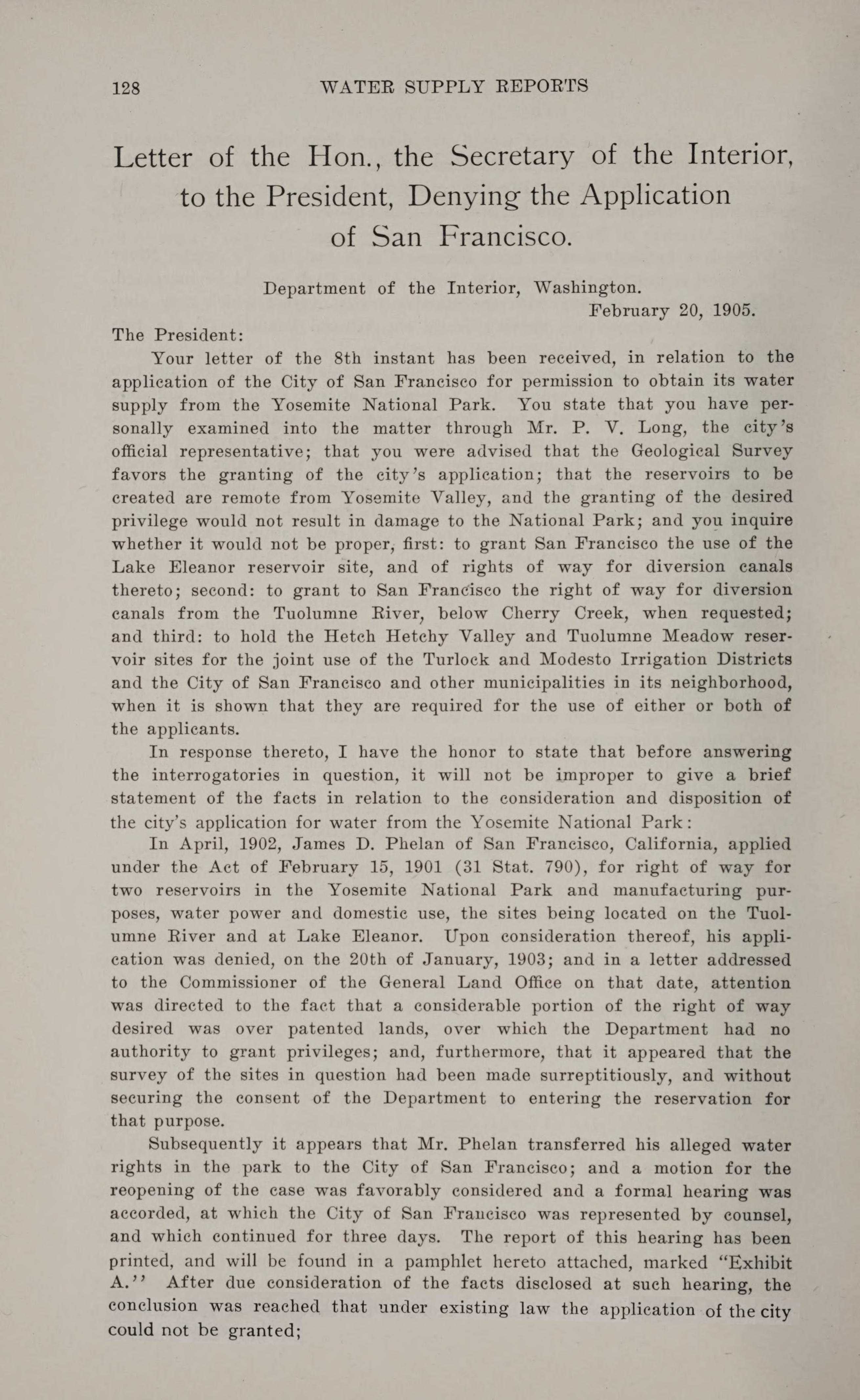
(Carl Ewald Grunsky and Marsden Manson, Reports on the water supply of San Francisco, California, 1900 to 1908, inclusive, 1908)
This federal action demonstrated the government’s prioritization of environmental responsibility over San Francisco’s water rights while creating a precedent for federal authority over public lands, making an effort to preserve nature.
Preservationism
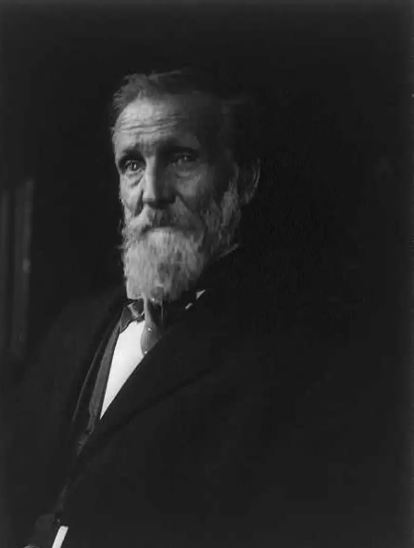
(John Muir. 1912, Library of Congress (2004673176))
John Muir became known as a preservationist and the “Father of the National Parks” through his book, Our National Parks, and his creation of the Sierra Club, which inspired the public and sparked the idea of preserving the natural beauty of the world, especially that of Yosemite.
“Of this glorious range the Yosemite National Park is a central section … full of God's thoughts … the deepest sections of the famous canons, of which the Yosemite Valley, Hetch-Hetchy Valley, … grandeur of sculpture.”
(John Muir, Our National Parks, 1901).
John Muir and the Sierra Club fought against the creation of Hetch Hetchy dam, emphasizing humanity's responsibilities towards preserving the environment, which means protecting nature in its original, untouched condition. Muir passed away in 1914, one year after the Raker Act's passage approved the Hetch Hetchy project.
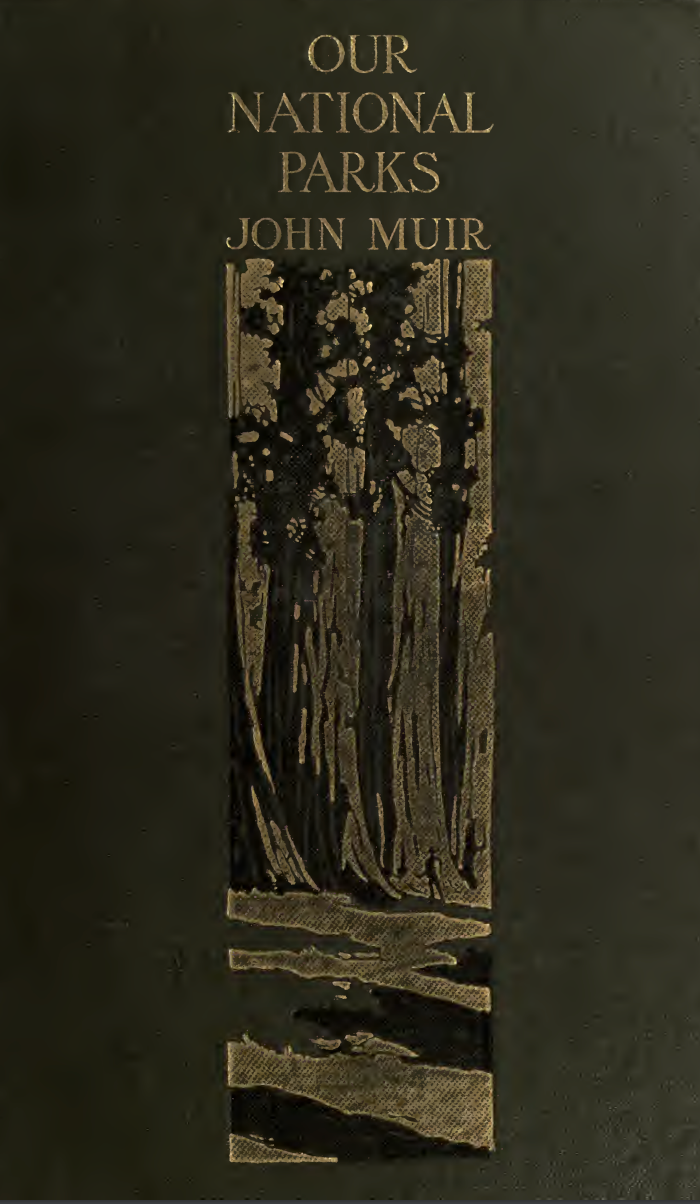
(John Muir, Our national parks, 1901)
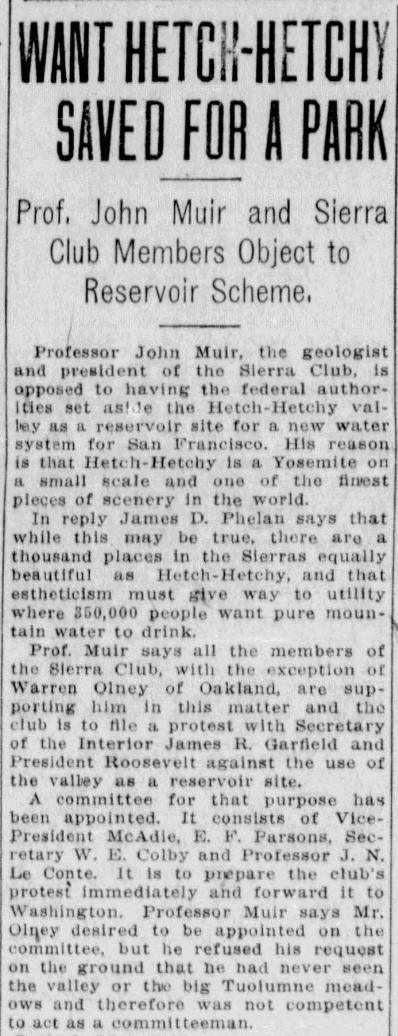
(Want Hetch-Hetchy Saved for a Park, 1907)
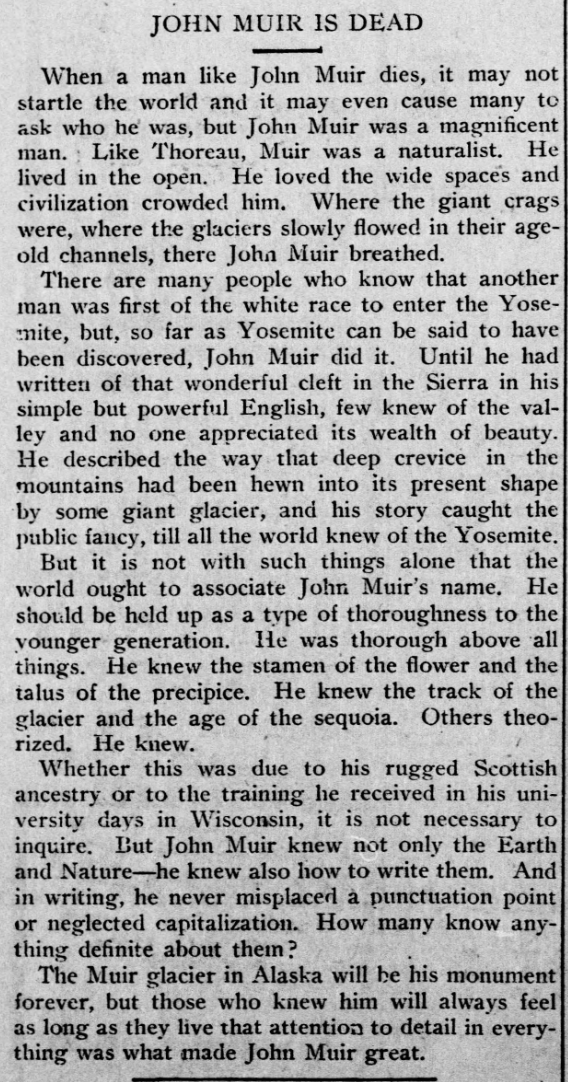
(John Muir is Dead, 1914)