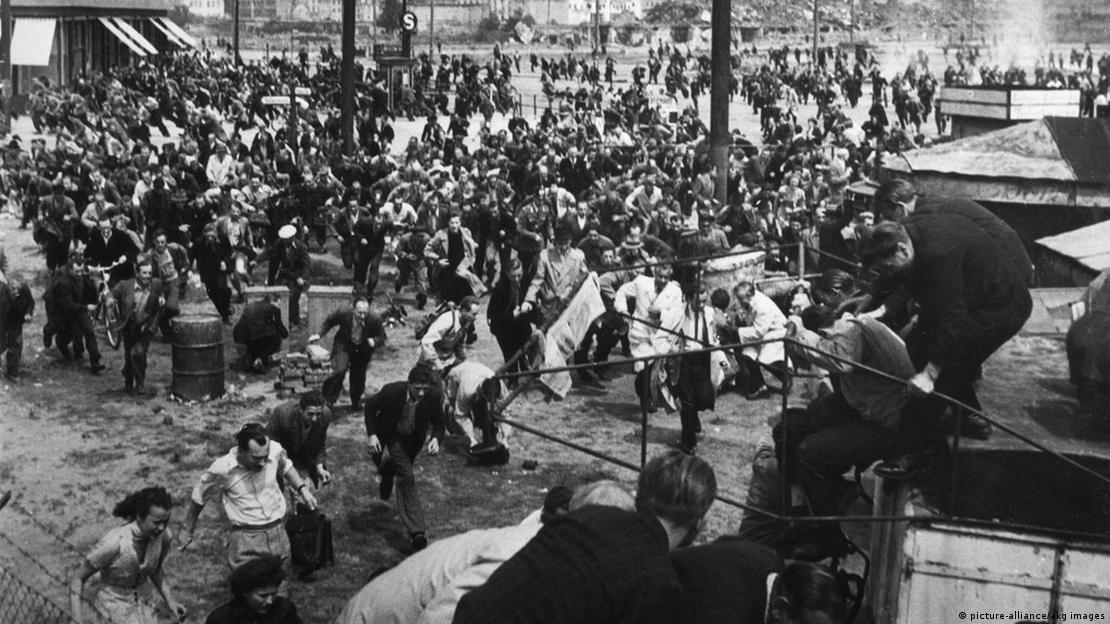
The uprising led to work quotas returning to the status quo, and, due to fears of another uprising, significant economic reform was near impossible.
"SED leader Walter Ulbricht feared, more than anything else, a repetition of the events of June 17"
(Kopstein, Chipping Away at the State: Workers' Resistance and the Demise of East Germany)
(DW: Soviet tanks shot at protesters in Potsdam Square)
“we think it appropriate...To firmly and consistently carry out the new political course, as outlined in the Soviet Government Resolutions of 6 June 1953”
(Sokolovskii et al., On the Events of 17-19 June 1953 in Berlin and the GDR and Certain Conclusions from these Events)
“The uprising in June effectively crippled the regime on the shop floor. Output norms and prices quickly returned to the status quo”
(Kopstein, Chipping Away at the State: Workers' Resistance and the Demise of East Germany)
“an implicit agreement between the workers' state and the working class began to take shape: production could rise so long as norms remained low and wages high”
(Kopstein, Chipping Away at the State: Workers' Resistance and the Demise of East Germany)
This agreement is referred to as the Labor Pact.
"by 1960, Germany had a higher rate of absenteeism among industrial workers…than any other country in Soviet-controlled Eastern Europe"
(Kopstein, Chipping Away at the State: Workers' Resistance and the Demise of East Germany)
"East German labor had become as much a constraint as a productive resource, and…restrict[ed] the scope of plausible economic reform"
(Kopstein, Chipping Away at the State: Workers' Resistance and the Demise of East Germany)
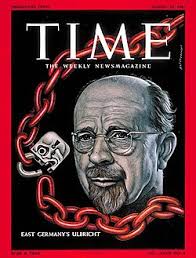
(Wikipedia- Walter Ulbricht on the cover of Time magazine- 25 August 1961)
"In the long run, the labor pact...weakened the regime by eliminating the possibility of meaningful economic reform"
(Kopstein, Chipping Away at the State: Workers' Resistance and the Demise of East Germany)