Reform-2

Surveillance Reform

After the uprising, in order to prevent further uprisings, surveillance systems and police forces were expanded significantly.

Following the Uprising, East Germany began a comprehensive reform of their surviellance of the population

“it is necessary…to liquidate the Ministry of State Security [Stasi] of the GDR, by merging into the Ministry of Internal Affairs”

Sokolovskii et al., On the Events of 17-19 June 1953 in Berlin and the GDR and Certain Conclusions from these Events

“At the 15th Plenum of the SED Central Committee, held on 24–26 July, the SED called for a more complete system of monitoring and controlling the population.”

(Bruce, The Prelude to Nationwide Surveillance in East Germany: Stasi Operations and Threat Perceptions, 1945–1953)
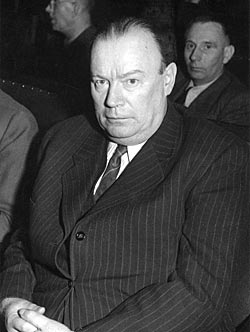

“The SED Central Committee expelled Zaisser…for having failed to foresee the uprising of 17 June…Zaisser was accused of ineffective leadership of the MfS [Stasi]”

(Bruce, The Prelude to Nationwide Surveillance in East Germany: Stasi Operations and Threat Perceptions, 1945–1953)

Wilhelm Zaisser, Minister of State Security (Stasi) 1950-1953

“Ulbricht’s accusation that Zaisser had failed to foresee the ‘fascist putsch’ [the uprising] was a convenient pretext…to remove a political rival who had been a persistent critic”

(Bruce, The Prelude to Nationwide Surveillance in East Germany: Stasi Operations and Threat Perceptions, 1945–1953)

"[The] Stasi experience[d] ‘exponential growth’ (up to 17,400 [employees] by November 1957), but it also set about massively increasing its domestic surveillance program by recruiting informants”
Lee Ack, East Germany 1953: Workers’ forgotten rebellion against Stalinism

(Wikimedia Commons, Stasi seal, public domain)

Since "unofficial sources" like workers would better know the mood of the population--as other workers would not know they had connections to the Stasi--
“Tilch, the head of the new information service…noted that unofficial informants from the general population should be used…rather than "official sources"

(Bruce, Resistance in the Soviet Occupied Zone/German Democratic Republic 1945-1955)

“By 1954, the Stasi had almost 145,900 agents [informants] on its books”

(Lee Ack, East Germany 1953: Workers’ forgotten rebellion against Stalinism)

“In the factories, additional surveillance was carried out by newly established Kampfgruppen der Arbeiterklasse [Combat Groups of the Working Class]”

(Lee Ack, East Germany 1953: Workers’ forgotten rebellion against Stalinism)

The Kampfgruppen der Arbeitklasse was "composed of workers chosen for their political reliability"

(Lee Ack, East Germany 1953: Workers’ forgotten rebellion against Stalinism)

(Wikimedia Commons, Banner of the Kampfgruppen der Arbeitklasse, public domain)

It was impossible to tell who was a government agent and who was not. No one trusted anyone, and people were often coerced into becoming informants themselves.

Johanna Roeber-Rosenthaal recalls an attempt to recruit her as an informant for the Stasi in 1961, stating that a "work acquaintance of [her] dad’s [who she had just met for the first time] was obviously trying to get [her] to inform for the GDR."

(Roeber-Rosenthaal)

Previous
Next