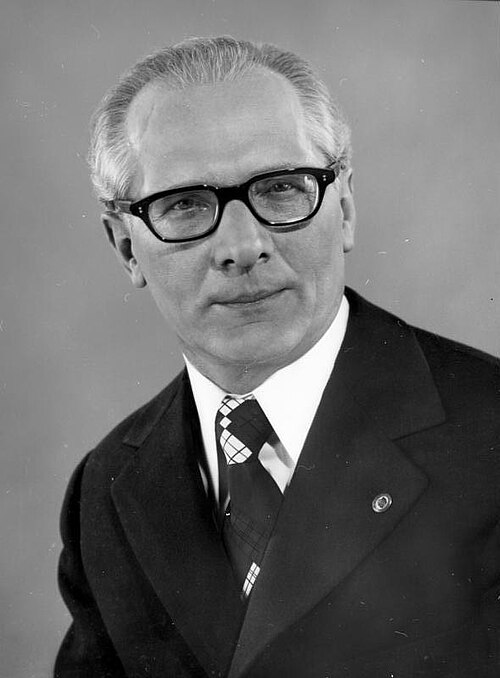
Fear to make economic reform lingered among the SED for much of East German history.
(Erich Honecker. 1976. Bundesarchiv)
"by 1974…when confronted with the need to place the burden of adjustment to a rapidly changing international economic environment on the working class, the East German leader, Erich Honecker [said] ‘In that case we can all resign immediately’”
(Kopstein, Chipping Away at the State: Workers' Resistance and the Demise of East Germany)
“Eisenhower ordered the [Psychology Strategy Board]... “while matters [were] still hot,” to develop food programs for all other satellites “similar to the current one for East Germany.”
(Ostermann- The United States, the East German Uprising of 1953, and the Limits of Rollback)
The Stasi were an extremely repressive surveillence system, collecting information on every aspect of people's lives.
"indication of the extent of the Stasi's surveillance activities is the…file[s] on individuals, which was compiled by the Stasi and includes information on six million people"
(Jedlitschka, Karsten. "The Lives of Others: East German State Security Service's Archival Legacy")
Stasi Records. Bundesarchiv
June 17 became a public holiday in West Germany on August 4, 1953, known as the "Day of German Unity" (Deutschlandmuseum) and remained as such until German reunification.
A street west of the Brandenburg Gate, previously called Charlottenburger Chaussee, was renamed Straße des 17. Juni, or "17 June Street"
The East German Uprising of 1953 exposed deep fissures within East Germany, proving the fragility of SED rule and the discontent of the workers. In the fallout of the uprising, the SED quickly repealed economic changes to appease workers. At the same time, the GDR took measures to ensure another uprising never happened, forming the Kampfgruppen der Arbeitklasse and expanding the Stasi into an extremely repressive surveillance system to spy on the whole population.