Gender Reforms Within the
Taiping Rebellion
Gender Reforms
Traditional China
In traditional China, women were neglected and mistreated. Confucian ideals saw them as inferior to men. They were all oppressed by these Confucian principles, and were limited to roles in the domestic sphere without any autonomy. The Taiping Rebellion enacted reforms for women to dismantle the harsh Confucian social structure and to promote gender equality by no allowing women to have more rights, education, jobs, and responsibilites.
"A woman's life was one of service and silence; her work was never done...submissions to father, husband, and finally son, mapped out the course of a woman's life." Adrienne Johnson, Taiping Pipe Dreams: Women's Roles in the Taiping Rebellion, Ohio State University, 2006
"As soon as women were considered nubile they were secluded to inside the inner chambers of their houses. A woman outside the household was considered shameful and inappropriate." Adrienne Johnson, Taiping Pipe Dreams: Women's Roles in the Taiping Rebellion, Ohio State University, 2006
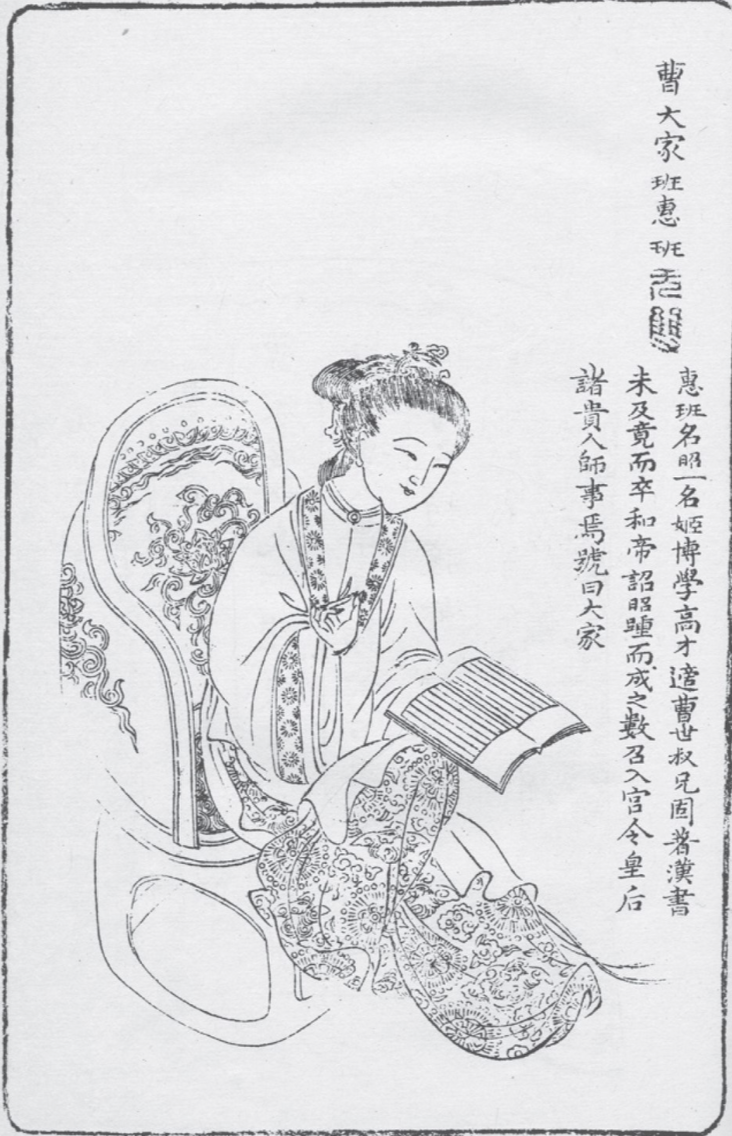
Writings from Ban Zhao, a scholar woman who lived in the Han dynasty (206 BCE - 220 CE), wrote her three daughters a book called Lessons for Women, in which she described the roles of women under the Confucian societies.
"Let a woman modestly yeild to others; let her respect others; let her put others first; let her put herself last." Excerpt of Ban Zhao, Lessons For Women 100 CE, found in Pan Chao : Foremost Woman Scholar of China, Nancy Lee Swan, 1932
"Let a woman be correct in manner and upright in character in order to serve her husband...if a woman fail to observe them, how can her name be honored?" Excerpt of Ban Zhao, Lessons For Women 100 CE, found in Pan Chao : Foremost Woman Scholar of China, Nancy Lee Swan, 1932
"Confucian doctrine, however, did not accord women a status euqal to that of men...the Confucian classics say little about women, which shows how little they mattered in the scheme of Confucian values." Excerpt of Ban Zhao, Lessons For Women 100 CE, found in Pan Chao : Foremost Woman Scholar of China, Nancy Lee Swan, 1932
Jin Shi, drawing of Ban Zhao, found in Wu Shang Pu, 1966
Hong supposedly even wrote to the President of the United States,
I have heard that your country emphasizes the importance of the people, that in everything they are considered equal, that freedom is your fundamental principle, and that there are no obstacles in the association of men and women. In these things, I am greatly delighted to find that your principles agree completely with those upon which we have based the establishment of our dynasty.
Shih, Vincent Yu-Chung. The Taiping Ideology: Its Sources, Interpretations, and Influences. U of Washington P, 1967.
The Taiping women were allowed to take civil service examinations and hold civil or military positions. They had equal rights in the distribution of land. Their education was no longer neglected…Foot-binding, slavery, adultery and prostitution were forbidden. These were drastic changes in the traditional Chinese society. These reforms showed how the Taiping were trying to break away from the traditional practices. Yuh-Chen, The Position of Women in Taip'ing Tien-kuo, The University of British Columbia, 1971
Gender equality was an important aspect in the Taiping Rebellion, as the movement sought to revolutionize traditional Chinese customs by allowing women to have more rights, education, jobs, and responsibilities. The reforms were revolutionary and appealed to many women.