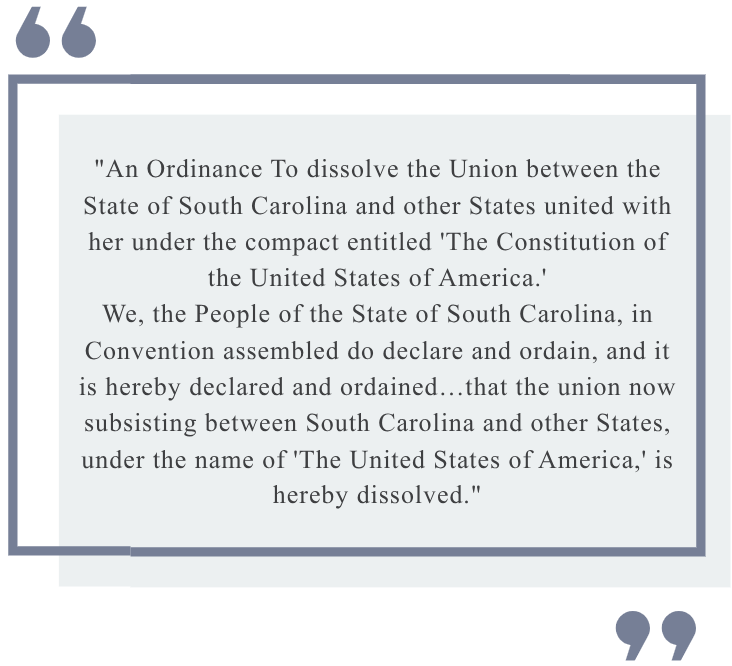
"South Carolina Ordinance of Secession," December 20, 1860.


Clary Ray, "United States Steamer Monitor," ca. 1900. U.S. Naval History and Heritage Command.
Beginning in 1860, conflict over slavery led several southern states to secede from the United States, forming the Confederacy. Northern states, known as the Union, refused to acknowledge their secession.
"South Carolina Ordinance of Secession," December 20, 1860.
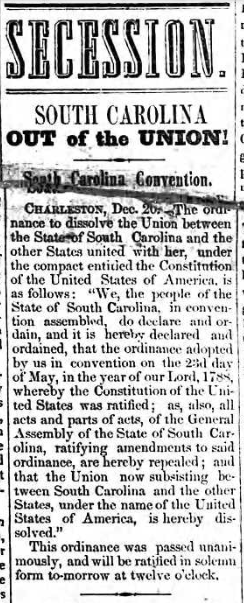
"Secession. South Carolina out of the Union!" The Southern Banner (Athens, GA), December 27, 1860.
"Our position is thoroughly identified with the institution of slavery-- the greatest material interest of the world...There was no choice left us but submission to the mandates of abolition, or a dissolution of the Union, whose principles had been subverted to work out our ruin."
"An Address Setting Forth the Declaration of the Immediate Causes Which Induce and Justify the Secession of Mississippi from the Federal Union and the Ordinance of Secession," 1861.
On April 12th, 1861, Confederate forces fired on Union-held Fort Sumter, sparking the Civil War.
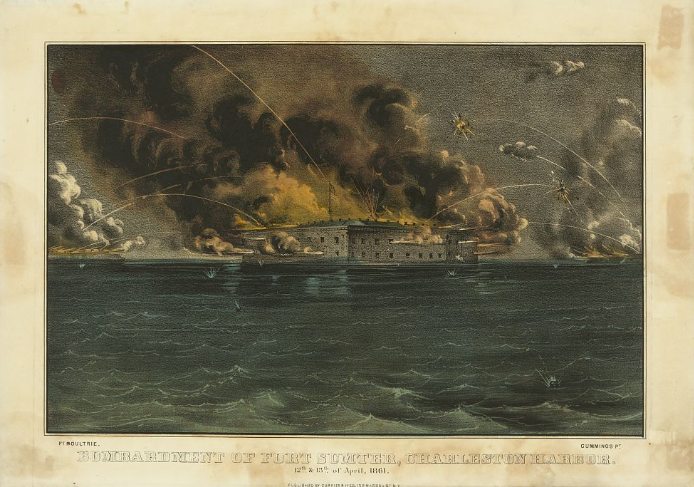
"Bombardment of Fort Sumter, Charleston Harbor: 12th and 13th of April, 1861," 1861. Library of Congress.
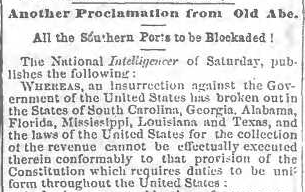
"Another Proclamation from Old Abe. All Southern Ports to Be Blockaded!" The Savannah Republican (Savannah, GA), April 25, 1861.
On April 19th, President Lincoln declared a naval blockade of Confederate ports, intending to cut off supplies and end the war sooner.
The blockade limited exports, causing international tensions as European countries threatened to help the Confederacy.
"It is well known that the French government depends for its revenue, to a very great extent, upon the sale of tobacco…The question is, how is the tobacco to be got out of Virginia and delivered to France? The blockade is an effectual barrier…The deficit in the French revenue amounts to…two hundred millions of dollars. Spain…has the same interests at stake, both as to her commerce and her revenue. English merchants have also interests in tobacco."
"The Emperor Napoleon on the Civil War," The New York Herald, February 12, 1862.
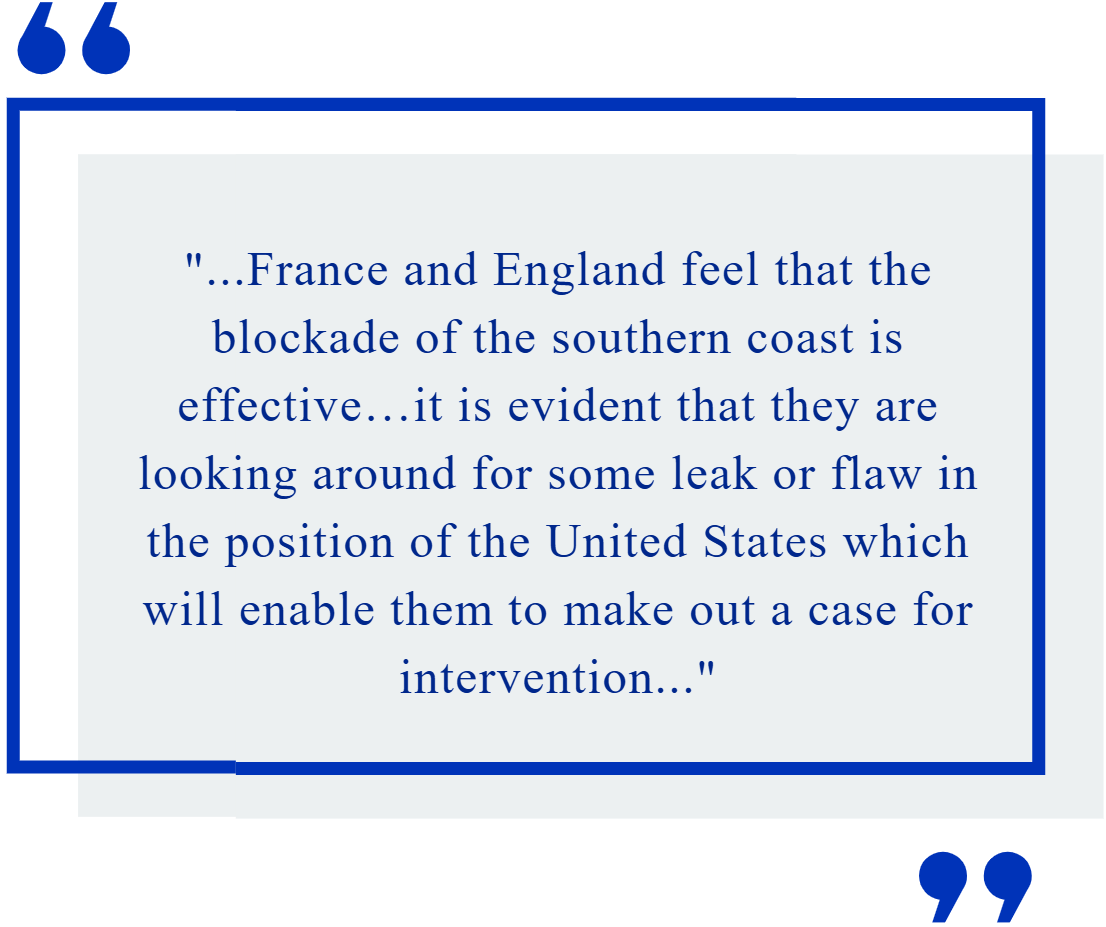
"The Emperor Napoleon on the Civil War,"
The New York Herald, February 12, 1862.
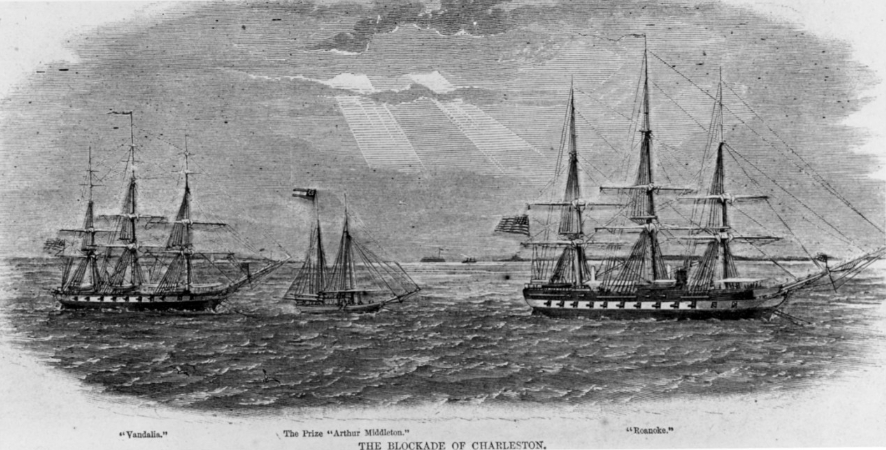
"The Blockade of Charleston," 1861. U.S. Naval History and Heritage Command.
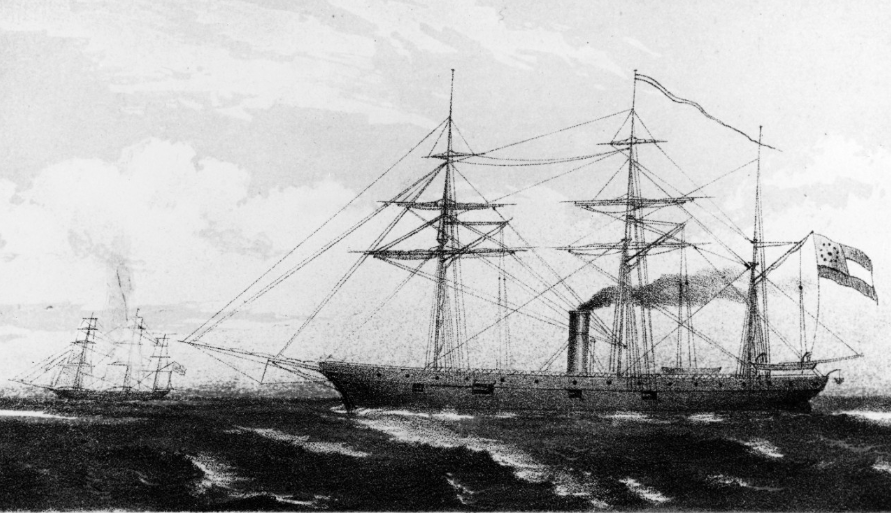
Netherclift, "Running the Blockade. (The Sumter and the Brooklyn)," 1864. U.S. Naval History and Heritage Command.
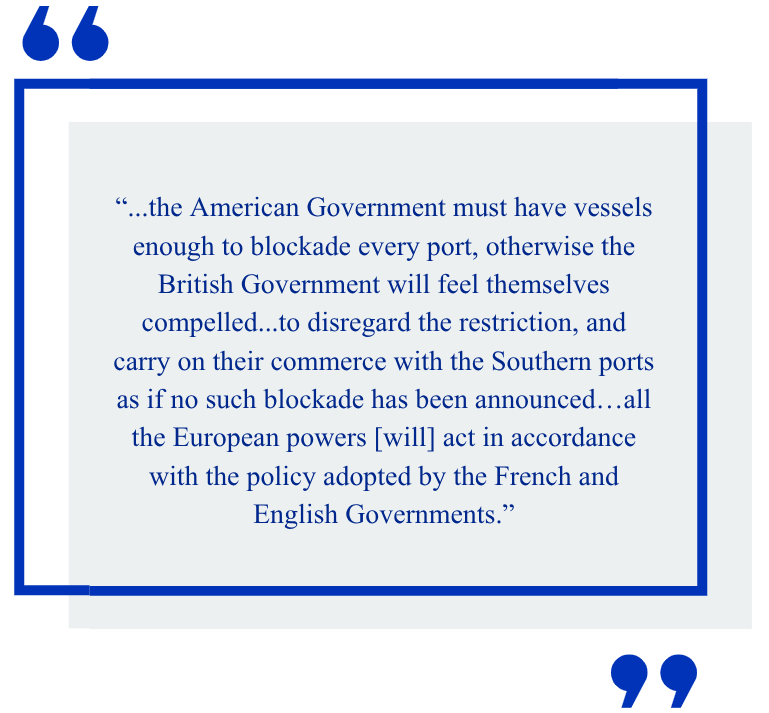
"Inaugural Address," The Morning Chronicle (London),
March 19, 1861.
These threats highlighted the Union’s need for a navy capable of matching European ironclads, to deter potential European intervention in the war.