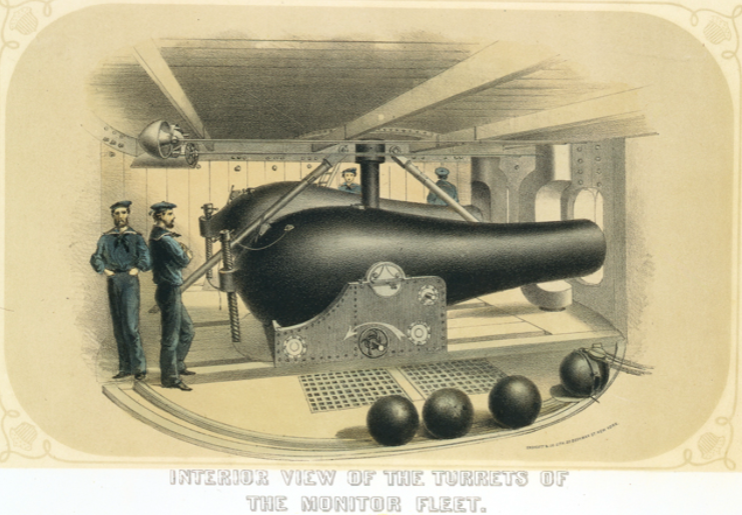
Endicott & Co, "Interior View, Turrets of the Monitor Fleet," April 12, 1862. The Mariner's Museum and Park.


Clary Ray, "United States Steamer Monitor," ca. 1900. U.S. Naval History and Heritage Command.
The Monitor significantly impacted subsequent naval technology and the Civil War.
The Monitor was the first ship to utilize a revolving turret in battle, and its success caused navies to quickly begin building turrets, permanently transforming naval strategy. Whereas previously ships had to form lines in order to fire, now they could freely maneuver and fire in any direction.
Endicott & Co, "Interior View, Turrets of the Monitor Fleet," April 12, 1862. The Mariner's Museum and Park.
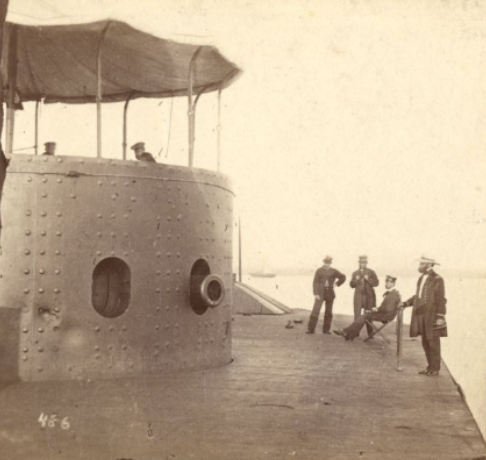
"The Original Monitor After Her Fight with the Merrimac," July 1862. National Archives.
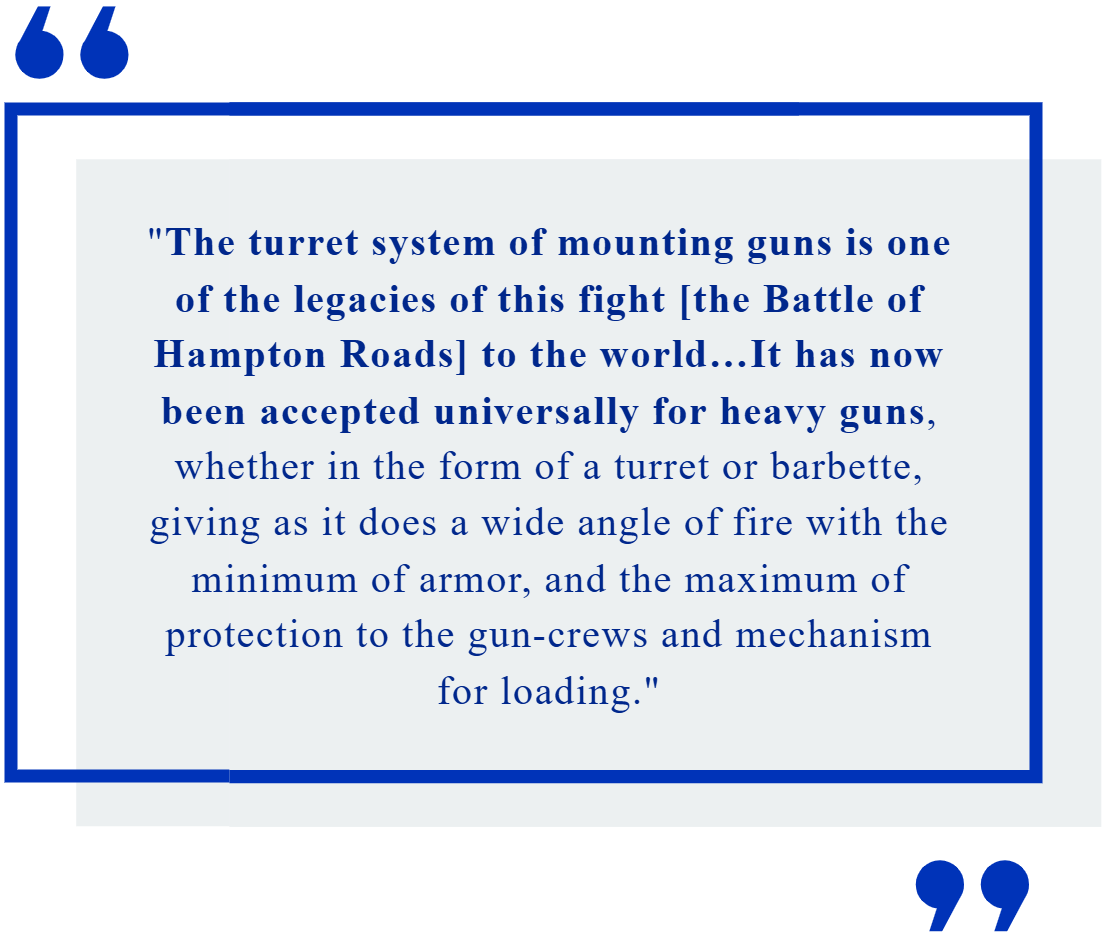
Herbert Wrigley Wilson, Ironclads in Action:
A Sketch of Naval Warfare from 1855 to 1895, 1896.
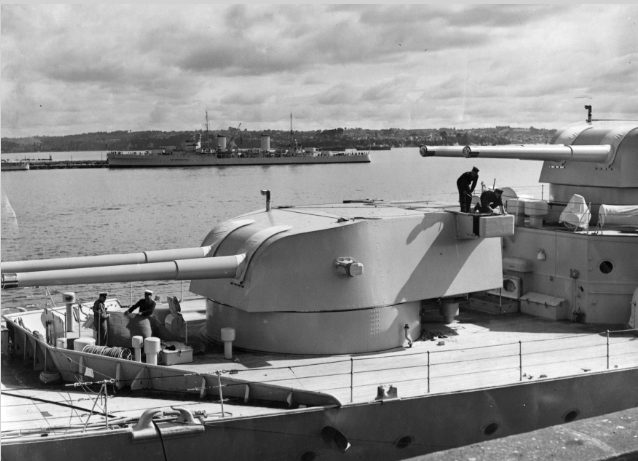
"H.M.A.S. Canberra," ca. 1930s. State Library Victoria.
The Monitor played an important role in the Union’s eventual victory in the Civil War.
The battle deterred Britain from supporting the Confederacy by proving the Union’s naval power.
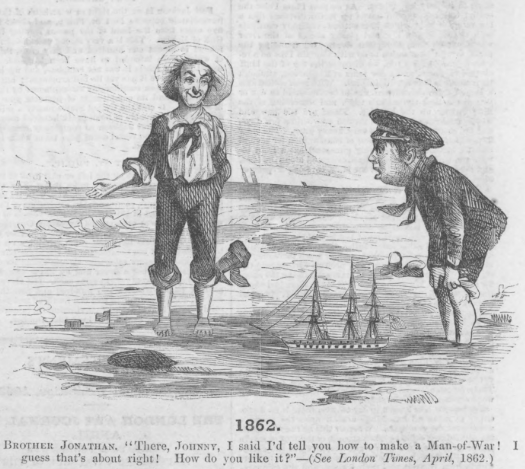
"A Promise Fulfilled," Harper's Weekly, March 10, 1862.
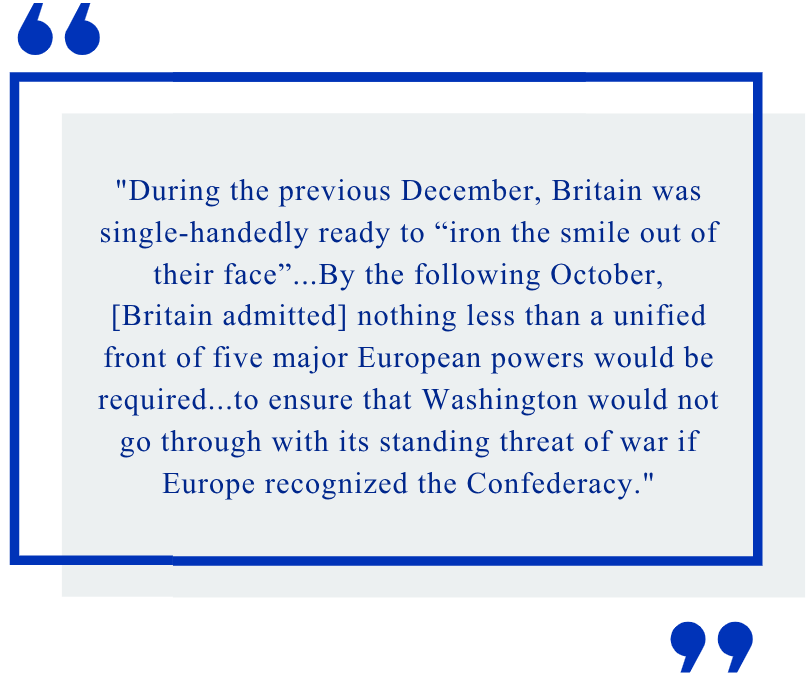
Howard J. Fuller, "From Hampton Roads to Spithead," June 2015.
Subsequent monitors successfully countered and captured Confederate ironclads several times.
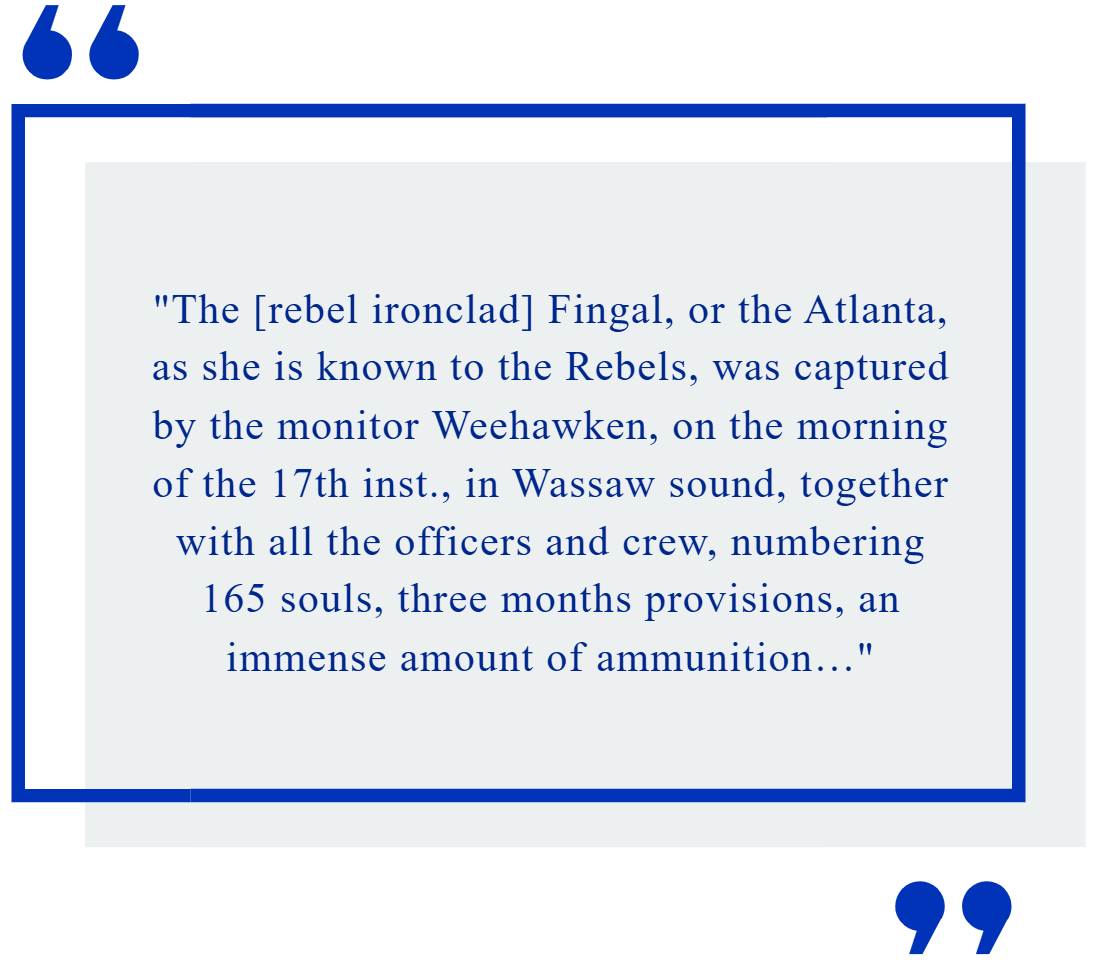
"The Capture of the Rebel Monster Atlanta,"
Daily Commercial Register (Sandusky, OH), June 26, 1863.
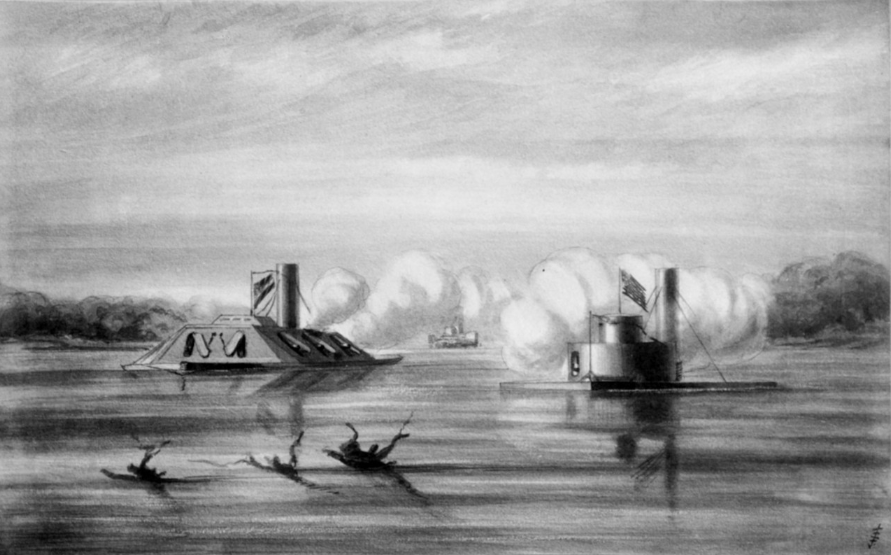
"U.S. Monitor 'Weehawken' and Confederate Ram 'Atlanta,'" 1863.
U.S. Naval History and Heritage Command.
Monitors inspired further technological developments as the Confederacy created underwater mines (called “torpedoes”) and submarines to counter them.
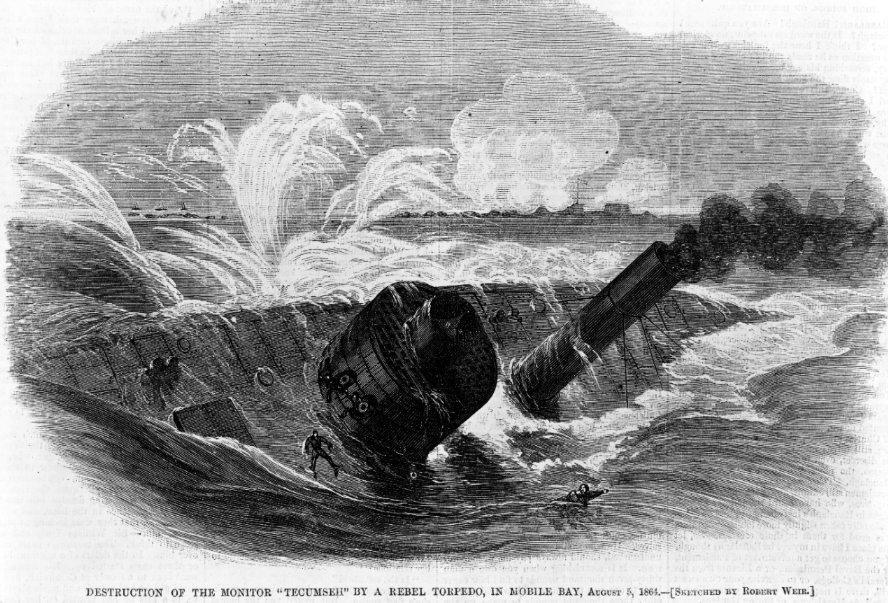
Robert Weir, "Destruction of the Monitor 'Tecumseh' by a Rebel Torpedo, in Mobile Bay, August 5, 1864," 1864. U.S. Naval History and Heritage Command.

Roger A. Bailey, "Steel and Steam," n.d.
Roger A. Bailey, "Steel and Steam," n.d.
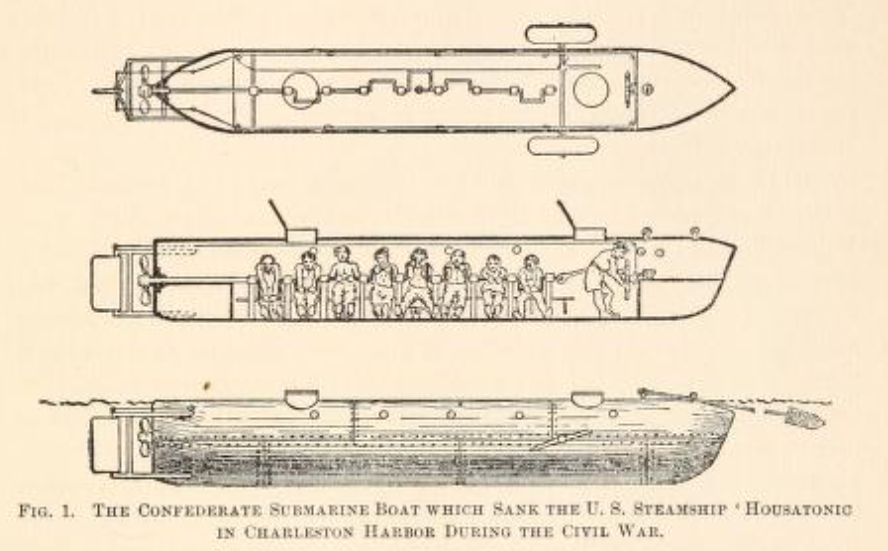
"The Confederate Submarine Boat Which Sank the U.S. Steamship 'Housatonic' in Charleston Harbor during the Civil War," in The Popular Science Monthly, edited by J. McKeen Cattell, 1901.