On the first day of the battle, the Virginia defeated two wooden warships.


Clary Ray, "United States Steamer Monitor," ca. 1900. U.S. Naval History and Heritage Command.
On the second day of the Battle of Hampton Roads, the Monitor revolutionized naval warfare by proving that only an ironclad could defeat another ironclad.
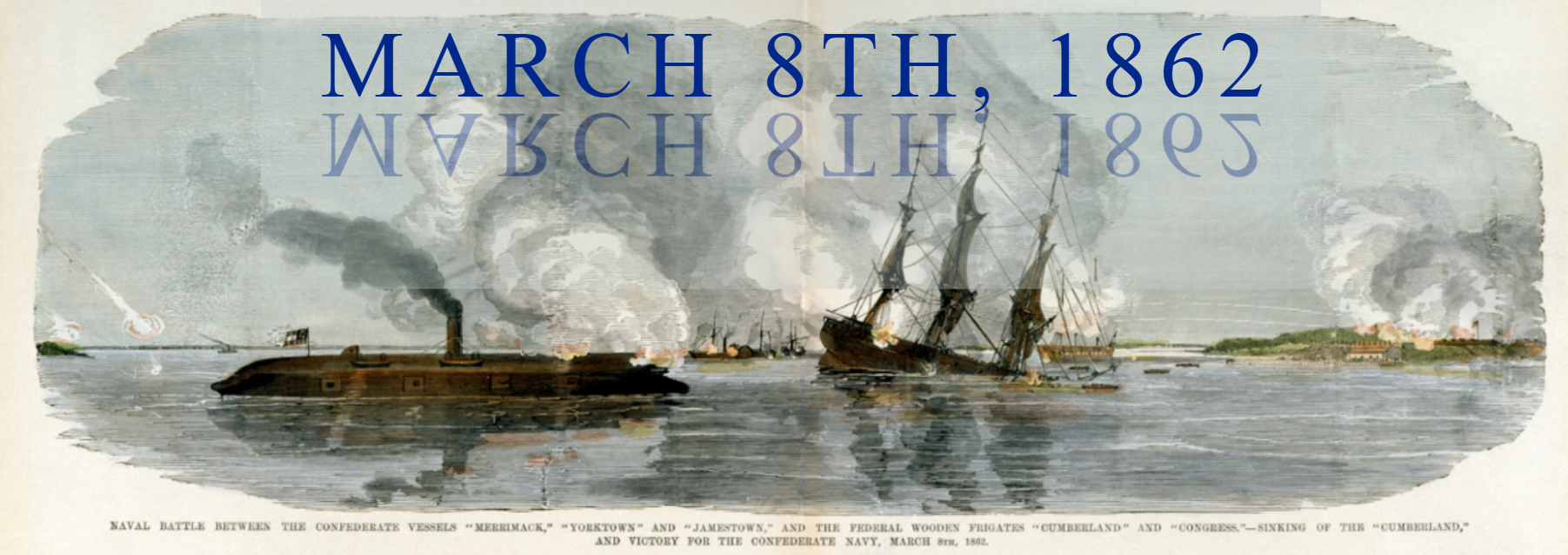
"Naval Battles in Hampton Roads," 1862. The Mariner's Museum and Park.
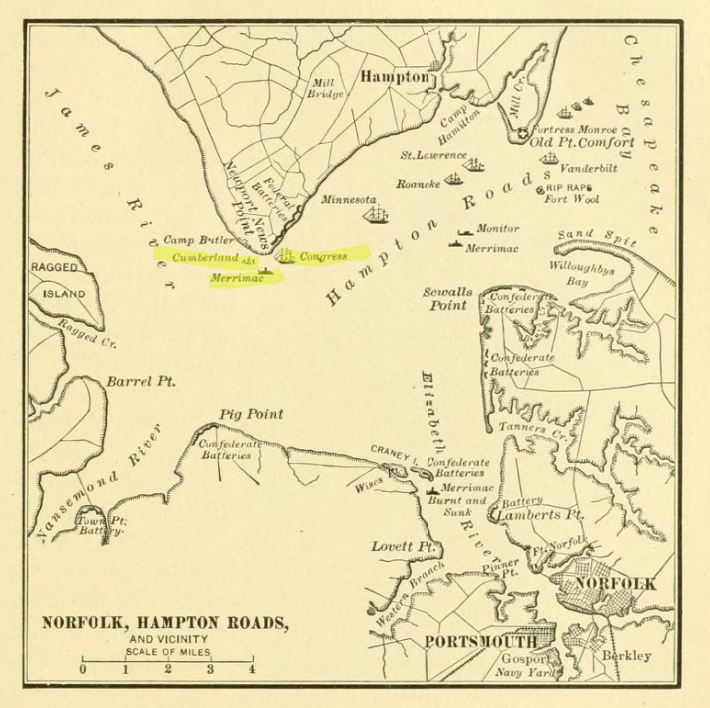
"Norfolk, Hampton Roads, and Vicinity," 1922, in A History of the United States, by
Charles Kendall Adams and William P. Trent.
That morning, the Virginia steamed out of Norfolk into Hampton Roads. The Union fleet’s wooden ships were powerless to stop Virginia’s attacks as their cannons couldn’t penetrate its armor.
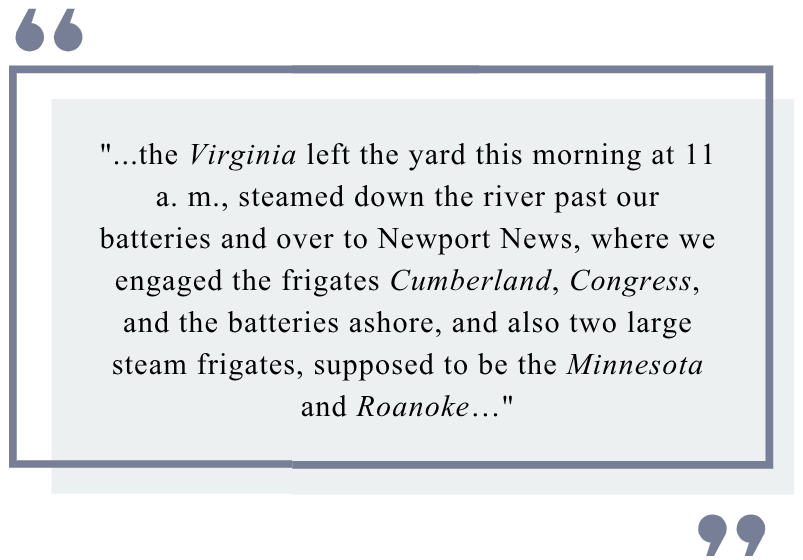
Catesby ap R. Jones, a lieutenant on the Virginia.
Report of Lieutenant Jones, Executive Officer of the Ironclad Ram CSS Virginia, in Command during the Battle with USS Monitor, March 8, 1862.
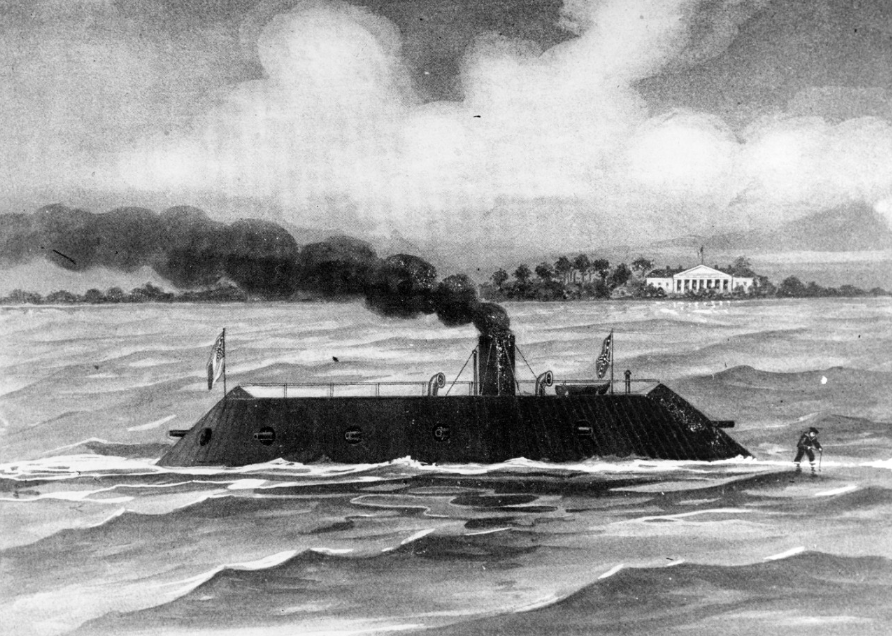
"CSS Virginia (1862-1862)," 1907. U.S. Naval History and Heritage Command.
"...turning into the channel leading to Newport News, [the Merrimac] steamed direct for the Cumberland and Congress…As soon as the Merrimac came within range of the Cumberland, the latter opened on her with her heavy guns, but the balls struck and glanced off, having no more effect on her than peas from a pop-gun….The Merrimac…kept steadily on her course, and slowly approached the Cumberland, when the latter, as well as the Congress, at the distance of one hundred yards, rained full broadsides on the iron-clad monster. The shots took no effect, glancing upwards and flying off, having only the effect of checking her progress for a moment."
"The Union Fleet Attacked by Rebel Steamers Merrimac, Jamestown, and Yorktown," The Philadelphia Inquirer, March 10, 1862.
The Virginia easily rammed and sank the USS Cumberland.
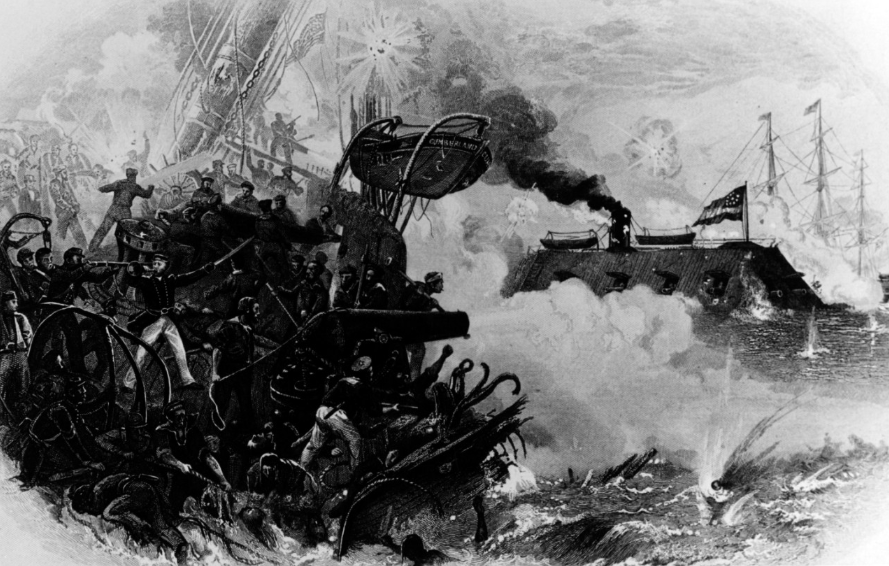
"Sinking of USS Cumberland by CSS Virginia, 8 March 1862," ca. 1862. U.S. Naval History and Heritage Command.
George Morris, a lieutenant on the USS Cumberland.
Report of Lieutenant George Morris, Executive Officer
of the Frigate USS Cumberland, March 9, 1862.
Franklin Buchanan, captain of the Virginia.
Report of Flag-Officer Buchanan, Commander of CSS
Virginia and the James River Squadron, C.S. Navy, March 27, 1862.
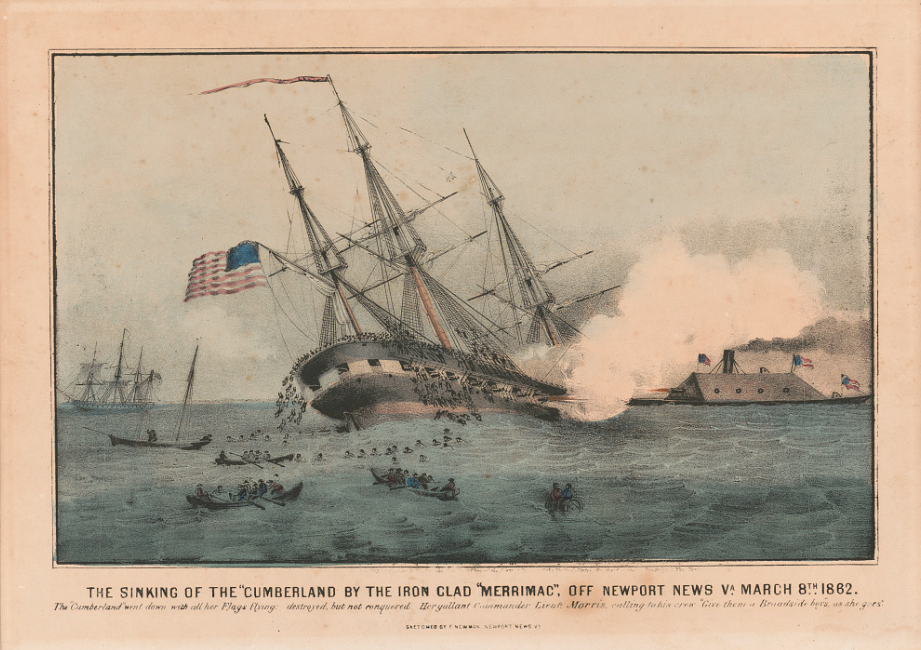
Currier & Ives. The Sinking of the "Cumberland["] by the Iron Clad "Merrimac," off Newport News Va. March 8th 1862, 1862. Library of Congress.
The Virginia then set the USS Congress on fire.
Austin Pendergrast, a lieutenant on the USS Congress.
Report of Lieutenant Pendergrast, U.S. Navy, Executive
Officer of the Frigate USS Congress, March 9, 1862.
Catesby ap R. Jones, a lieutenant on the Virginia.
Report of Lieutenant Jones, Executive Officer of the Ironclad Ram CSS Virginia, in Command during the Battle with USS Monitor, March 8, 1862.
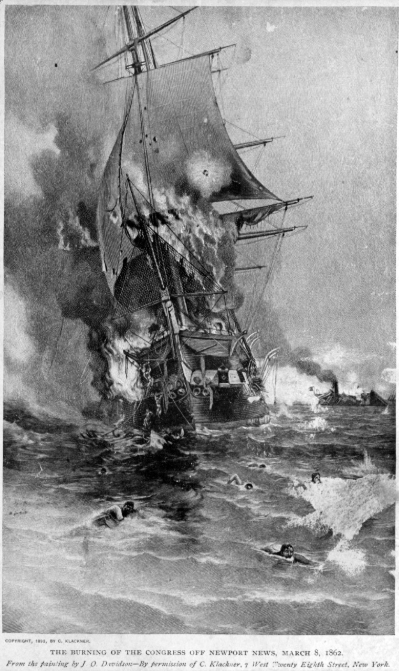
"The Burning of the Congress off Newport News, March 8, 1862," 1892. U.S. Naval History and Heritage Command.
The Virginia left in good condition, threatening to cause more destruction the next day.
"It was now five o’clock, nearly two hours of daylight, and the Minnesota only remained. She was aground and at our mercy. But the pilots would not attempt the middle channel with the ebb tide and approaching night. So we returned by the south channel to Sewall’s Point and anchored, the Minnesota escaping, as we thought, only until morning."
John Taylor Wood, a lieutenant on the CSS Virginia.
"The First Fight of Iron-Clads," The Century Illustrated, March 1885.
The Virginia had completely destroyed the wooden ships while receiving negligible damage, demonstrating the complete superiority of ironclad ships over wooden ones.
"From Fortress Monroe: Further Particulars of the Terrible Naval Conflict," The Philadelphia Inquirer, March 11, 1862.
Catesby ap R. Jones, a lieutenant on the Virginia.
Report of Lieutenant Jones, Executive Officer of the
Ironclad Ram CSS Virginia, in Command during the Battle with USS Monitor, March 8, 1862.
"On the 8th day of March 1862...we proclaimed to the world that hence forth it must look to the mines as well as the forest for material with which to build battleships."
Elijah W. Flake, a sailor on the Virginia.
Battle between the Merrimac and the Monitor, 1914.
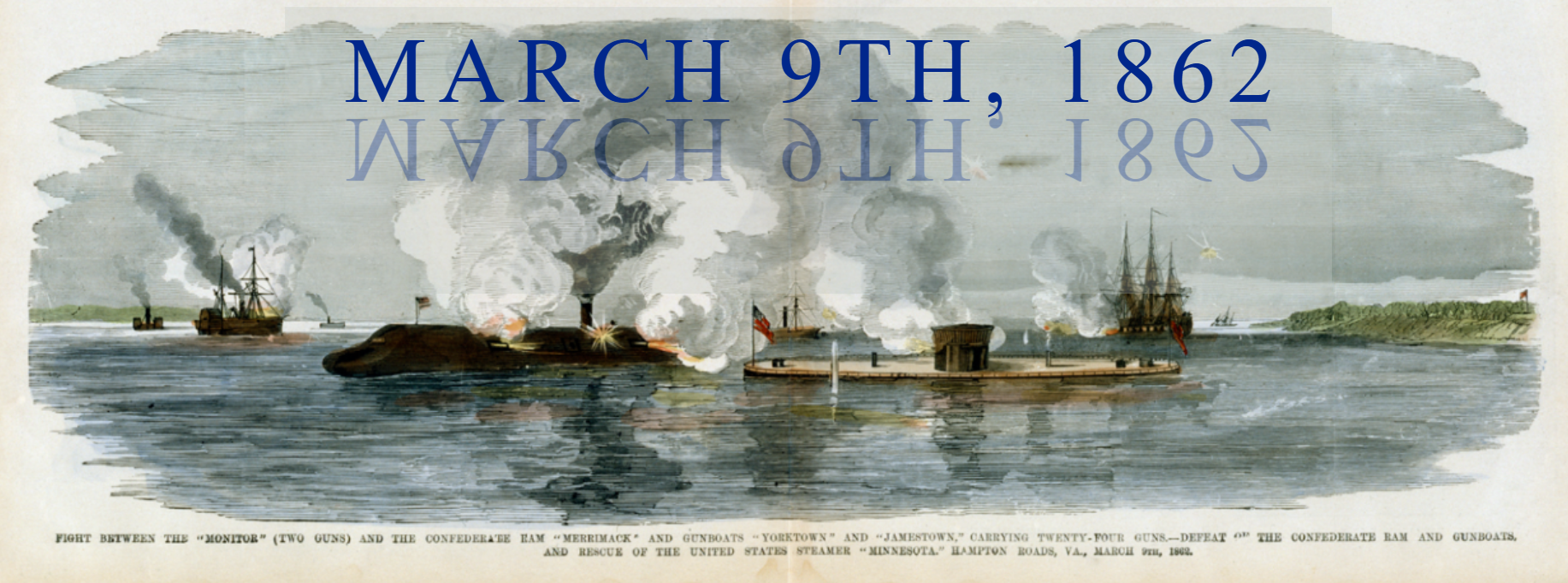
"Naval Battles in Hampton Roads," 1862. The Mariner's Museum and Park.
"This is the first fight that has ever taken place between ironclad vessels."
"Chronicle of the Week," The Weekly Chronicle and Register (London). March 29, 1862.
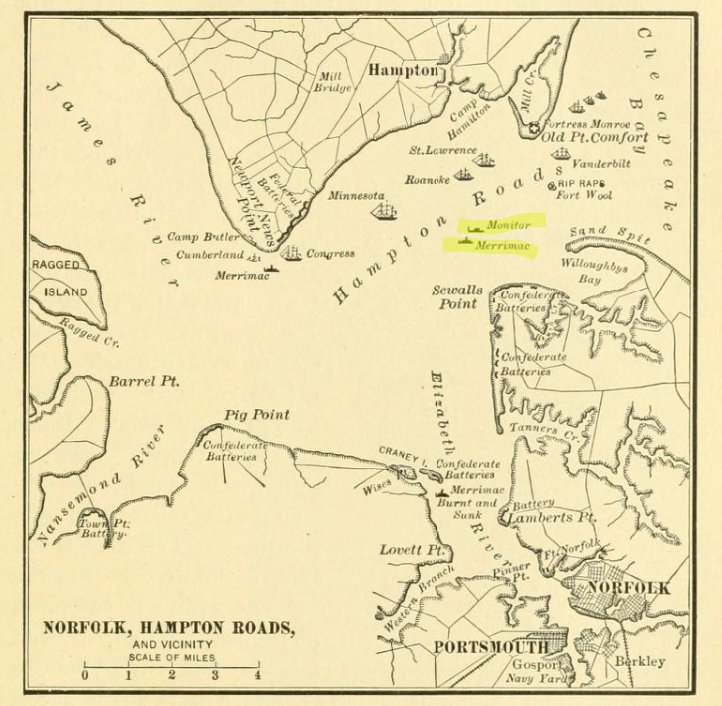
"Norfolk, Hampton Roads, and Vicinity," 1922, in A History of the United States, by
Charles Kendall Adams and William P. Trent.
The Monitor arrived at Hampton Roads overnight.
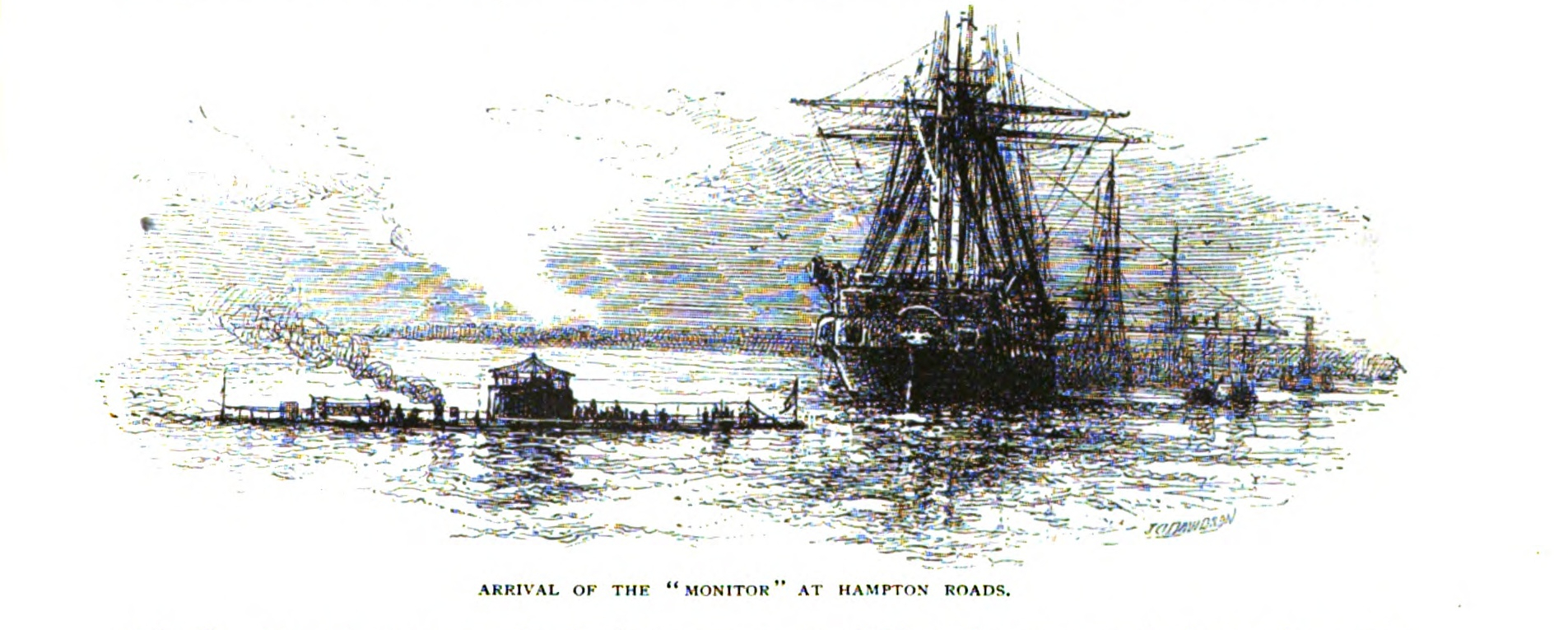
"Arrival of the 'Monitor' at Hampton Roads." The Century Illustrated, March 1885.
"...at daybreak we discovered lying between us and the Minnesota, a strange-looking craft, which we knew at once to be Ericsson’s Monitor, which had long been expected in Hampton Roads...She could not possibly have made her appearance at a more inopportune time for us, changing our plans, which were to destroy the Minnesota, and then the remainder of the fleet below Fortress Monroe."
John Taylor Wood, a lieutenant on the Virginia.
"The First Fight of Iron-Clads," The Century Illustrated, March 1885.
In the morning, the Monitor battled the Virginia for over four hours.
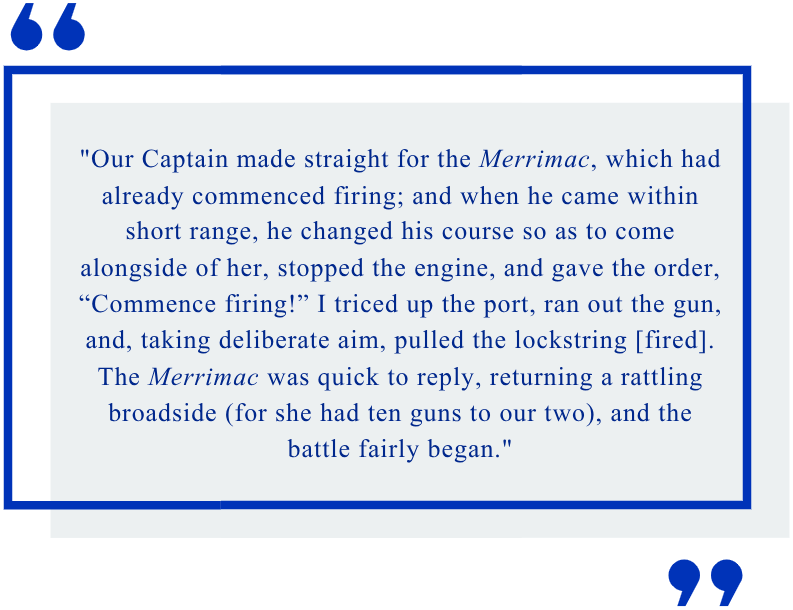
Samuel Dana Greene, lieutenant on the Monitor.
"In the 'Monitor' Turret," The Century Illustrated, March 1885.
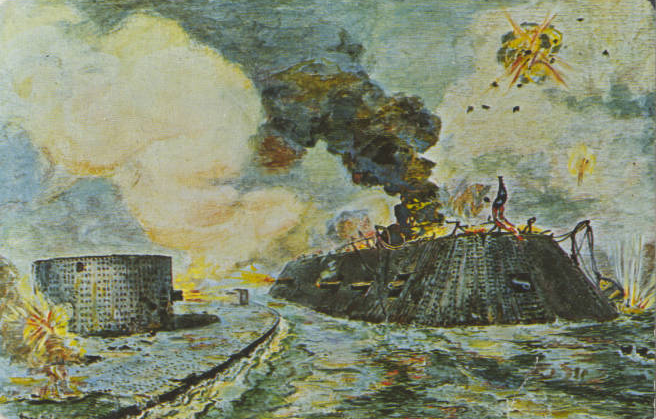
"Monitor (Ironclad)," n.d. The North Carolina Collection Photographic Archives.
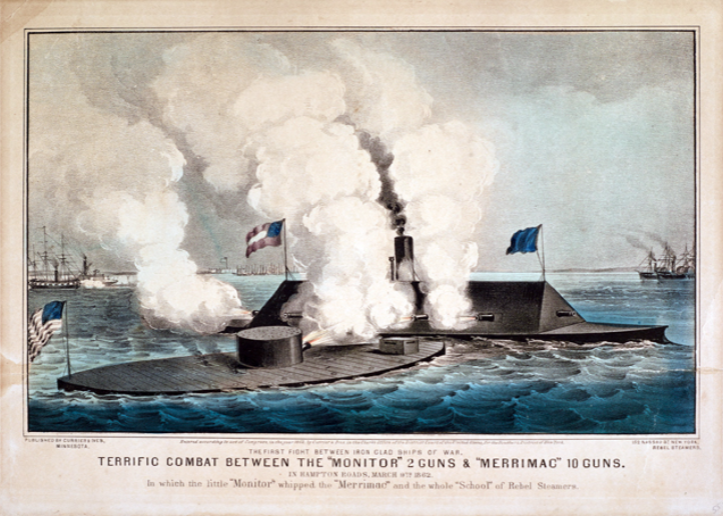
Currier & Ives, "Terrific Combat between the Monitor, 2 Guns, and the Merrimac, 10 Guns," 1862. The Mariner's Museum and Park.
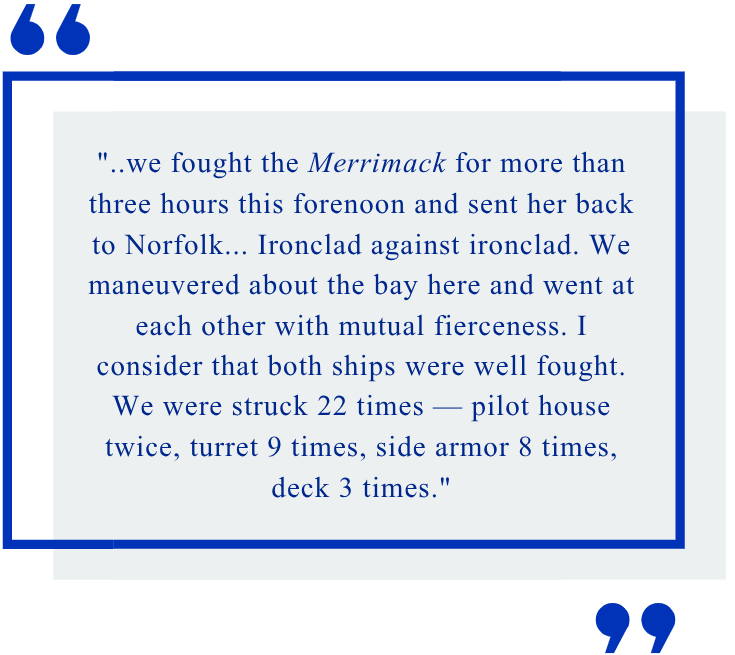
Alban C. Stimers, chief engineer on the Monitor,
to John Ericsson, inventor of the Monitor.
"Letter from Chief Engineer Stimers, USS Monitor, to Captain John Ericsson, Giving an Account of the Engagement," March 9, 1862.
During the battle, the Monitor’s innovative design proved successful – the turret rotated and fired effectively, and its armor was never penetrated.
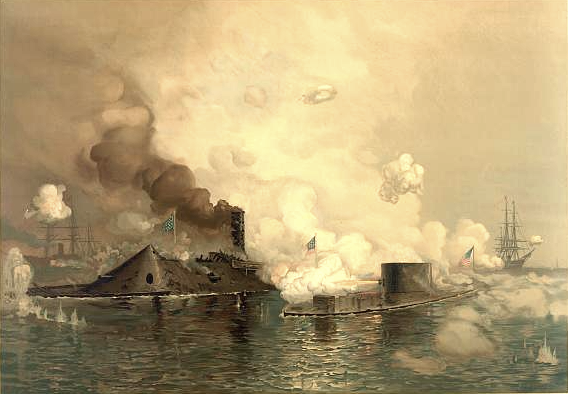
L. Prang & Co, "The Monitor and Merrimac," 1886. Library of Congress.
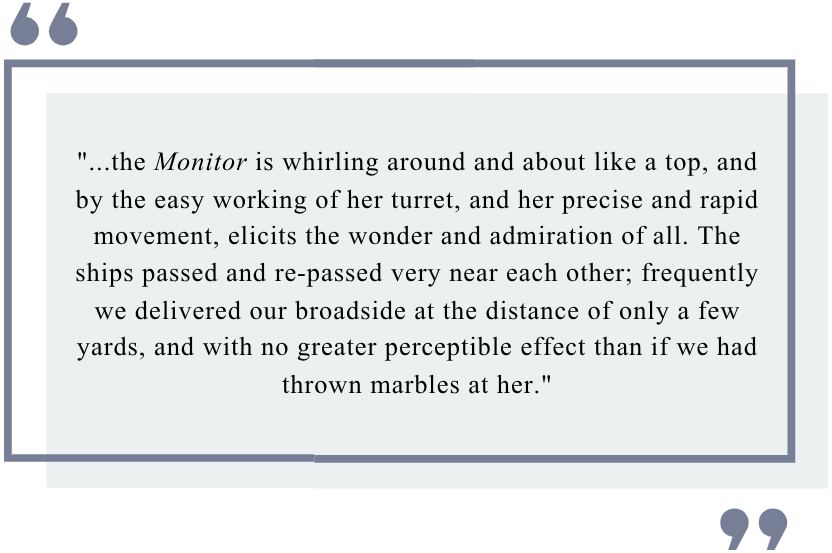
Wiliam Norris, a sailor on the Virginia.
The Story of the Confederate States' Ship 'Virginia' (once Merrimac): Her Victory over the Monitor: Born March 7th, Died May 10th, 1862, 1879.
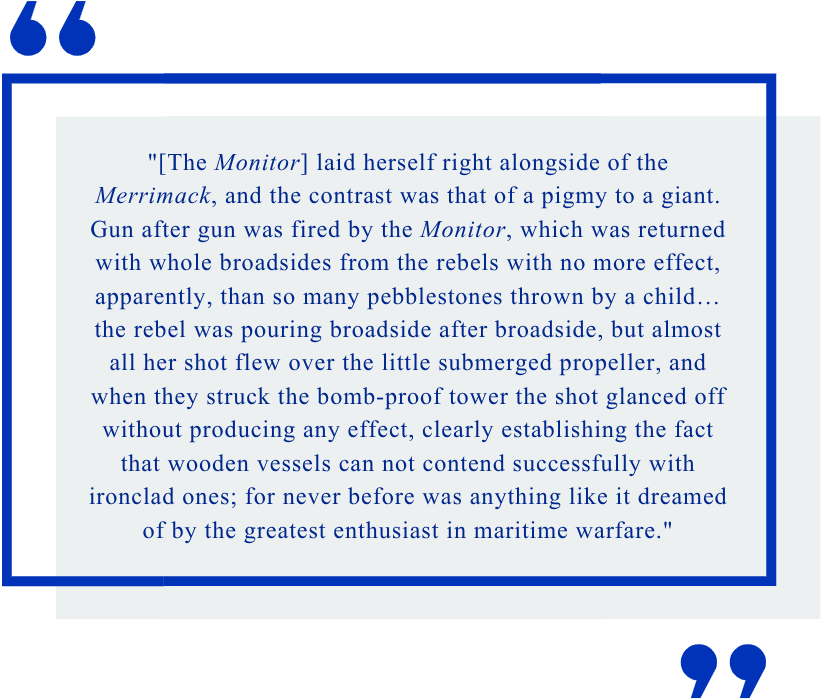
G. J. Van Brunt, captain of the USS Minnesota.
Report of Captain Van Brunt, U.S. Navy, Commanding
the Steam Frigate USS Minnesota, March 10, 1862.
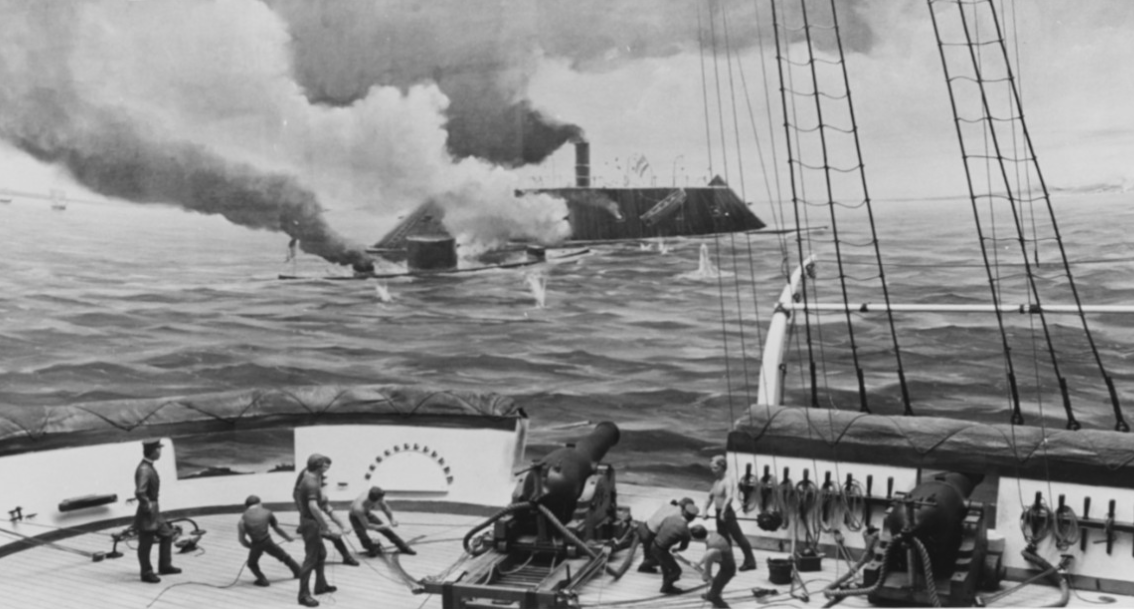
"Civil War Battle between the First Ironclads," 1966. U.S. Naval History and Heritage Command.
Eventually both ships withdrew with minimal damage. Although tactically a draw, both sides claimed victory.
The Monitor fared far better than any of the wooden ships, despite being a tenth of their size. This proved that only another ironclad could stop an ironclad.
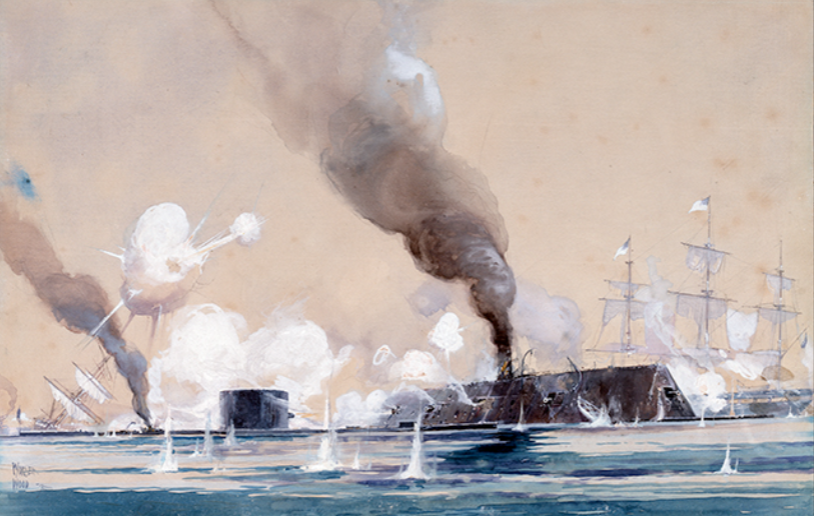
Worden George Wood, "Battle of the Ironclads," 1925. The Mariner's Museum and Park.
Herbert Wrigley Wilson, Ironclads in Action: A Sketch of Naval Warfare from 1855 to 1895, 1896.
The Battle of Hampton Roads revolutionized naval warfare by proving decisively that ironclads were more effective than wooden ships.
Benj. Huger, Report of Major-General Huger, C.S. Army, Commanding Department of Norfolk, on the Impact of
Ironclad Warships in Warfare, March 10, 1862.
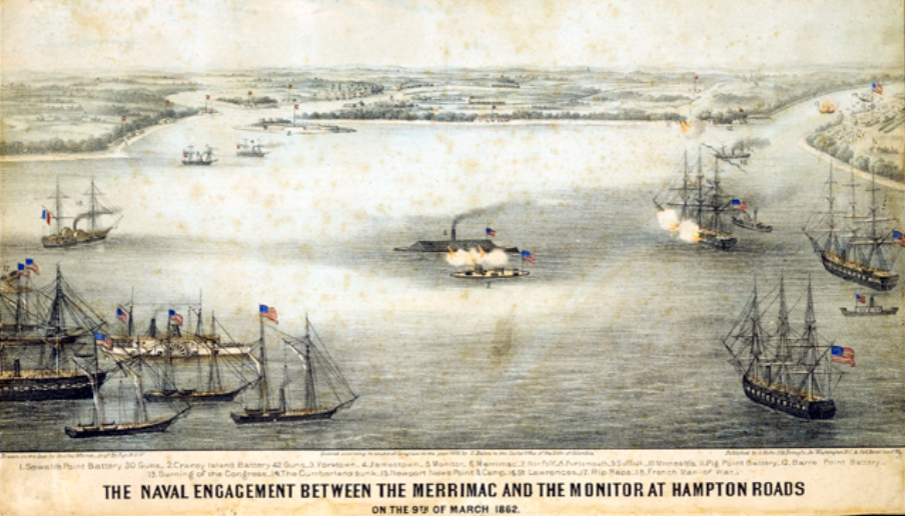
Charles Worret, "The Naval Engagement between the Merrimac and the Monitor at Hampton," 1862. The Mariner's Museum and Park.
"The engagement in Hampton Roads on the 8th of March, 1862, between the Confederate iron-clad Virginia…and the United States wooden fleet, and that next day between the Virginia and the Monitor, was, in its results, in some respects the most momentous naval conflict ever witnessed. No battle was ever more widely discussed or produced a greater sensation. It revolutionized the navies of the world. Line-of-battle ships, those huge, overgrown craft, carrying from eighty to one hundred and twenty guns and from five hundred to twelve hundred men...were at once universally condemned as out of date…iron-clads were in future to decide all naval warfare."
John Taylor Wood, a lieutenant on the Virginia.
"The First Fight of Iron-Clads," The Century Illustrated, March 1885.