
Aftermath
Following the publication of the story was an international public outcry. The events of the study, exposed during a period where unethical experimentation was becoming more widely known and civil rights advocacy was growing in popularity, enraged the medical and civil rights communities.
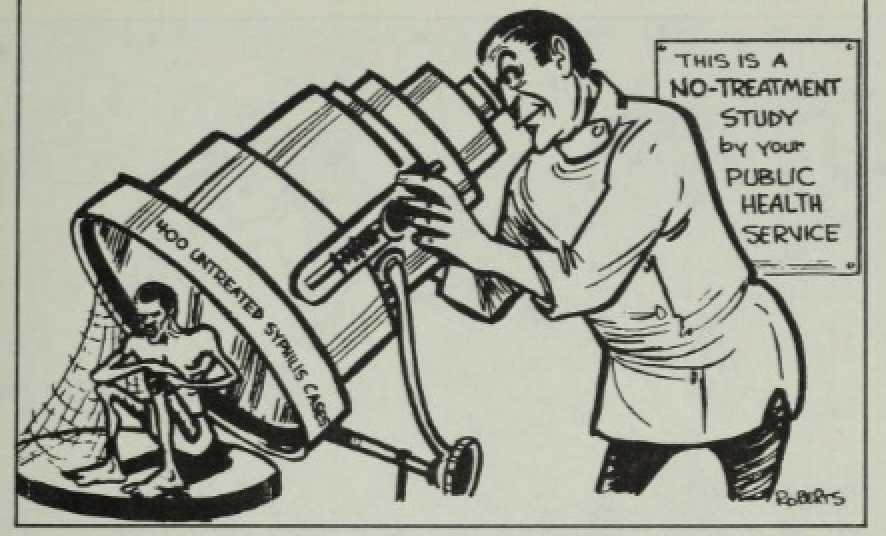
Jones, James Howard. "Bad blood : the Tuskegee syphilis experiment." New York : Free Press ; London : Collier Macmillan Publishers, 1981,"

Jones, James Howard. "Bad blood : the Tuskegee syphilis experiment." New York : Free Press ; London : Collier Macmillan Publishers, 1981,"

Jones, James Howard. "Bad blood : the Tuskegee syphilis experiment." New York : Free Press ; London : Collier Macmillan Publishers, 1981,"
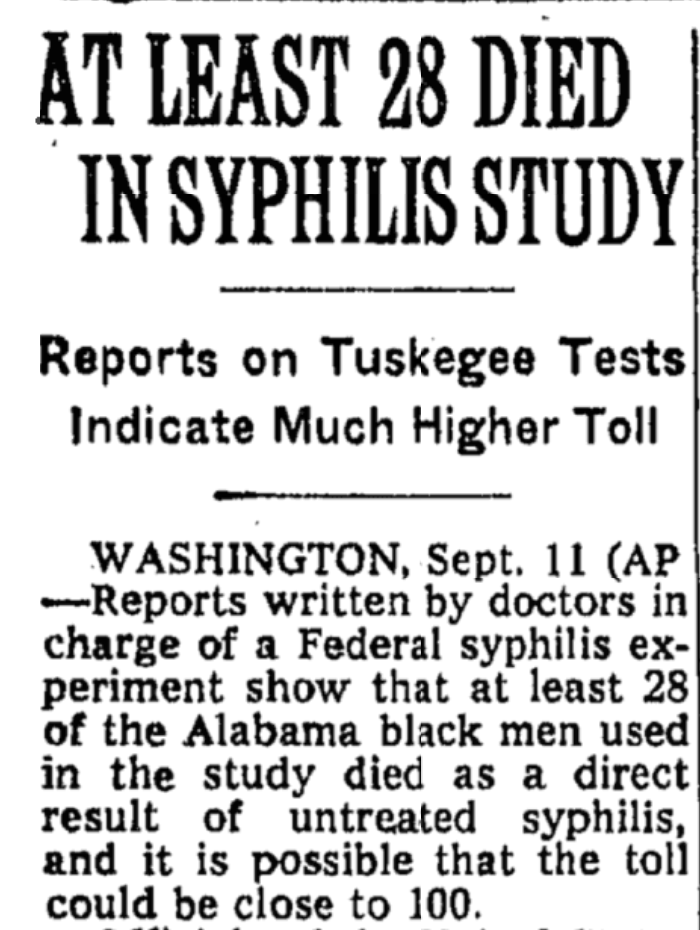
“AT LEAST 28 DIED IN SYPHILIS STUDY.” 12 September 1972,

“AIDE QUESTIONED SYPHILIS STUDY.” 9 August 2025,
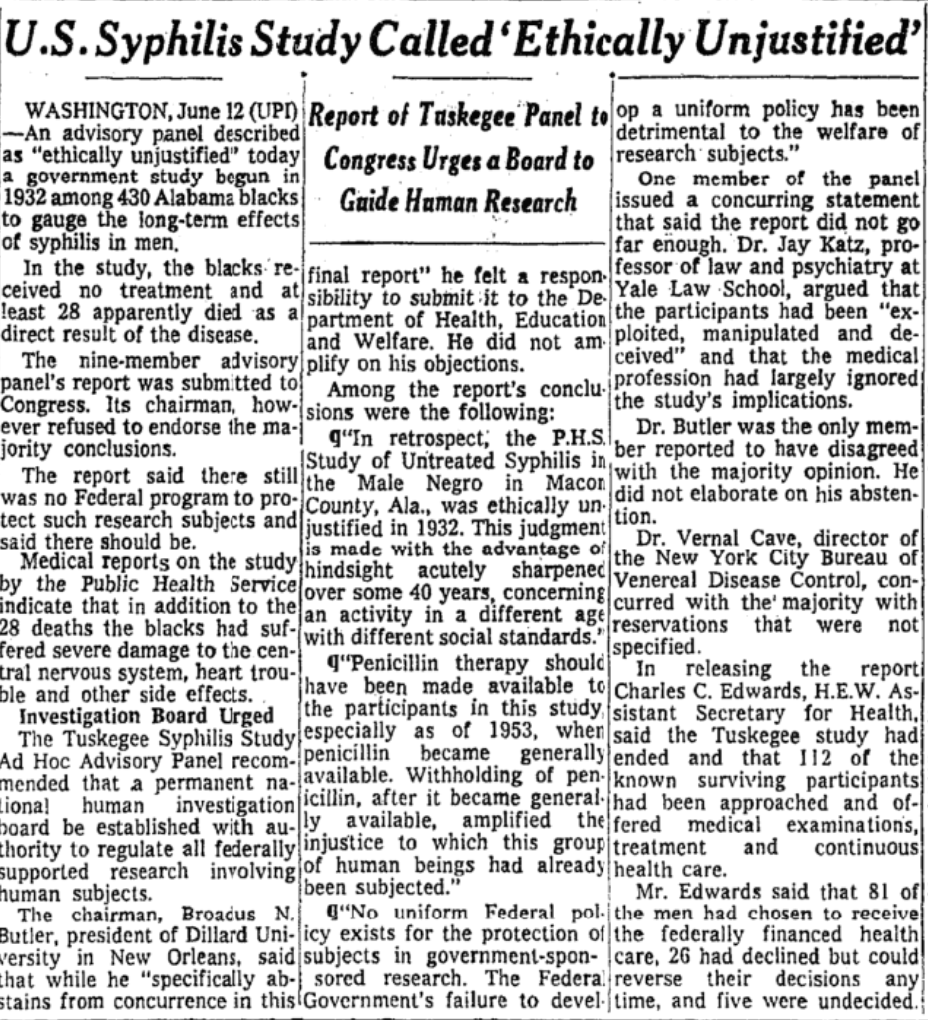
"U.S. Syphilis Study Called 'Ethically Unjustified', 13 June 1973,
"People who worked in the main office of H.E.W. in Washington staged a sit-in in his office, protesting the study. A few days afterwards, Ted Kennedy said he was convening a Senate investigation into how this started and why it went on for 40 years and why these men were denied penicillin when it became the drug of choice to treat syphilis."
- Jean Heller
Civil-rights attorney Fred D. Gray, a member of the NAACP, filed a lawsuit against Alabama and the USPHS in 1972 that was settled in 1975 for $10 million and medical care for survivors.
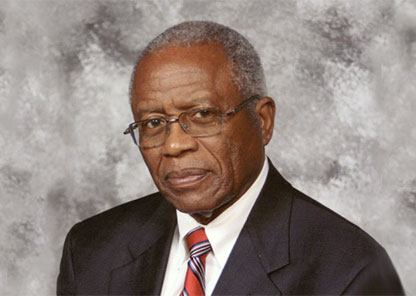
“Gray.” Tuskegee to award honorary degree to attorney, civil rights legend Fred D. Gray, 2018,
"He handed me the newspaper and he said, 'I'm Charlie Pollard, in this paper.' He explained to me how he was at the stockyard a day or so before and was approached by a newspaper reporter and he discovered, as a result of that conversation, that he was a part of what has become known as the Tuskegee Syphilis Study, and he wanted to know whether or not I could do something for him about it."
- Attorney Fred D. Gray
In direct response to the Tuskegee Syphilis Study, the 1974 National Research Act was signed into law, establishing a commission to identify ethical guidelines and Institutional Review Boards (IRBs) to ensure that research protocols met ethical standards, including obtaining consent from study participants.
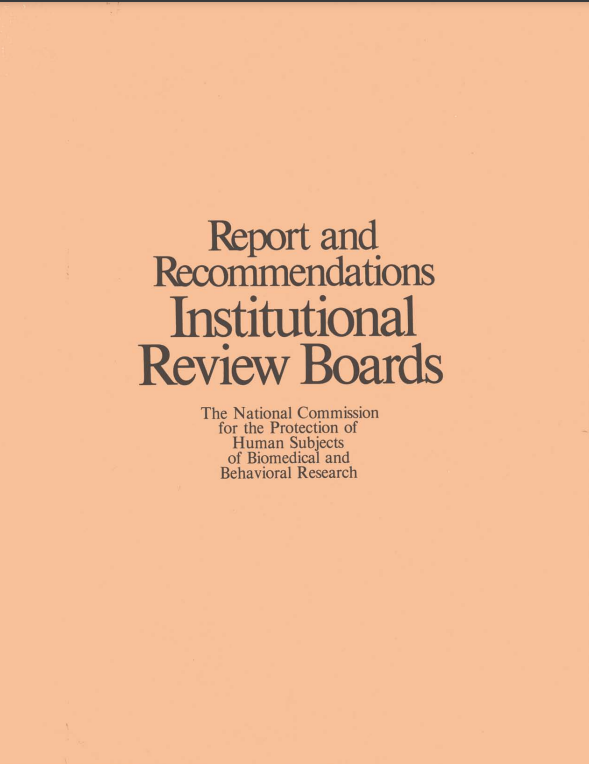
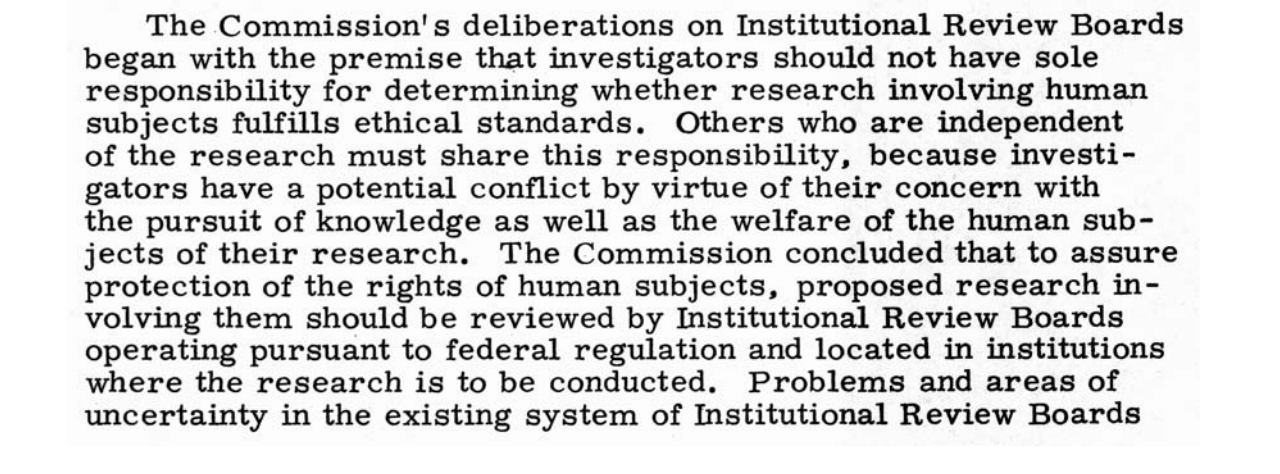

“REPORT AND RECOMMENDATIONS: INSTITUTIONAL REVIEW BOARDS.” 1 September 1978,
In 1979, the commission published the Belmont Report that emphasized and addressed the need for equality in research, clarifying ethical standards to prevent discrimination by requiring fair subject selection and equitable distribution of risks and benefits.

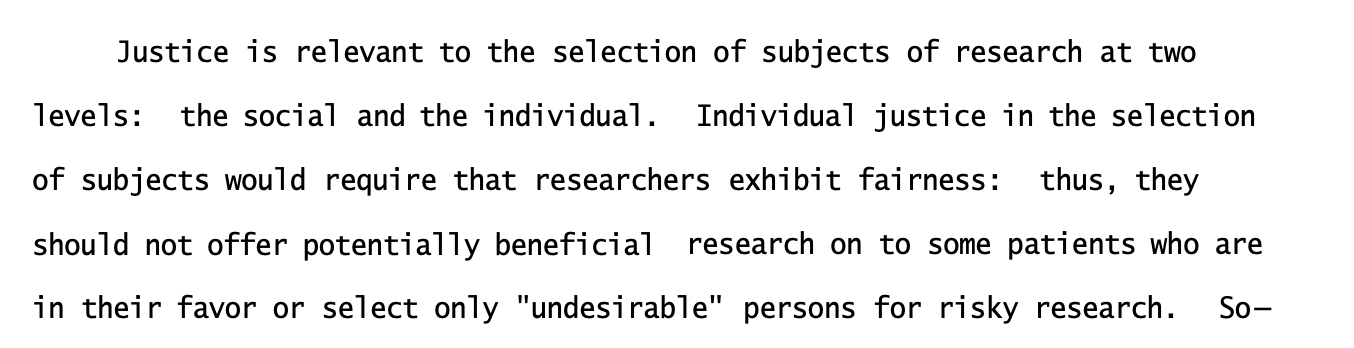

"The Belmont Report." 1978. THE BELMONT REPORT: ETHICAL PRINCIPLES AND GUIDELINES FOR THE COMMISSION,