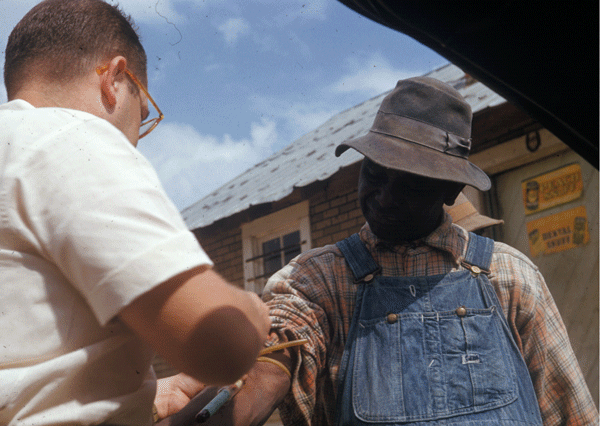
"Department of Health, Education, and Welfare. Public Health Service. Health Services and Mental Health Administration. Center for Disease Control. Venereal Disease Branch. Photograph of Participants in the Tuskegee Syphilis Study,"

“You will never have another study like this; take advantage of it,"
- Lawton Smith
In 1932, the United States Public Health Service (USPHS) initiated the Tuskegee Syphilis Study in Macon County, Alabama, involving 600 African American men, 399 with syphilis. The participants consisted of poor and illiterate sharecroppers promised free medical care, meals, and transportation in the government flier advertising the study.
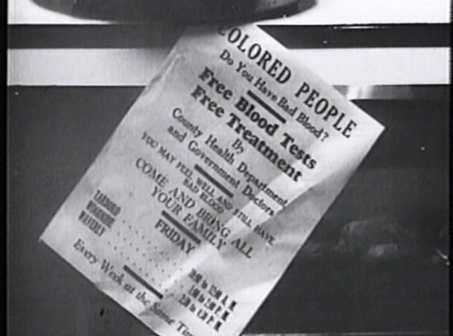
""The Participants" Zabell, Ally"
"As a group, they were susceptible to kindness."
- Dr. Frost, black physician
"CDC. ‘Colored People, Bad Blood, Free Blood Test, Free Treatment,’ campaign flyer, ca. 1930s. tuskegeestudy. 1930s. 20 Photos from the Tuskegee Syphilis Study,"
"Without this suasion it would, we believe, have been impossible to secure the cooperation of the group and their families."
- A report from the study
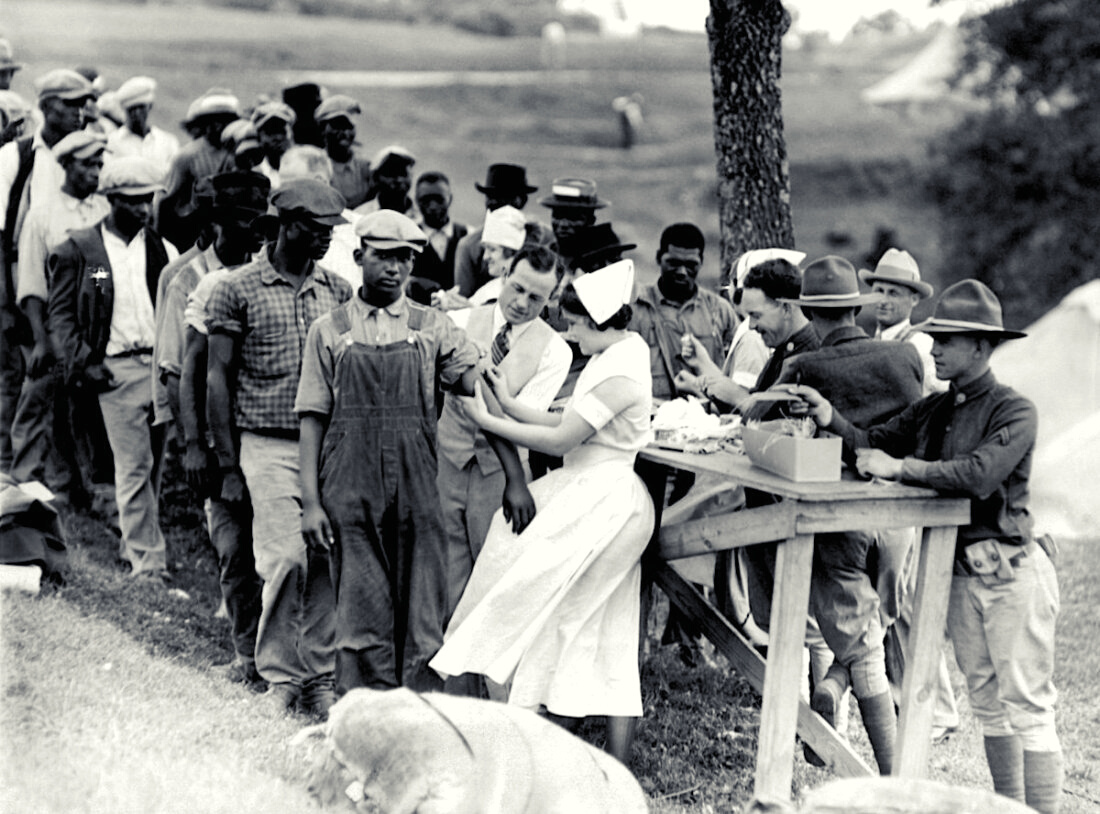
"Rajan, Ravi. At Tuskegee, the U.S. government experimented on black men with syphilis for 40 years. 27 January 2023. Tuskegee Syphilis Study, the Most Notorious Medical Experiment in American History,"
After being diagnosed, the participants were never told they had syphilis or that they were participating in a clinical study. They were instead informed that they were being treated for “bad blood”, a term commonly used in the South to describe a range of illnesses. The diagnostic process of spinal taps was explained to be "back shots" with therapeutic purposes.
"So I went on over and they told me I had bad blood, and that's what they've been telling me ever since. They come around from time to time and check me over and they say, 'Charlie, you've got bad blood.'
- Charlie Pollard
"Department of Health, Education, and Welfare. Public Health Service. Health Services and Mental Health Administration. Center for Disease Control. Venereal Disease Branch. Photograph of Participants in the Tuskegee Syphilis Study,"
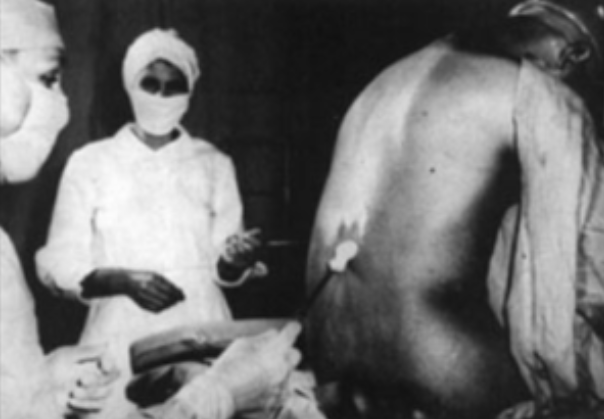
"CDC. A Tuskegee study subject undergoes a spinal tap to obtain spinal fluid for neurosyphilis testing. The subjects were duped into agreeing to the painful and dangerous procedure. CDC. 20 Photos from the Tuskegee Syphilis Study,"
“Details of the puncture techniques should be kept from them as far as possible”
- Raymond Vonderlehr
They were only administered iron tonic and aspirin as placebos, and local doctors were asked to withhold treatment from the men.
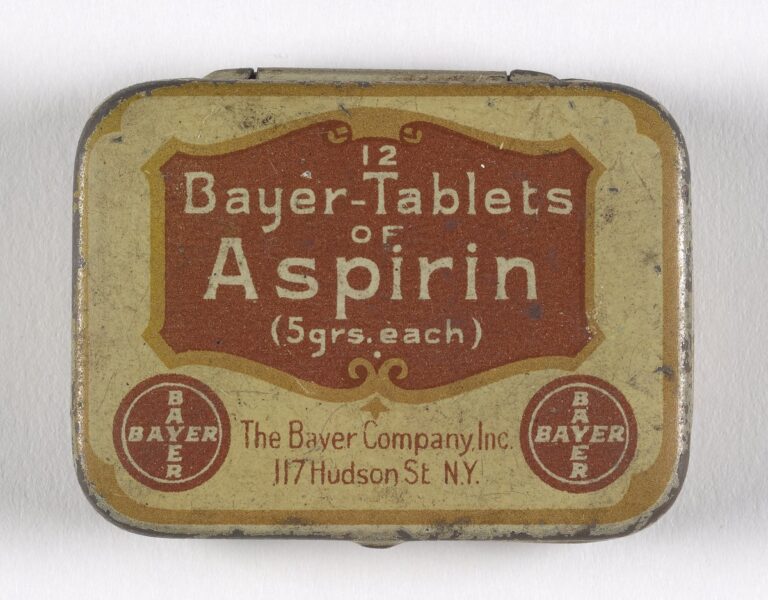
"Goldberg, Daniel R. A Bayer aspirin tin, undated. Aspirin: Turn-of-the-Century Miracle Drug, "
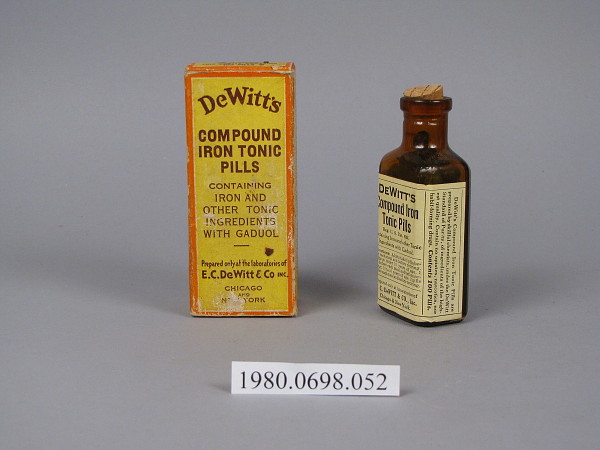
"The indications or uses for this product as provided on its packaging: To increase the reserve stock of iron and to improve nutrition. They are also a stomachic tonic and by their stimulating action improve the appetite and digestion in nervous dyspepsia. 1935. Dewitt's Compound Iron Tonic Pills,"
"And one man who found out what he had drove over to Montgomery to a clinic to get treated. And the doctors had him chased and brought back and warned the clinic that if they ever treated another subject from Tuskegee, they would lose their federal funding."
Jean Heller
Researchers ensured that none of the study’s subjects were drafted during World War II to prevent their syphilis from being detected and treated. Even when penicillin became widely available as an effective drug for the disease in 1945, men in the study did not receive treatment.
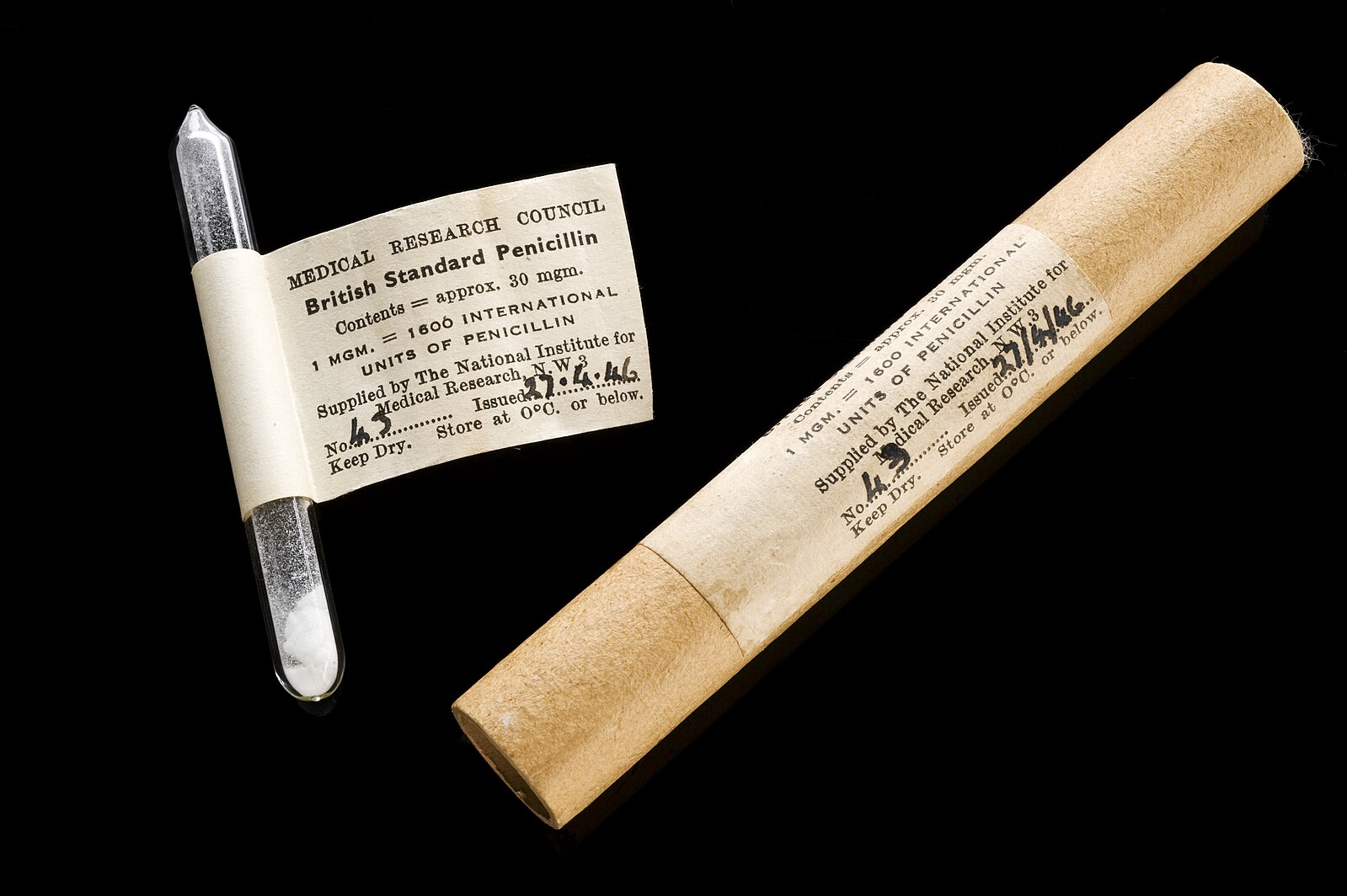
"Glass phial of British Standard penicillin, London, England, Wellcome L0059573.jpg. File:Glass phial of British Standard penicillin, London, England, Wellcome L0059573.jpg, "
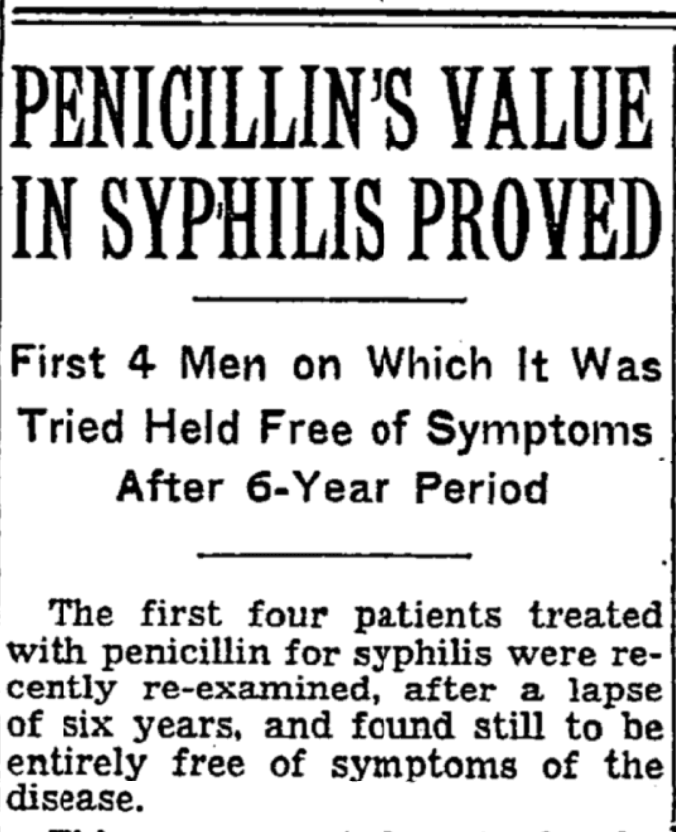
"New York Times. “Penicillin’s Value in Syphilis Proved.” The New York Times, 16 December 1949,"
The 1947 Nuremberg Codes and the 1964 Helsinki Declaration provided codes for medical ethics, but the study went on.

"The Helsinki Accords, the final act of the Conference on Security and Co-operation in Europe, which was signed in Helsinki in 1975 by the US, Canada and 33 European countries. Exhibited in the House of History in Bonn. 1 August 1975. Category:Helsinki Accords,"
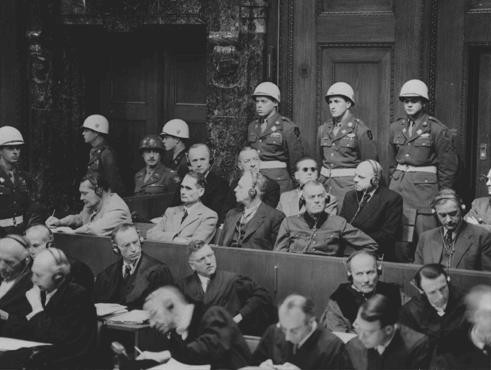
"National Archives and Records Administration, College Park, MD. The defendants listen as the prosecution begins introducing documents at the International Military Tribunal trial of war criminals at Nuremberg. November 22, 1945. 22 November 1945. The prosecution introduces documents at the International Military Tribunal,"
For decades, the study’s unethical practices went unchallenged, even as concerns of the study’s violations of the state law that required the reporting and treatment of sexually transmitted diseases arose.
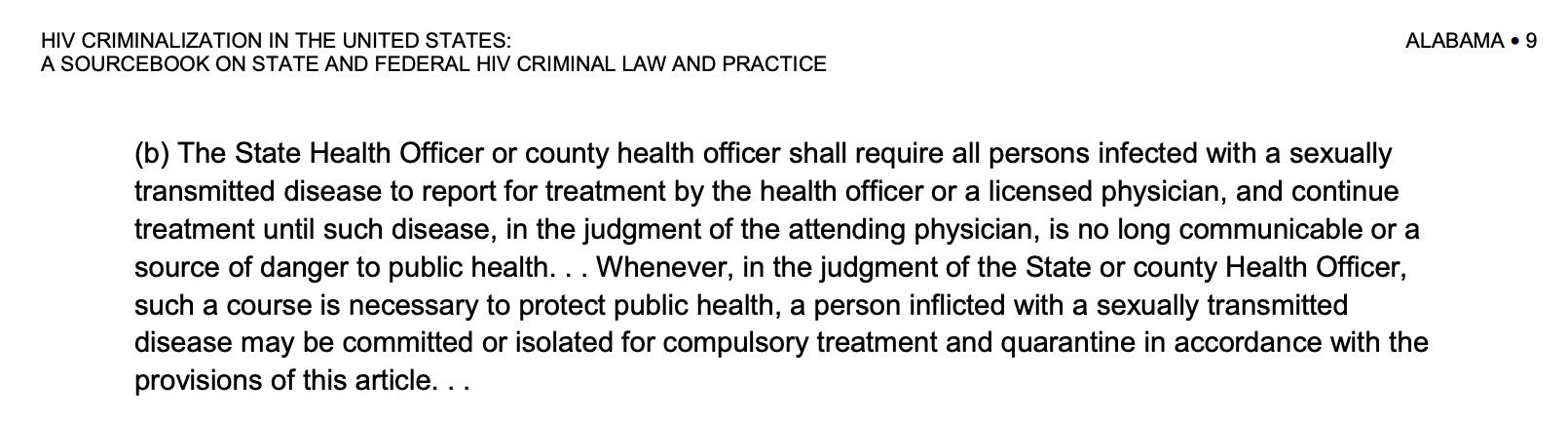
"The Center for HIV Law and Policy. HIV Criminalization in the United States: A Sourcebook on State and Federal HIV Criminal Law and Practice."
"At the beginning he thought he had "bad blood". They said that was syphilis. (He) just thought it was an "incurable disease." He was booked for Birmingham for "606" shots but "nurse stopped it." Some doctor took blood that time and he was signed up to go to Birmingham. Nurse Rivers said he wasn't due to take the shots...he went to get on the bus to Birmingham and they turned him down. This was some time between 1942-1947."
- Unnamed Participant of the Tuskegee Syphilis Study
It wasn’t until Peter Buxton, a social worker and epidemiologist working for the CDC, took note of the unethical practices of the study. This led the CDC to call a meeting in 1969 to discuss whether the study should be terminated. However, the researchers downplayed the ethical concerns, dehumanizing the men to study subjects.
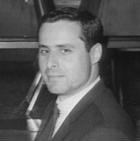
“Peter Buxtun.”, Wikipedia,
"As I see it, we have no further interest in these patients until they die."
- Surgeon O. C. Wenger
"The group is 100% Negro. This in itself is political dynamite."
- Buxtun
Buxton eventually put a stop to the Tuskegee Syphilis Study by providing Jean Heller information that was published into a story on July 25, 1972. A study that was intended to last only 6-9 months ended up lasting for 40 years, with 128 participants dead, 40 wives infected, and 19 children born with congenital syphilis.
"It was toward the end of the evening in that library downtown, and I thought: I’ve got to do something."
- Buxtun
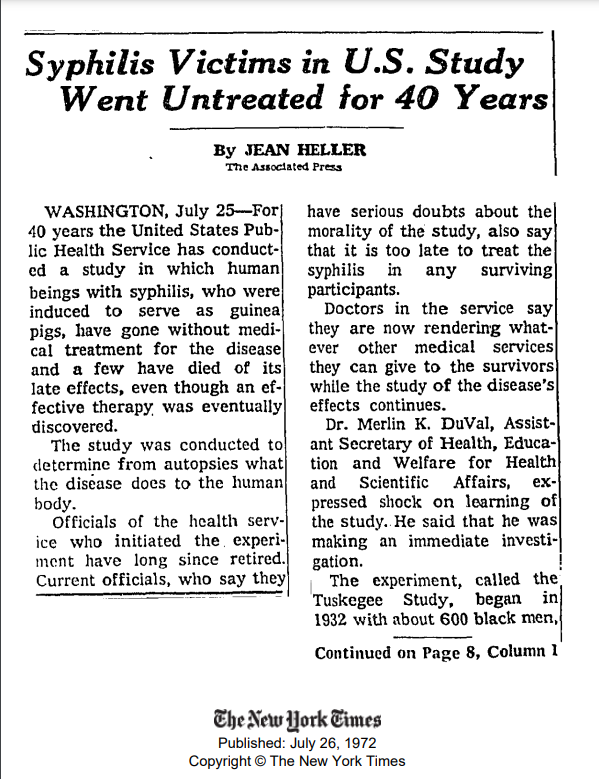
"The New York Times, and Jean Heller. “Syphilis Victims in U.S. Study Went Untreated for 40 Years.” 26 July 1972,"
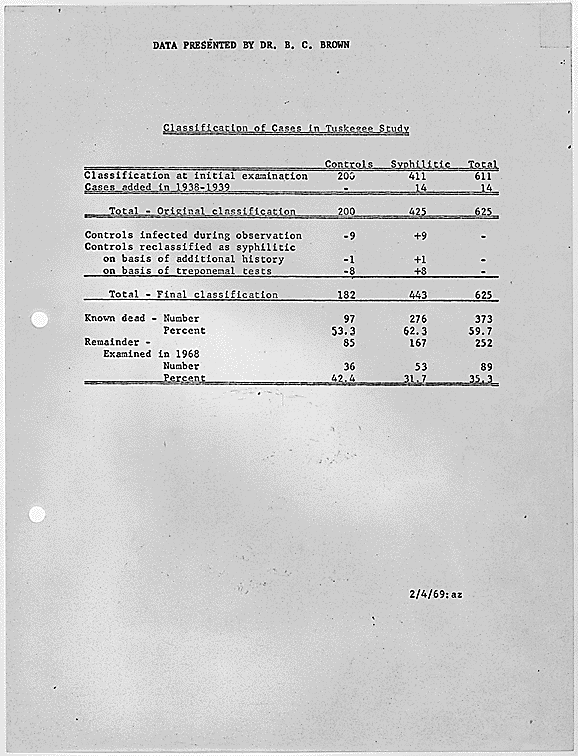
"Tuskegee Syphilis Study Administrative Records. 12 February 1969. Table depicting number of participants in the Tuskegee Syphilis Study showing number of patients with syphilis and number of controlled non-syphlitic patients.,"