In the United States, modern, avant-garde, abstract art was widely rejected by political leaders and the public. It was seen as absurd, nonsensical, lazy, and not 'real' art.
Abstract Expressionism:
Cold War Propaganda to Combat Communism
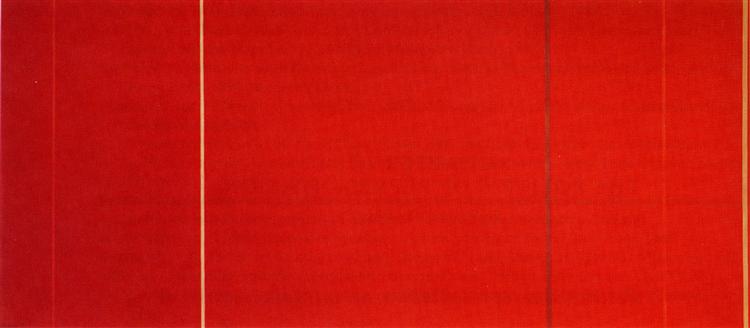
Barnett Newman, Vir heroicus sublimis, 1951
Controversy
"merely the vaporings of half-baked lazy people."
-President Truman
[after seeing abstract art at the United Nations building] “To be modern you don't have to be nuts."
-General Eisenhower
"If that's art, then I'm a Hottentot"
-President Truman
"I am just a dumb American who pays taxes for this kind of trash"
-U.S. Congressman
"Four works-- and what are they? A drawing of a baseball game by Ben Shahn called "National Pastime"; a skating scene by Kuniyoshi and another winter view by Leon Kroll; an elderly fisherman by William Zorach. Subversive as all get out, eh?"
-Aline B. Saarinen, New York Times
Struggle to Get Overseas
In 1947, the State Department organized and funded an international touring exhibition entitled "Advancing American Art", in an attempt to refute Soviet claims that America was a cultural desert. However, the exhibit never made it out of the U.S. after Truman's Hottentot comment and the Congressman's statement.
Later, in May 1956, a show of paintings by American artists titled Sport in Art, organized by Sports Illustrated for the United States Information Agency (USIA), was scheduled to be shown at the Olympic Games in Australia. This exhibit did not leave the country because the Patriotic Council, a right-wing group in Dallas, Texas, objected to the exhibition since four of the included artists had been part of communist-front groups in the past.
In June 1956, another international exhibit called "100 American Artists" was abruptly cancelled by the USIA since the American Federation of Arts refused to exclude ~10 artists the USIA considered "social hazards" and "unacceptable" because of their prior links to the Communist Party.