Interview with Dr. Terry Huang, Clinical Director, Department of Anesthesiology, CHI Health Creighton UMC, Assistant Professor, Creighton University School of Medicine, courtesy of Amelia Cheng, Zoom interview
It took decades to refine modern anesthesia. Lack of standard procedures and initial experimental failures caused skepticism in the process.
"Like every branch of medicine, the discovery and study of anesthesia has been a long one, full of twists and turns, dead ends, weird ideas and incredible innovation."
-Philip Lederer (Sarasota Memorial)
The Start: Ether
While ether, the first anesthetic proved effective at reducing pain, it also posed serious risks. As a highly flammable substance, it could ignite in operating rooms that relied on open flames for lighting, highlighting the need for safer anesthetics.
"While ether was effective as an anesthetic, it did have its shortcomings. It was highly flammable, and once it was released into the air, it could easily cause explosions. As well as this, patients often felt a chocking sensation, and because the onset could last up to 15 minutes, the patients had to be held down. The odor of ether was often found irritating as well."
-Josh Bicker
"The first recorded fire resulting from the use of an anaesthetic agent occurred in 1850, when ether caught fire during a facial operation."
-British Journal of Anaesthesia
Enter: Chloroform
Chloroform, discovered by James Simpson in 1847, was another gas found to have anesthetic properties. Simpson began to use it to dull labour pains. After successfully administering chloroform to Queen Victoria during childbirth, his pamphlet describing chloroform’s uses received the royal seal of approval.
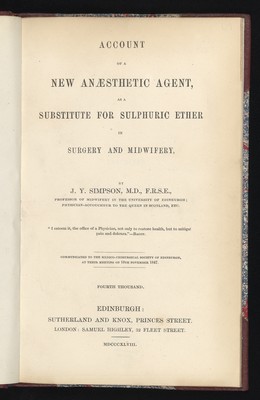
James Simpson's "An Account of a New Anaesthetic Agent, as a Substitute for Sulphuric Ether in Surgery and Midwifery" [Wellcome Collection].
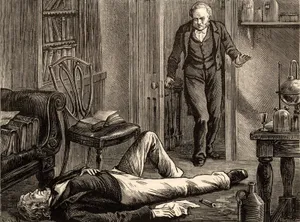
Scottish obstetrician Sir James Young Simpson, unconscious following an experiment with chloroform, in a lithograph by Edwin Hodder, c. 1880. Simpson first tested the anesthetic properties of chloroform on a patient in 1847. [Britannica]
"In no case could it be justifiable to administer chloroform in perfectly ordinary labour; but the responsibility of advocating such a proceeding in the case of the Sovereign of these realms would, indeed, be tremendous"
-James Simpson
Overdoses of chloroform, however, could be fatal. Eventually, surgeon John Snow created an inhaler enabling precise administration of chloroform, although it required great skill to use. As a result, surgeons and scientists began seeking safer alternatives.
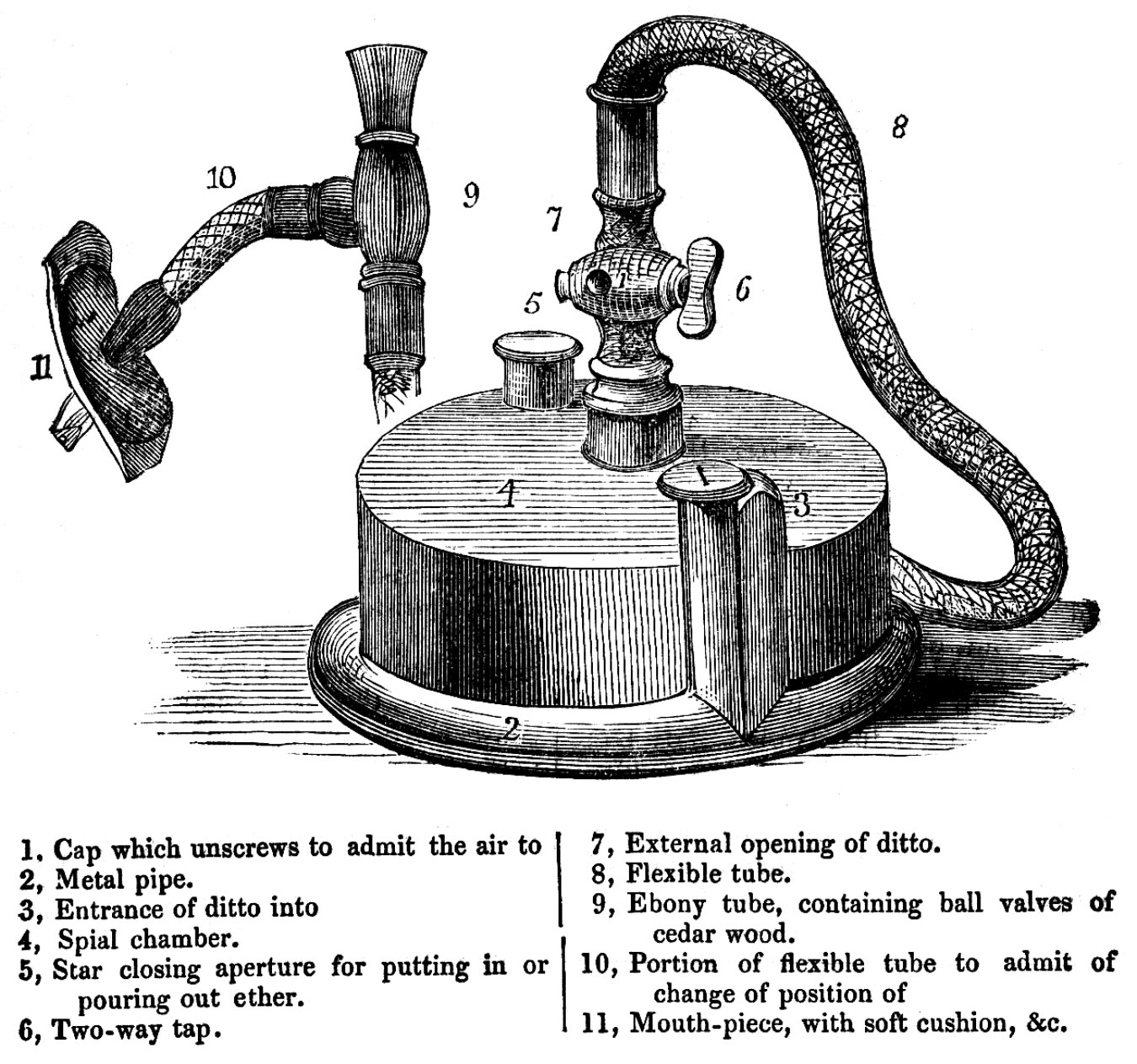
Snow's first modification of his inhaler. [The John Snow Archive and Research Companion].
"Hannah Greener of Winlaton, near Newcastle in the United Kingdom, died more than 150 yr ago, on January 28, 1848, after receiving a chloroform anesthetic for the removal of a toenail. She was a healthy 15-yr-old girl who had successfully undergone an anesthetic with diethyl ether several months before for the removal of another toenail. Hers was the first death attributed to the new and wondrous blessing of anesthesia for surgical pain relief."
-Semantic Scholar
“It will be remembered that Dr. Simpson recommended the general use of undiluted chloroform very quickly after its existence was made known to him by Mr. Waldie, and that amongst the advantages which he stated that chloroform possessed over sulphuric ether was this, that it requires no particular apparatus on its administration. There can be no doubt that this was a great error. Chloroform being more powerful, when inhaled, than any other agent which has been used in a similar manner […] particularly requires mechanical means for its regulation.”
-John Snow (The First English Anesthetist)
Nitrous Oxide: A Safer Alternative
Nitrous oxide (laughing gas) was discovered by Joseph Priestley in 1772. It was mainly used during parties, where guests who inhaled it would act strangely. In 1844, dentist Horace Wells started investigating whether laughing gas affected pain. Using it on himself, he successfully extracted his molars. However, during his public demonstration, the gas failed to take full effect, leading to widespread skepticism. This slowed the acceptance of anesthesia.
"He [Wells] became intrigued when one of the volunteers, while still under the effects of the gas, injured his leg as he stumbled into some nearby benches. Wells noticed that the man was completely unaware of his injury because he was feeling no pain."
-Cornerstone Dentistry
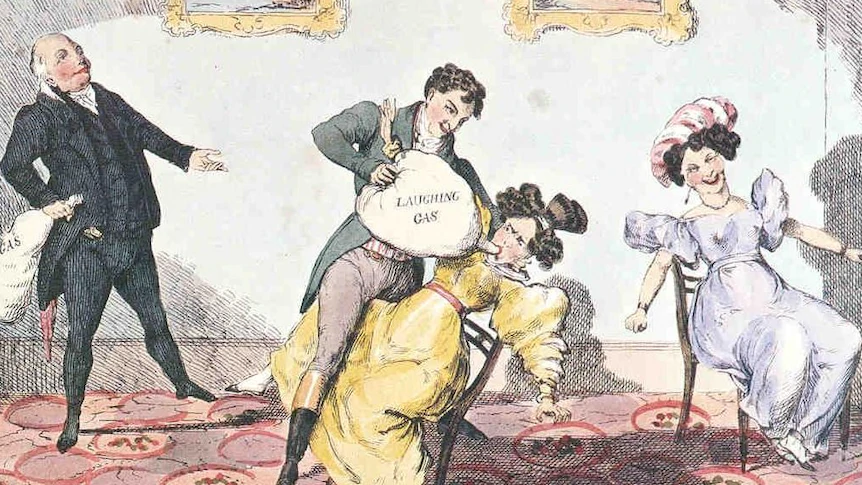
Nitrous oxide frolics led to one of the most significant medical advances of the 19th century. (National Library of Medicine, London)
"The discovery of the sedative and pain killing effects of the gasses nitrous oxide and ether revolutionized the practices of medical and dental surgery."
-Cornerstone Dentistry
Despite setbacks, additional demonstrations such as William Morton’s sparked a worldwide revolution in the medical industry, and the world started to accept the idea of anesthesia.
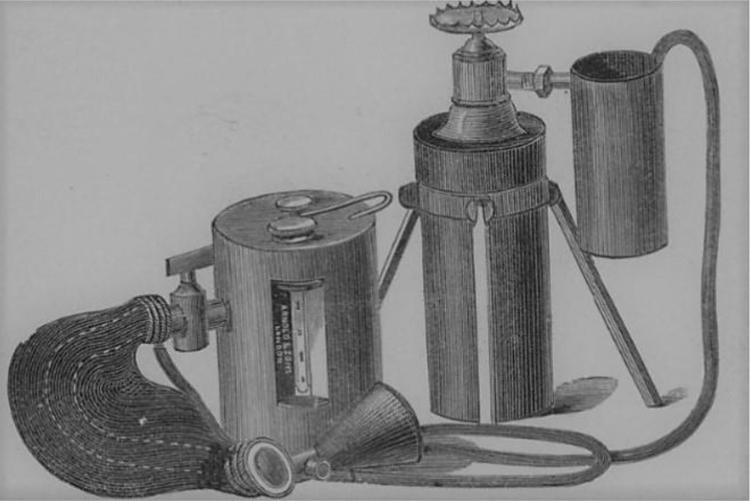
Clover's nitrous oxide/ether apparatus (1876). Manufacturer's catalogue, p. 325. Public Domain. [Credit: Wellcome Collection. CC BY].
"In a further development, Clover manufactured a nitrous oxide/ether apparatus in 1876, which was the first attempt to sequence the administration of these anesthetic gases [ether and laughing gas]."
-National Library of Medicine
"Thus, the anesthesia could be induced with nitrous oxide and later maintained with the ether vaporizer, a method that was less disagreeable for the patient."
-National Library of Medicine
The pairing of inhalers with anesthetic gases like laughing gas led to more precise doses, resulting in widespread adoption.