The seeds of the 1980s farm crisis were sown during the 1970s due to political and economic factors, combined with existing technological changes. This sparked an agricultural boom and unprecedented expansion by producers, which later put them in peril.
1970s: Boom
1977 Crop Failure (Des Moines Register Photo Archive)
(Lancaster Farming, 3 December 1977)
Politics
During the early 1970s, concerns regarding agricultural stockpiles and low commodity prices diminished as drought problems overseas prompted grain contracts between the U.S. and Soviet Union. As U.S. agricultural product demand and profits exploded, U.S. Secretary of Agriculture Earl Butz called on farmers to plant "fencerow to fencerow" and to "get big or get out."
-Earl Butz, U.S. Secretary of Agriculture (Associated Press Archive, 31 December 1975)

(TIME, 6 November 1978)
Favorable Economics
Due to political pressure and prospective profitability, farmers eagerly grew their operations. Lenders further encouraged expansion by offering easy credit to optimistic farmers, as both mistakenly viewed these conditions as the new normal. Thus, farmers borrowed excessively by leveraging existing farmsteads as collateral to purchase additional land and equipment.
"If a farmer went to his lender to take out a modest loan, the lender would encourage him to borrow more, to take advantage of the land boom and be a progressive, modern farmer."
-Marty Strange, Center for Rural Affairs Spokesman (The Cedar Rapids Gazette, 20 June 1985)
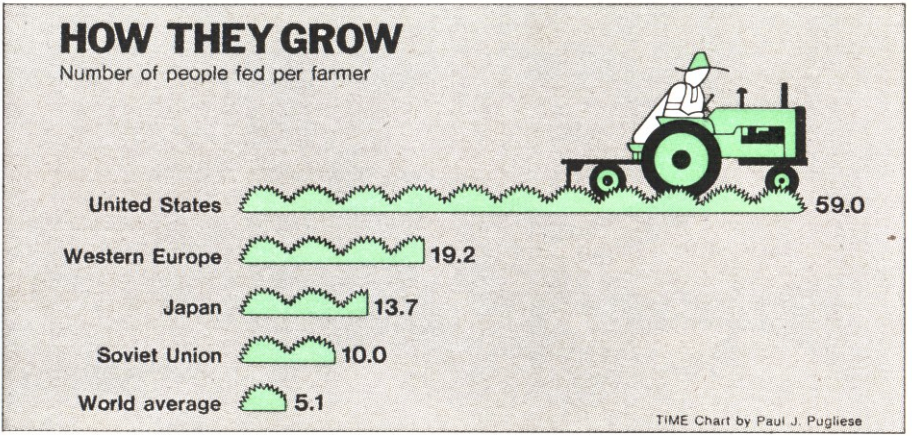
(TIME, 6 November 1978)
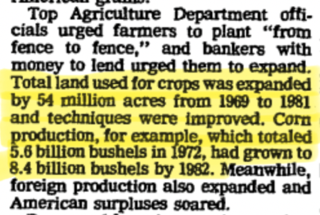
(New York Times, 10 February 1985)
"My dad had taught me to be cautious, but everybody—I mean everybody—was saying that biggest had become best."
-Jim White, Farmer in Pleasantville, Iowa (The Atlantic, July 1985)
However, overexpansion and changing credit conditions quickly turned prosperity to crisis in the 1980s.