Prelude to the uprising

Prelude to the Uprising

In the GDR, there was mounting unrest amongst the working class due to high prices and poor living standards; This unrest put pressure on the SED and Moscow, as discontent among workers was slowly building up to a tipping point.

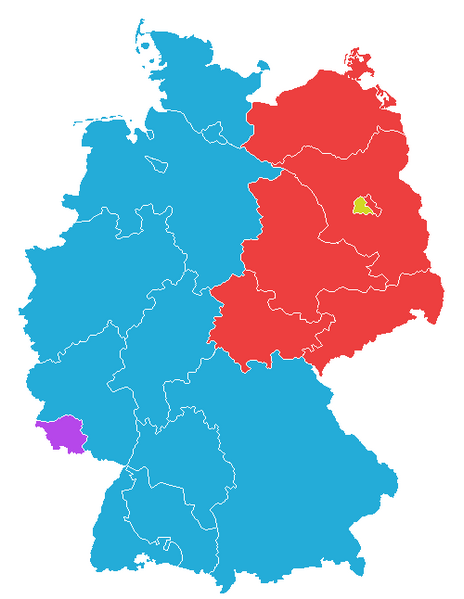
(Wikimedia Commons, Deutschland Bundesländer 1949)

Following World War II, Germany was divided into East Germany (red) and West Germany (blue). Berlin was also divided into West Berlin (yellow) and East Berlin (red).

Britain, France, and the United States had control over West Germany and the Soviet Union had control over East Germany.

The Soviets had “hopes for the traditional German virtues of hard work and discipline in their own zone of occupation”

Kopstein, Chipping Away at the State: Workers' Resistance and the Demise of East Germany
However, “By the summer of 1947, East German labor productivity remained at less than half of its 1936 level” and “into the early 1950s, despite their best efforts, the SED [Socialist Unity Party of Germany] had still not gained control over the [working class].”

Kopstein, Chipping Away at the State: Workers' Resistance and the Demise of East Germany

“In July 1952 under the slogan of ‘building socialism’ the East German regime began to accelerate the sovietization of the economy.”

Probable Developments in Eastern Germany Through 1955

“as a result of…the construction of socialism…there began to rise…ever-increasing interruptions in the supply of goods of basic necessity

Sokolovskii et al. (Sokolovskii, Semyonov, Yudin) On the Events of 17-19 June 1953 in Berlin and the GDR and Certain Conclusions from these Events

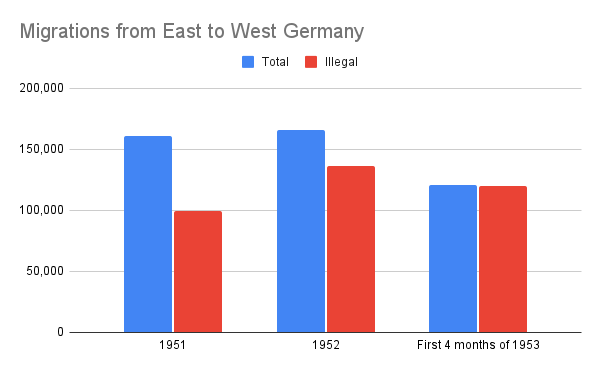
"the departure of the population from the GDR [German Democratic Republic] to West Germany is growing"

Chuikov et al. memorandum to Georgii Malenkov

“in November 1952, West German newspapers reported sporadic food riots and industrial unrest in the…GDR”

Kopstein, Chipping Away at the State: Workers' Resistance and the Demise of East Germany

Student creation, data from Chuikov et al. 

Vasilii Sokolovskii was Chief of the General Staff, the highest ranking officer in the Soviet army. Vladimir Semyonov was Chief Commissar of the USSR in Germany and an ambassador to the GDR. Pavel Yudin was Deputy High Commissioner of the USSR in East Germany.

Vasilii Chuikov was Chief of the Group of Soviet Forces in Germany. Ivan Il'ichev was Head of the Soviet Diplomatic Mission to the GDR. Gerogii Malenkov was the Premier of the Soviet Union.

"These signs of growing dissatisfaction among the population were ignored by the party and state leadership. If anything, they gave the regime another means to reinforce its Sovietization policy"

Ostermann, The United States, the East German Uprising of 1953, and the Limits of Rollback
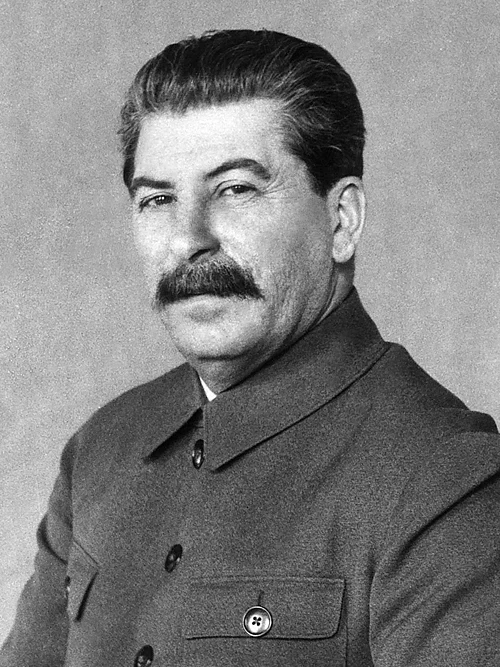
Abbe, James: portrait of Joesph Stalin

On March 5th, 1953, Stalin died. New Soviet leadership was less harsh in their policies.

Ostermann, Uprising in East Germany 1953

"Soviet exactions in the form of reparations and occupation costs have kept the scale of living more than 20 percent below prewar levels."

Probable Developments in Eastern Germany Through 1955

Due to wage inflation, the Resolution of the 13th Meeting of the Central Committee of the SED stated the "regulation of work quotas" was "unsatisfactory" and called for "an increase in work quotas in areas critical to production by an average of at least 10% by June 1, 1953"

Resolution of the 13th Meeting of the Central Committee of the SED (May 14, 1953)

The increased quotas coincided with “increases in prices” and "Taken together, the norm and price increases amounted to a 33 percent monthly wage cut."

Kopstein, Chipping Away at the State: Workers' Resistance and the Demise of East Germany

On June 2, a USSR Council of Ministers order "recognize[d] the course of forced construction of socialism in the GDR…as mistaken under current conditions.”

USSR Council of Ministers Order, 'On Measures to Improve the Health of the Political Situation in the GDR'

“Under pressure from the new Kremlin leadership...the SED leadership finally announced on June 9 a change of economic policy”

Grabas, 17 June 1953 – The East German Workers' Uprising as a Catalyst for a Socialist Economic Order
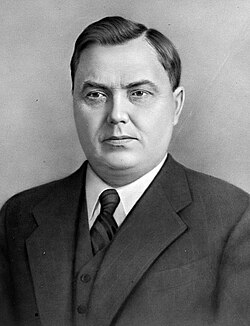
(WIkimedia Commons- Georgy Malenkov, Stalin's successor)

“This 'New Course' was oriented towards a slowing…industrialization, coupled with an improvement in people's living conditions. One strategic mistake was that …workers…profited from this policy change only indirectly”

Grabas, 17 June 1953 – The East German Workers' Uprising as a Catalyst for a Socialist Economic Order

“The SED…curiously, did not rescind the industrial norm increase”

Kopstein, Chipping Away at the State: Workers' Resistance and the Demise of East Germany

Previous
Next