Negative_Aspects
Research

Negative Notions

"Children with disabilities are among the World's most marginalized and excluded children."

~Word Health Organization, World Bank, 2011

"I believe that “special” has become a euphemism for “separate.” When we create a separate, “special” places for children where their “special needs” can be met, we are teaching them that their place is over there, with people like them and not in the full community."

~Torrie Dunlap, CEO of Kids Included Together

 Although most aspects of the Special Olympics have been beneficial to the intellectually disabled, some experts fear that the organization's efforts may actually undermine their intended goals.  Such arguments include the promotion of pity, segregation, and child-zation of the adult participants. Connections can be drawn between these arguments to how some people feel superior to their disabled counterparts.

"When young, impressionable children are taught that their needs are too great, that they are too different and that they don’t fit our very narrow definition of “normal” this has a life long affect on their ability to contribute positively to society."​​​​​​​

~Torrie Dunlap, CEO of Kids Included Together

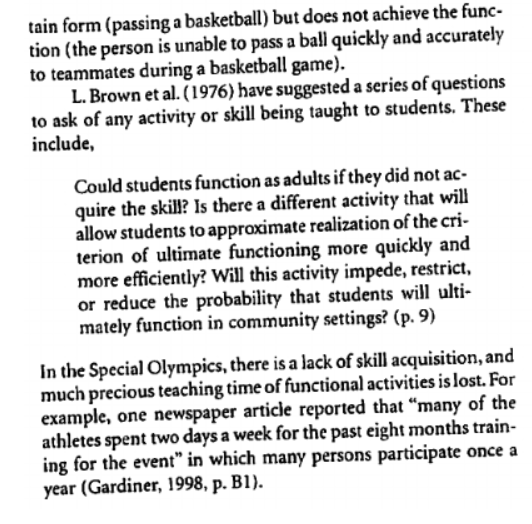
Document by Keith Storey, Clinical Director at Juvo Autism and Behavioral Health Services.

Courtesy of Research Gate 

Document by Keith Storey, Clinical Director at Juvo Autism and Behavioral Health Services.

Courtesy of Research Gate

Document by Keith Storey, Clinical Director at Juvo Autism and Behavioral Health Services.

Courtesy of Research Gate

“The adult participants in the Special Olympics are often perceived as children because both children and adults compete at the same event, which often leads to the infantilization of adults with disabilities. This infantilizations leads to participants’ being denied adult status and dignity...Each of the following quotes labels adults with disabilities as children, this reinforcing this stereotype for the general public.”

~Courtesy of The Case Against the Special Olympics by Keith Storey, Special Education Expert

"In the case of the Special Olympics, the dominant hegemanic viewpoint is evident in the competing as athletes capable of success, the Special Olympics and its resultant media coverage perpetuates the social 'reality' of people who are incompetent and in need of protection and pity in order to be successful."

~Courtesy of Katie Windlemeese, Pity the Special Olympics

"Smart (2001) reviewed research indicating that superficial and causal interactions, such as those that occur in the Special Olympics between people with and without developmental disabilities, do not lead to a reduction in prejudice and may actually reinforce negative stereotypes regarding people with disabilities. As Johnson (2003) noted, events such as the Special Olympics foster the “us against them” attitude (with “them” being people with disabilities), and there has been a backlash against disability rights in part due to people with disabilities being in segregated setting and events and not being part of mainstream society...The Special Olympics stand in contrast with efforts to integrate people with disabilities into normalized recreational settings (Schleien et al.,1993;Schleien, Green & Stone, 1999; WIlliams & Dattilo, 1997)."

~Courtesy of The Case Against the Special Olympics by Keith Storey, Special Education Expert

Courtesy of Rachel Rodriguez, parent of a child with autism and former Special Education teacher.