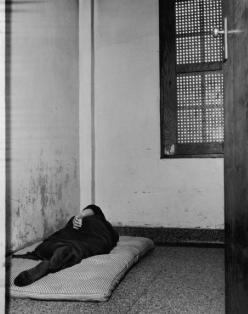
A patient lying on a thin matress in a barren room inside of
Cleveland State Mental Hospital 1946.
Courtesy of Jerry Cooke
 Research
"For more then any other type of illness, mental disorders are subjected to negative judgements and stigmatization...patients not only have to cope with the often devastating effects of their illness, but also suffer from social exclusion and prejudices."
~National Library of Medicine
Imprisoned, exploited and isolated. These were some of the common abuses endured by the intellectually disabled during the 20th century.
“Jail was preferable. There they only limited you physically. In a mental ward they tampered with your soul and worldview and mind.”
~John Kennedy Toole
Institutions, designed to lock away anyone who didn’t fit society’s standard of “normal”.
A patient lying on a thin matress in a barren room inside of
Cleveland State Mental Hospital 1946.
Courtesy of Jerry Cooke
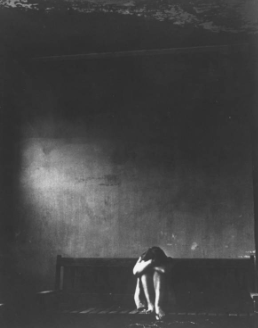
A patient sitting inside a dark room in Ohio's Cleveland State Hospital, February 3, 1955.
Courtesy of Jerry Cooke
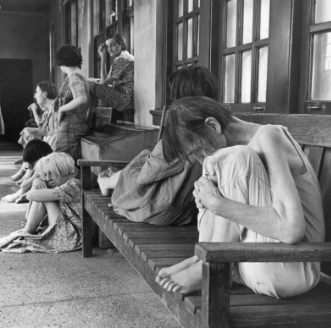
Patients sitting inside of Ohio's Cleveland State Mental Hospital, 1946.
Courtesy of Mary Delaney
“I remember well one state institution we visited served years age. There was an overpowering smell of urine from clothes and from the floors. I remember the retarded patients with nothing to do, standing, staring, grotesque-like misshape statures. I recall other institutions where several thousand adults and children were housed in bleak overcrowded wards if 100 or more, living out their lives on a dead-end street. Unloved, unwanted, some of them strapped in chairs like criminals.”
~Eunice Kennedy Shriver, Courtesy of
For centuries these buildings of insanity have ruined the lives of the intellectually disabled. The rooms were barren and overcrowded. Basic human resources were often scarce. Dangerous people also lurked in these unsanitary conditions.
"Those who had beds usually slept two or more to a mattress, lying head to foot. If someone misbehaved they were tied to their bed or kept in a locked room. Patients were not separated by age or sex and often included sex offenders. In 1948, the only year figures are available, its death rate was far higher than its discharge rate and the hospital averaged only one doctor for every 225 patients."
~Victoria Brignell, Courtesy of NewStatesman
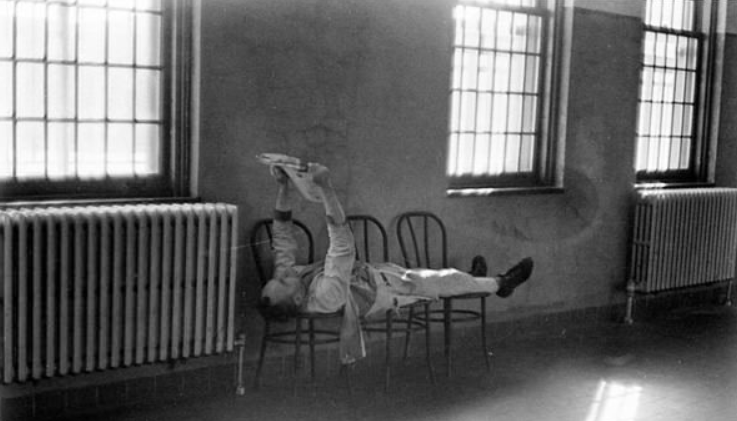
Patient inside of Pilgrim State Hospital, 1936, taken by Alfred Eisenstaedt
Courtesy of Opacity
Pilgrim State Hospital, 1936, by Alfred Eisenstaed
Courtesy of Opacity
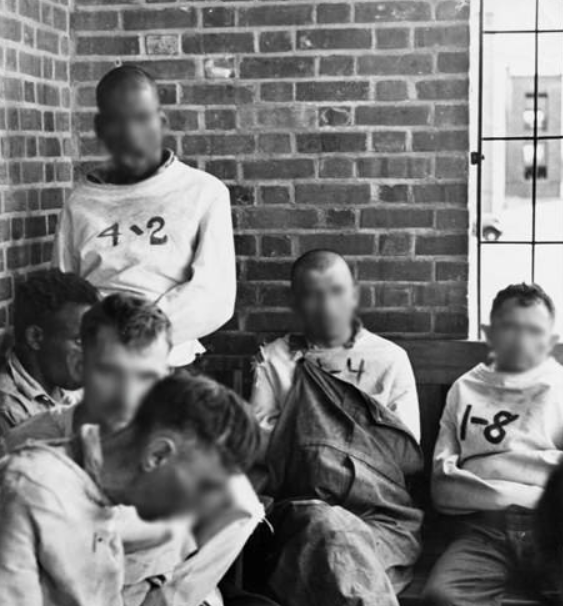
Patients inside Pilgrim State Hospital, 1936, by Alfred Eisenstaed
Courtesy of Opacity
The care provided to the intellectually disabled was almost torturous. These barbaric treatments included lobotomies, electroconvulsive therapy, and insulin shock therapy. Other attempted treatments included the use of LSD and the deprivation of basic needs.
“It is important to remember there were doctors as late as the 1980s who categorized feeding a baby with Down syndrome as a “lifesaving procedure” and proceeded to starve babies to death with Down syndrome and other intellectual and developmental disabilities until all 50 state governors created legislation to ban this horrific practice.”
~Courtesy of the Global Down Syndrome Foundation
"Between 1960-1965 scientists investigated the use of LSD-25, a serotonin-inhibiting drug, as a treatment for autism. The idea behind using drugs to treat autism is based on the concept that autism is a personality and therefore the drugs are meant to alter the person’s perceptive state."
~Courtesy of The Evolution of the Treatments of Autism
"It is important to remember people with Down syndrome and other intellectual disabilities were systematically physically and sexually abused through forced sterilization."
~Courtesy of the Global Down Syndrome Foundation
"In insulin coma treatment, initially 10 to 20 units of insulin are given, and up to 1000 3 units are given subcutaneously. The daily dose of insulin is increased until that point when the patient reaches a semi-comatose stage with facial twitching of muscles. The degree of hypoglycemia can be judged by the extent to which the patient sweats – which can be considerable with rising pulse rate. An accidental occurrence of seizures in the process can be terminated by the intravenous administration of glucose. The treatment is continued daily and patients are given 30 to 40 insulin comas. In this way, insulin coma treatment may be considered similar to Electroconvulsive treatment."
~Courtesy of Insulin Coma Treatment: Facts and Controversies by Professor Shridhar Sharma
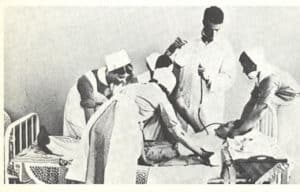
Patient undergoing insulin shock therapy while the attendant pours glucose into a feeder tube.
Courtesy of History Collection
"Comas were induced on five or six mornings a week. Typically, the third dose of insulin was 10-15 unites with a daily increase of 5-10 units until the patients showed severe hypoglycaemia."
~Courtesy of Journal of the Royal Society of Medicine
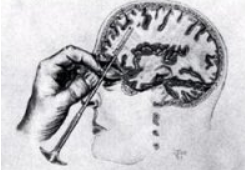
“As those who watched the procedure described it, a patient would be rendered unconscious by electroshock. Freeman would then take a sharp ice pick-like instrument, insert it above the patient’s eyeball through the orbit of the eye, into the frontal lobes of the brain, moving the instrument back and forth. Then he would do the same thing on the other side of the face.”
~Courtesy of NPR
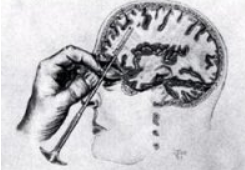
Diagram of a lobotomy
Courtesy of Duke Education
"The procedure leaves him in a vegetative state. Upon his return to the ward, another patient, Chief, remarks that 'There's nothin' in the face. Just like one of those store dummies.'"
~Courtesy of HowStuffWorks
This atrocious behavior wasn’t just confined in the walls of the institutions either. The social stigma surrounding the intellectually disabled created an oppressive environment. Extra measures were taken to isolate the intellectually disabled, even laws were enforced to fine those found outside.
"Any person who is diseased, maimed, mutliated or in any way deformed so as to be an unsightly or disgusting object, or an improper person to be allowed in or on the streets, highways, thoroughfares or public places in this city shall not therein or thereon expose himself or herself to public view under penalty of one dollar for each offense. On the conviction of any person for a violation of this section, if it shall seem proper and just, the fine provided for may be suspended, and such person detained at the police station, where he shall be well cared for, until the can be committed to the county poor house."
~Courtesy of America's Ugly Laws
Intellectual disabilities affected by the Ugly Laws:
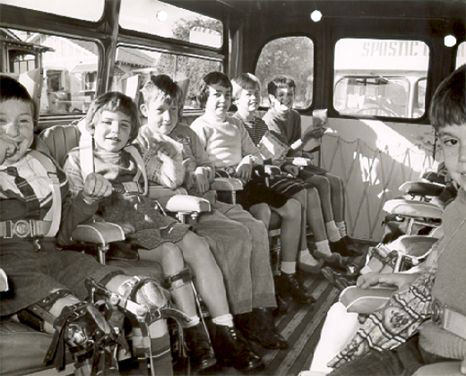
Children with cerebral palsy going to school, 1950s.
Courteys of Birth of the Associations
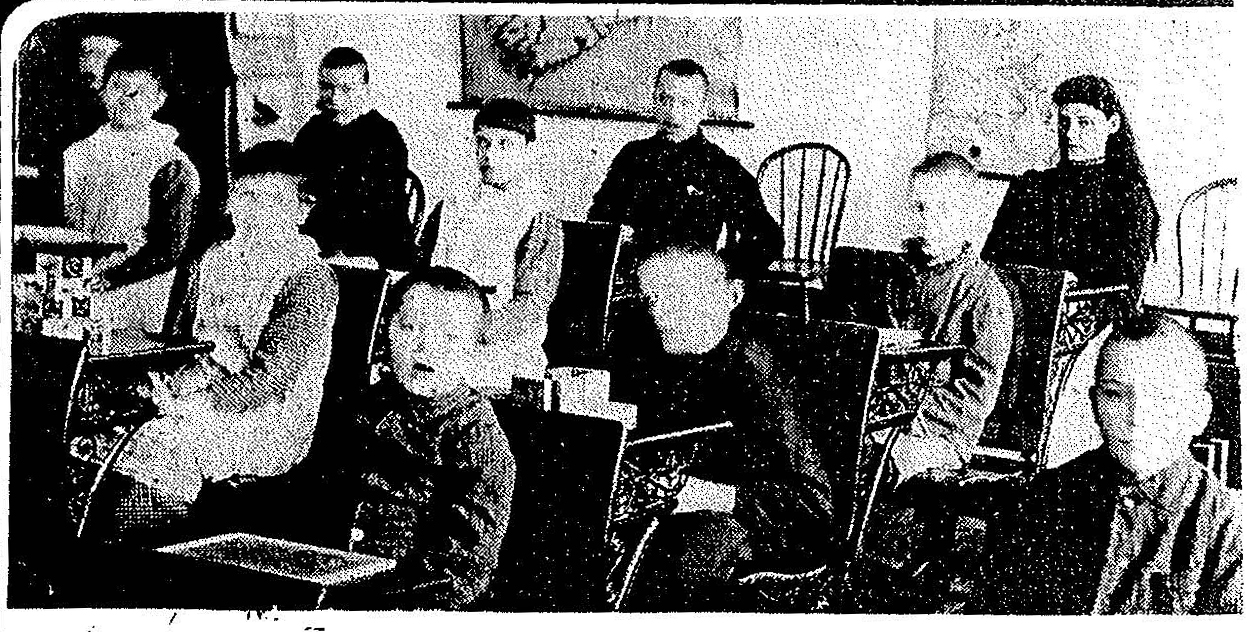
Children in the Idiot Aslyum school.
Courtesy of Archives of Ontario
There were separate schools for those with intellectual disabilities known as special schools. These schools had inadequate resources and often left the intellectually disabled very far behind those who were not disabled. They ripped the young children away from their parents for full semesters and kept the intellectually disabled students at a far distance from anyone else which dwindled their social skills. These conditions made it extremely difficult for anyone with an intellectual disability to acquire any skill needed for a job or to sustain a stable lifestyle.
"Oh, you know, that kind of belittling kids that can’t do things or that can’t tie their shoelaces or that can’t manage to do something. You know, making derogatory comments about one’s parents and, of course, you’re separated from them so you’re kind of feeling anxious already. So it’s not difficult to reduce a child to tears if someone says, 'Your mum and dad obviously don’t love you if that’s the way you behave now' and all that kind of … it was physical and mental abuse to be honest. You know, it was quite shocking really when I think back to it."
~Peter, a 19th Century Special Education Student
"Such segregated schools equally dissatisfied children with learning difficulties. A narrator in an oral history of special education in Glasgow compared his education in the 1960s with that of his brothers at the local primary school; ‘they had reading and writing where we had things like plastersine’. This poor education disadvantaged disabled children in the labour market. In a study of children born during one week in 1958, 22 % of those ‘ascertained’ as handicapped under the 1944 Act had taken a first job that was unskilled, compared with 9% of all 15-24 year olds. Two-thirds of this ‘handicapped’ group had been unemployed: twice as many as the non-handicapped group."
~Disabled Children and Special Education, 1944-1981 by Anne Borsay
"My only memory is of being taken to the school, and that awful business of parents disappearing, and I can still get upset, when I think of them, leaving me at the beginning of each term, you know. They explained to me so carefully that this was, it was important for me to go to school, and it didn’t mean they didn’t love me, but, you know, going to boarding school at that age is not easy, and it was in Croydon and home was in Manchester."
~Valerie Lang, Special Education Student with Cerebral Palsy, 1939