"The Commission has uncovered that the goals of these secret societies were not merely reformist but inherently criminal, aiming at the subversion of the fundamental laws of the Empire and the person of the Emperor himself."
(Fedorovich)
The Decembrists
Revolution
Reaction
Reform
Annotated Bibliography
Reaction
The Fundamental Laws (1832)
The Fundamental Laws of 1832 in Russia, established by Tsar Nicholas I, were a form of reaction to the rebellion of the Decembrists and their attempt to overthrow the autocracy.
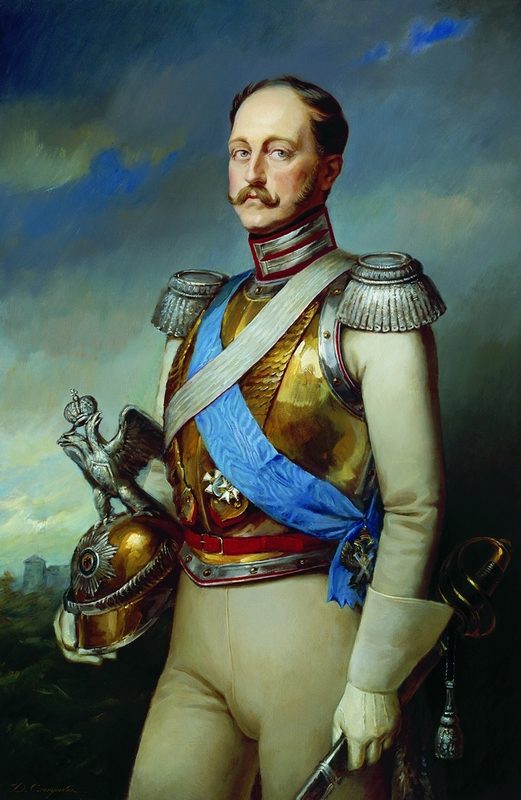
Portrait of Tsar Nicholas I
(TMORA the Museum of Russian Art)
"According to Russia's Fundamental Laws of 1832, "The All-Russian Emperor is an autocratic and unlimited monarch." He had the ability to overcome society more easily than most of his counterparts to the west of Russia simply because the tenets of autocratic thought did not accept the notion that the monarch should consult social groups or other forms of organized societal elements, and institutional constraints on monarchical power did not exist."
(Shakibi)
In his book The Process of the Decembrists, Fedorovich explains the actions of the autocracy from a firsthand point of view.
"The Emperor of All the Russias possesses Supreme Sovereign Power. Obedience to His authority, not only out of fear, but in good conscience, is ordained by God Himself."
("The Fundamental Laws" The Russian Legitimist)
This quote has been slightly changed from its original 1832 version of the Russian Fundamental Laws but still holds the key ideals of the Russian governements reasurment that the Tsar holds all power.
The Report of the Investigative Commission (1826)
The Report of the Investigative Commission issued by Tsar Nicholas I in 1826 fully addresses the Russian government's reaction specifically to the Decembrist Revolt and the secret Decembrist societies.
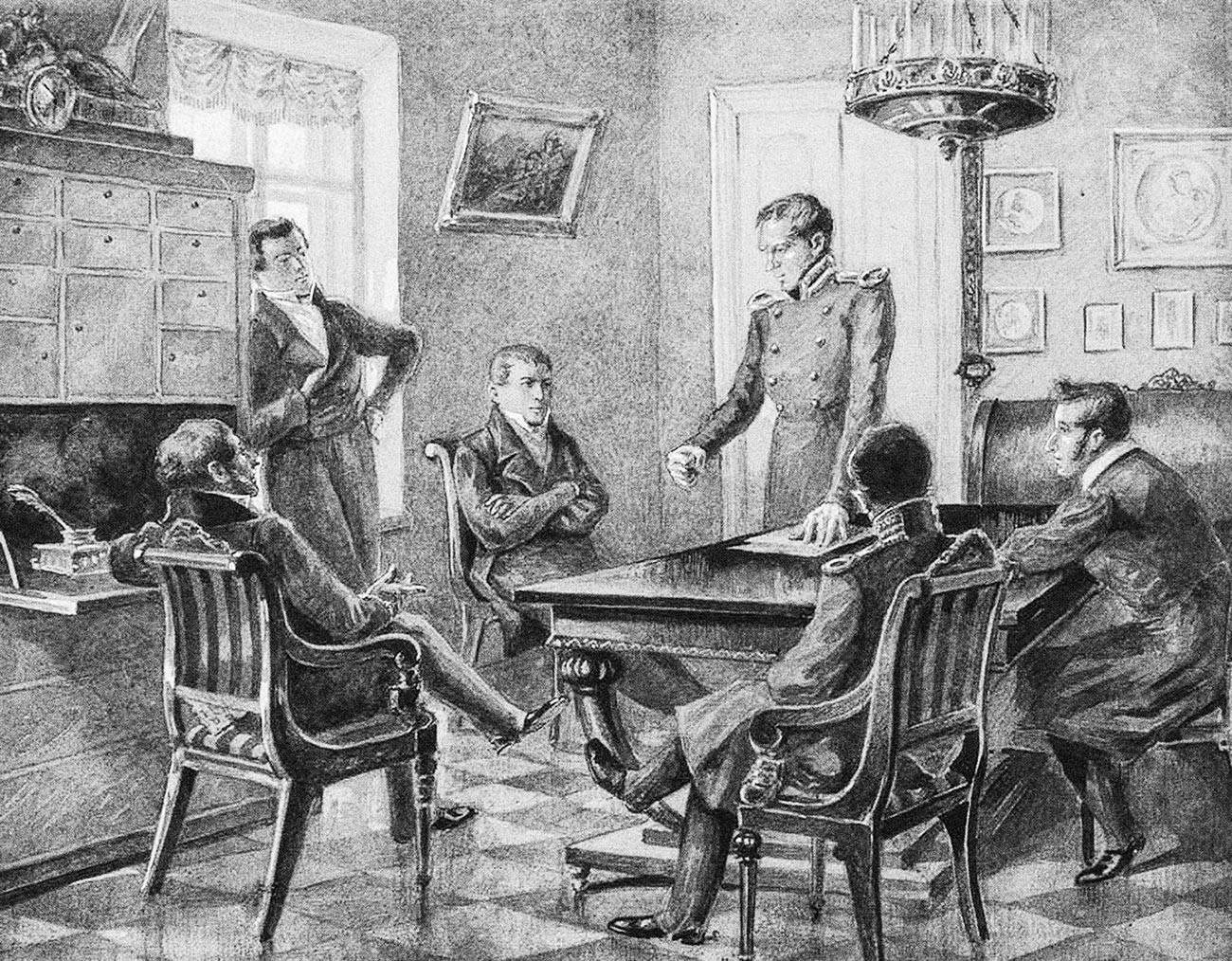
Pavel Pestel's speech at the meeting of the Northern Society of the Decembrists in Petersburg
(Getty Images)
"the existence of such Societies was illegal and contrary to morality... that the consequences are dangerous [and] sooner or later, must result in crimes..."
(Report of the Investigative Commission)
"...supervision of all schools; they were to instill in youth a love for everything native [Russian], hindering as much as possible education abroad and all foreign influence."
(Report of the Investigative Commission)
The Punishments of the Decembrists
The punishment of the Decembrists resulted in the hangings of the organizers and exile of others who were involved.
"These individuals, blinded by the false lights of foreign examples, sought to transplant ideas to Russian soil that are entirely alien to the character and history of our people."
(Fedorovich)
"It is the sacred duty of the Government, while maintaining the spirit of mercy, to ensure that such a betrayal of the Fatherland does not go unpunished, for the sake of the future peace and security of all loyal subjects."
(Fedorovich)
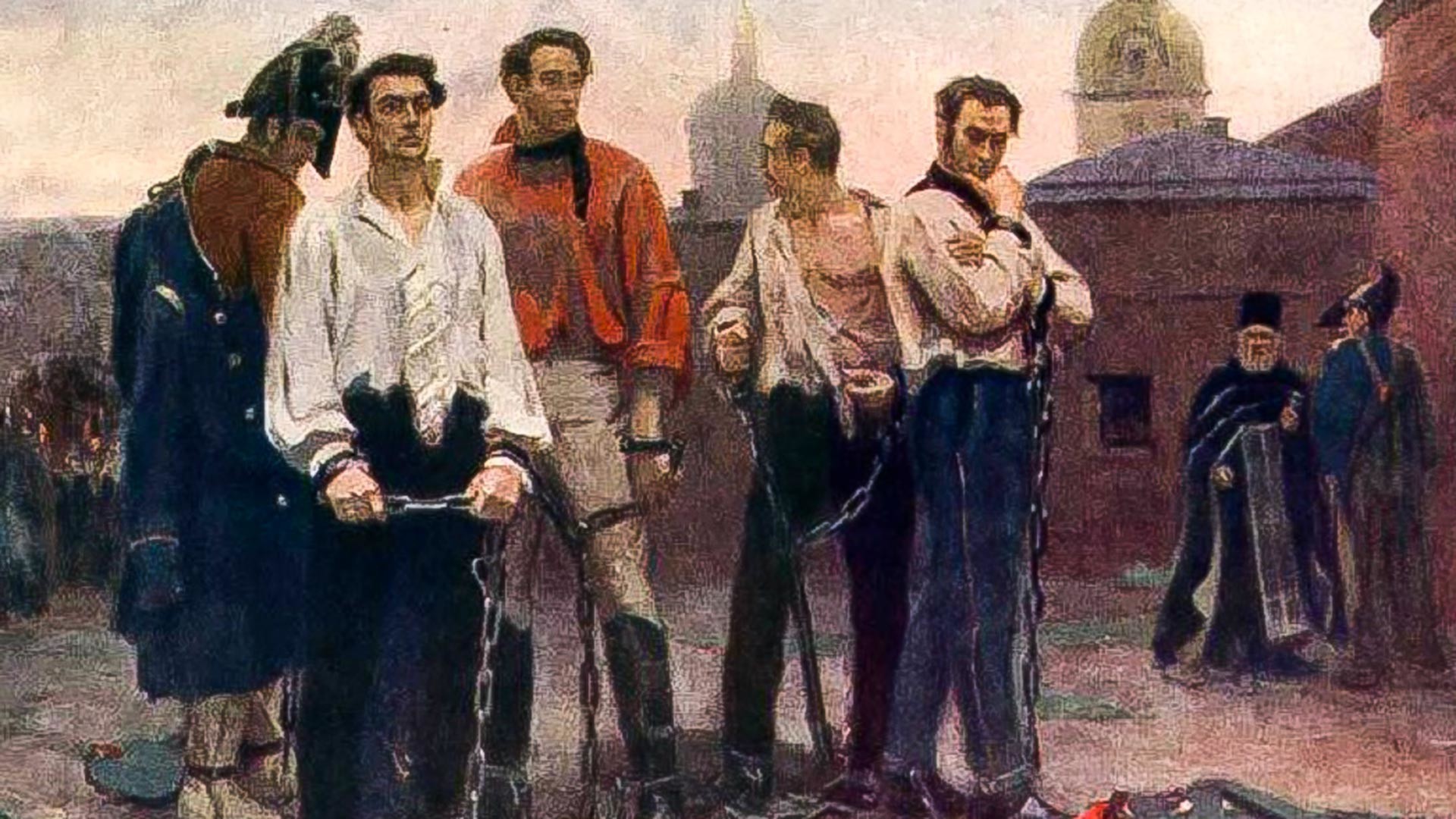
Execution of the Decembrists
(Gateway to Russia)
Decembrist Witnesses
In the book The First Breath of Freedom by Vladimir Fyodorov, the author compiles many key accounts and perspectives from key figures in the revolt. Throughout his book, he includes many primary sources, some of which are displayed below.
The Reminiscences of Nikolai Basargin, a member of the secret societies.
"the sentence of the Supreme Criminal Court was executed. The execution of this sentence was entrusted to General Chernyshev. Archpriest Myslovsky was with them to the last. Two of the ropes snapped,* and they fell to the ground alive. The executioners were at a loss and did not know what to do"
(Fyorodov)
"they picked them up, repaired the ropes and led them up again onto the scaffold and hanged them. Then, when they had made sure that all five were no longer living"
(Fyorodov)
The executions were a harsh and cruel reaction of the Tsar. Nikolai's description of the hangings portrays a cold and surprising point of view of those actions.
The overall impact of the government's reaction to the revolt changed society, as the government ensured that a revolution of its magnitude would never happen again.
The Reaction of the Decembrists
After the revolt, the Decemberists had to endure large repercussions as the Tsar interrogated, imprisoned, exiled, and even hanged many of the leaders.
Quotes from Alexander Muravyov, a Russian noble who co-founded the movement and was later imprisoned:
"There were not enough cells due to the large number of victims. Rooms serving as barracks for the garrison were converted into a prison. The glass in the windows, covered with a layer of chalk and glue, prevented the living rays of the sun from penetrating into these dungeons."
(Fyodorov)
"The food was disgusting. The money allocated for our rations was stolen by the officials and—at their head—the old deputy commandant. A number of the prisoners were on bread and water, many had irons on their hands and feet."
(Fyodorov)
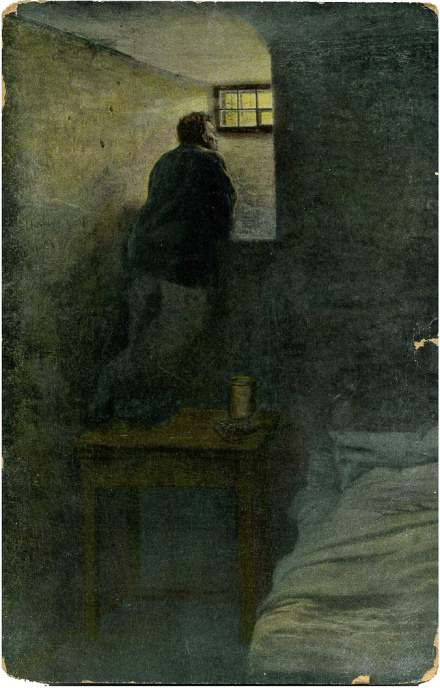
A worn postcard of a 19th century Russian painting depicting (perhaps) a political prisoner in the Peter and Paul Fortress.
(Executed Today)
The conditions that the Decembrists were put in after the revolt were dangerous and cruel. The Tsar did everything to get rid of Decembrist ideas.
Quotes below from Mikhail Lunin, a Decembrist in exile sending a letter to his sister criticizing the autocracy (1838):
Explaining the states use of propaganda and force:
"The Ministry of Public Education believes in autocracy as in a dogma and, possessing powerful means, uses them to strengthen it. It never ceases to preach that this mode of government would in every age be the dominant idea of the people, and that it is the only route to salvation in the present and the sole guarantee for the future"
(Fyodorov)
Explaining how the government shuts the people down:
"By what right does the Ministry, ascribing to itself legislative power, rob the people of their dearest hopes? ...Finally, does it think that, by inspiring in the people mistrust of the tsar’s word, it will incline it to support autocracy?"
(Fyodorov)
Lunin is explaining that the Tsar makes the people obey through fear and intimidation. No matter how hard the Tsar fights to get rid of the revolutionary ideas that oppose the autocracy, he will never succeed.