"I was ordered... to attend upon him and to offer him such informations of our religion and constitution as he was willing to receive"
(Bloomsbury)
Homepage
The DecembristsRevolution
Reaction
Reform
Annotated Bibliography
Revolution
Exposure in the late 1600s and early 1700s
The modernization efforts of Peter the Great helped spread Western ideas among the nobility, contributing to the rise of opposition movements such as the Decembrist Revolt.
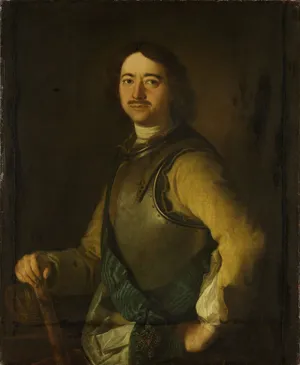
Peter I
(Britannica)
"Czar Peter I of Russia, known as Peter the Great, visited western Europe in 1697
to learn more about European customs and industry. Inspired by his trip, he
sought to westernize Russia in order to strengthen Russia’s position in the modern world"
(Students Friend)
Bishop Burnet was a Scottish historian and Bishop in England who provided a famous contemporary account of Peter the Great's visit to England in 1698; his accounts can be found on Bloomsbury's website, a well-renowned publisher in London.
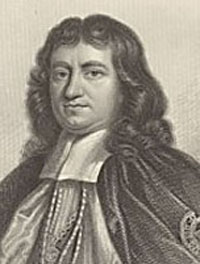
Portrait of Bishop Burnet
(Our Civilization)
"He was, indeed, resolved to encourage learning and to polish his people by sending some of them to travel in other countries and to draw strangers to come and live among them."
(Bloomsbury)
Bishop Burnet puts into perspective what Peter the Great wanted from his visit, explaining how his modernization efforts included exposure to Western ideas.
The Napoleonic Wars
The Napoleonic Wars exposed Russian soldiers and people to Western forms of rule that differed from their autocratic form of rule. The campaigns ultimately led to the development of Decembrist societies and their goals.
"In 1816, several young men, returning from abroad after the campaigns of 1813, 1814, and 1815, and having witnessed the political structures of Europe, conceived the idea of establishing a secret society in Russia for the purpose of mutual assistance and, as they claimed, 'the good of the Fatherland.'"
(Fedorovich)
"Czar Alexander I became a national hero after the Napoleonic Wars, and educated Russians believed that freedom for Europe would mean freedom for Russia. However, it was not to be. When peace in 1815 did not bring reforms, groups of young men began to discuss what should be done."
(McGrew)
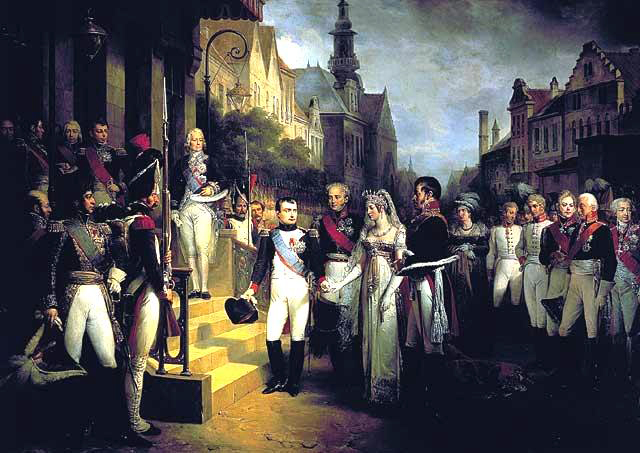
Portrait of Napoleon, Tsar Alexander I of Russia, and King Frederick William III and Queen Louise of Prussia in Tilsit
(Bargen)
"revolutionary sentiment fanned by the wars against Napoleon I and Alexander I's repression of dissent in the last decade of his reign, led to the Decembrist revolt upon Alexander's death."
(Kagan)
The Secret Societies of Early 1800s Russia
Union of Welfare
"Being convinced that good morality is the foundation of welfare and popular virtue, and that under all the care of the government it can scarcely achieve its goal if those governed do not assist it from their side in all beneficial endeavors, the Union of Welfare sets as its sacred duty to promote, by spreading among compatriots true rules of morality and enlightenment, to assist the government in raising Russia to a degree of greatness and prosperity to which it has been destined by the Creator Himself."
(First Article of the Union of Welfare's Charter)
"At the very beginning of its exposition, it was said that the members of the secret society unite with the aim of opposing ill-intentioned people and, together with them, assisting the benevolent intentions of the government. In these words, there was already half a lie, because none of us believed in the benevolent intentions of the government."
(Yakushkin, a Decembrist, speaking about the Union of Welfare's statute of the union.)
"And, of course, the society’s real aim was to overthrow the autocratic government by means of an uprising, to establish in Russia a government of the people and equality among citizens, to abolish serfdom, and to improve the economic condition of the peasants."
(Kirik Levin, in his "St. Petersburg: The Bell.")
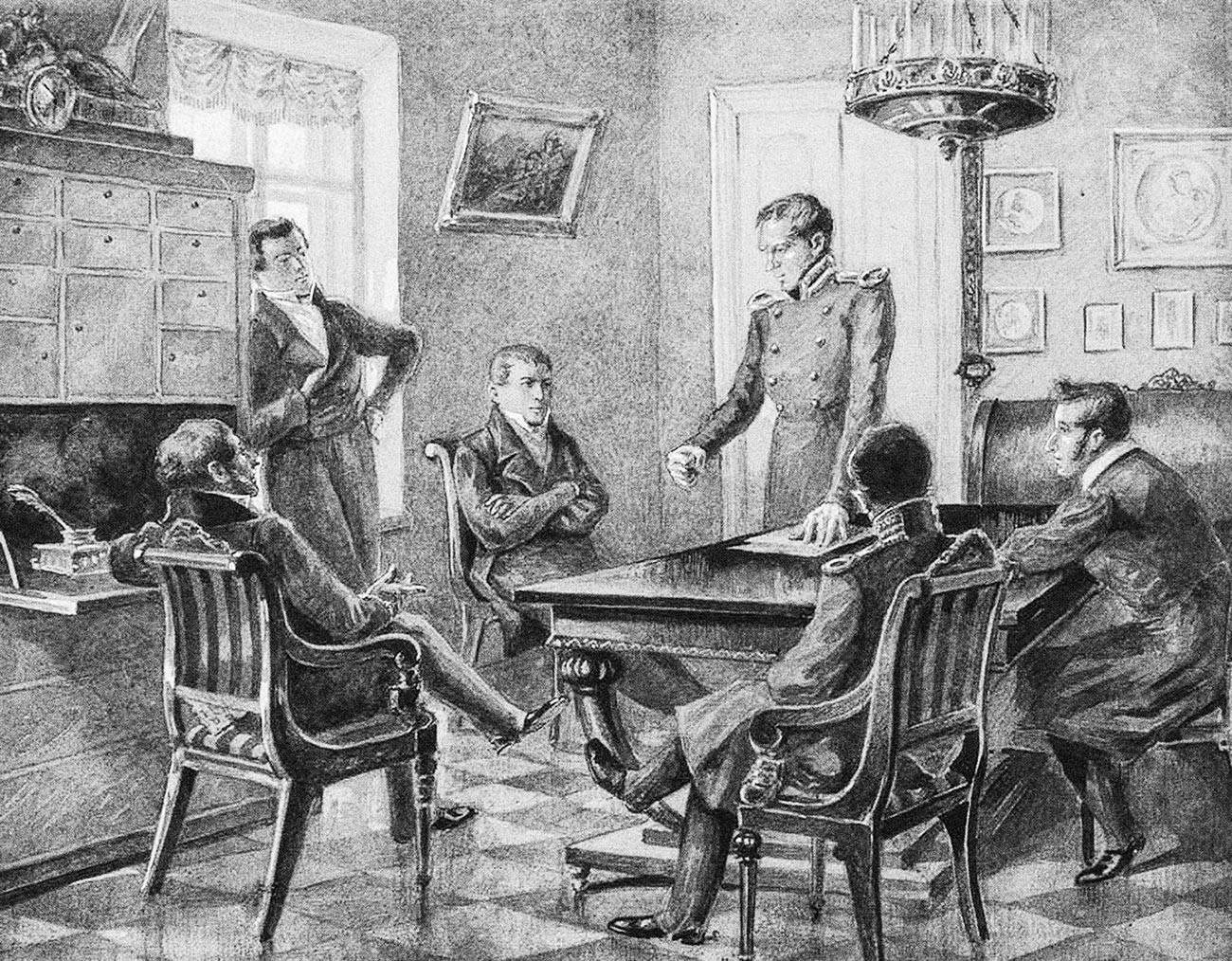
Pavel Pestel's speech at the meeting of the Northern Society of the Decembrists in Petersburg
(Getty Images)
The Northern and Southern Societies
"This society consisted of two branches...they acted independently, and later even began to bear their own names: the Northern Society and the Southern Society."
(Kirik Levin, in his "St. Petersburg: The Bell.")
Pavel Pestel is known as one of the most prominent figures in the revolt. He was very involved with all the main secret societies in Russia, but headed the Southern Society.
Pavel Pestel
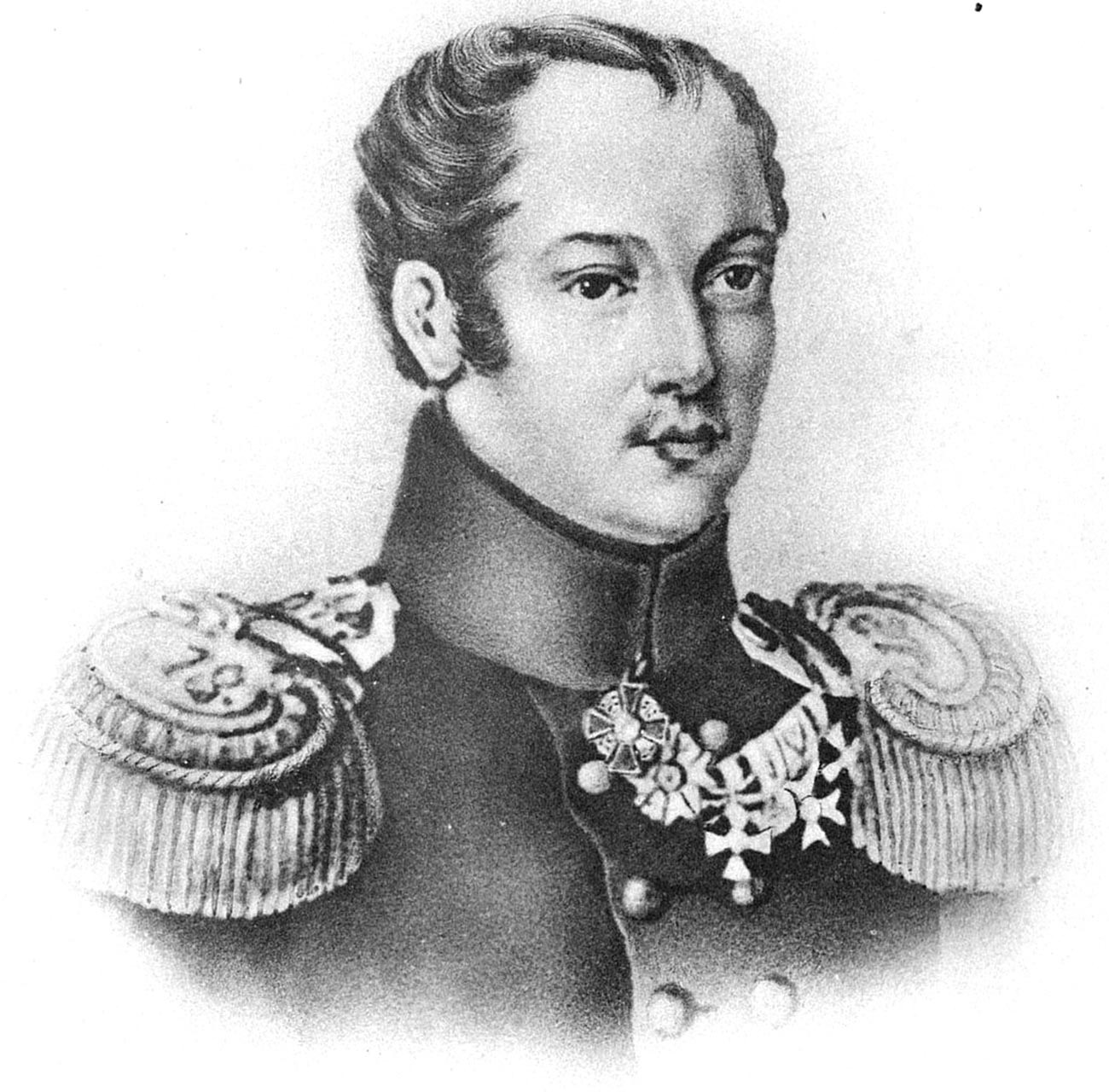
Pavel Pestel
(Pyotr Golovachev)
"Pavel Ivanovich Pestel was a pre-eminent and most radical thinker among the Russian nobles who staged the important but abortive 'Decembrist' Revolt against the Russian autocracy in December 1825."
(Patrick O'Meara in his "The Decembrist Pavel Pestel: Russias First Republican")
The Russkaya Pravda was a book that outlined Pavel Pestel's thoughts around the social and political problems of Russia.
“The Mandated State Charter of the Great Russian People, serving as a covenant for the improvement of the state structure of Russia and containing the true instructions both for the people and for the provisional Supreme Government.”
(Russkaya Pravda by Pavel Pestel)
Trubetskoy's notes give a description of the introduction of Decembrist ideology and the growing consciousness of the Russian people during the Napoleonic Wars. Petrovich was very involved with the secret societies and was ultimately chosen to lead the Decembrists in the revolt, but never attended.
"It may occur to them in later years to suspect that Providence is unjust, and that government consists in the oppression of innocence."
(Petrovich, Notes of Sergey Petrovich)
In his works, Petrovich explains the strength of the Western systems and how it differs from the Russian autocracy, sparking realization within the Russian population.
"...it was necessary to present to the landowners that sooner or later the peasants would be free... if the landowners persist and do not agree voluntarily, then the peasants may seize their freedom for themselves, and then the fatherland may find itself on the brink of the abyss."
(Petrovich, Notes of Sergey Petrovich)
“abolition of the former government” — followed by the establishment of a Provisional Government until a permanent one is decided upon by representatives; freedom of the press; religious tolerance; equality before the law…”
(Sergei Trubetskoy's Manifesto)
Sergei Trubetskoy Petrovich
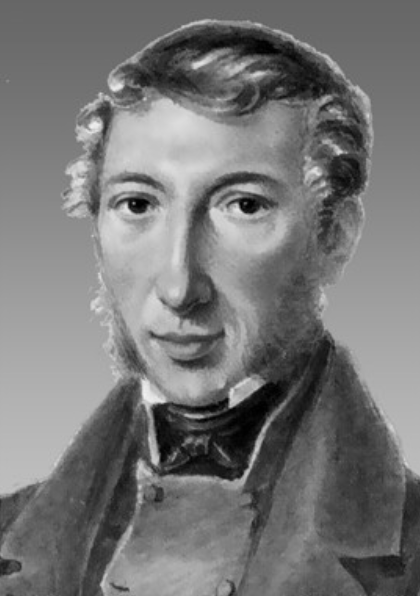
Portrait of Trubetskoy Sergey Petrovich
(Biliotsk Sivirsky Regional History)
Although both Pavel Pestel's Russkaya Pravda and Sergei Trubetskoy's manifesto aimed to modernize Russia and improve social conditions, they represented two distinct ideological paths that split the Decembrist movement: Pestel's radical republicanism and Trubetskoy's moderate constitutionalism. This major difference between the Southern Society and the Northern Society contributed to the revolt's failure.
Vladimir Fedoseevich Raevsky
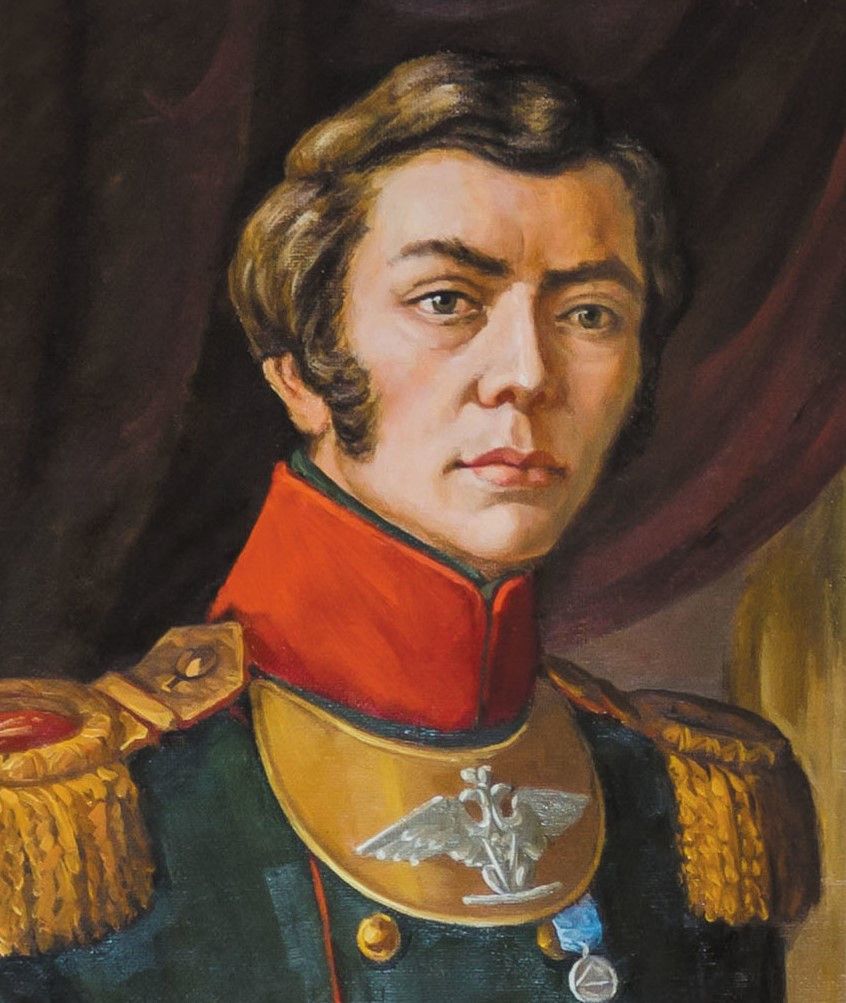
Portrait of Vladimir Raevsky
(Krasnoyarsk Regional Museum of Local Lore)
"Vladimir Fedoseevich Raevsky (1795-1872) is often called the "first Decembrist", he was arrested on February 6, 1822 and brought to trial first. During the years of imprisonment, after going through numerous interrogations, he held on so firmly that he practically saved secret societies from premature defeat."
(Krasnoyarsk Regional Museum)
Despite his early arrest, Raevsky was a foundational figure in the Decembrist movement, representing the idealistic beginnings of the struggle against the tsarist regime.