Harriet Tubman influenced many different aspects of contemporary rights and liberties. She took part in the women's suffrage movement (Dawson). Tubman played the role of spy during the Civil War and helped many slaves to freedom (Dawson). As well as all of this Tubman was a nurse for the United States Army, where she received a pension for her work in January of 1899 ("Claim of Harriet Tubman"). The pension that Tubman received was a payment of twenty-five dollars per month ("Claim of Harriet Tubman"). She was the hidden secret to more than just the people she freed but to the African Americans that were still enslaved, not because she was an African American who was making local, national and global news but because she helped people to freedom that would then be able to come back into slavery territory and free the others that were still enslaved. These actions that Tubman took to stand up for her freedom and the freedom of others around her influenced government leaders to pass the Thirteenth Amendment. In part of Tubman's hard work in the Underground Railroad and Civil War, she influenced and reformed the liberties and rights that are given to American citizens today.
Influence
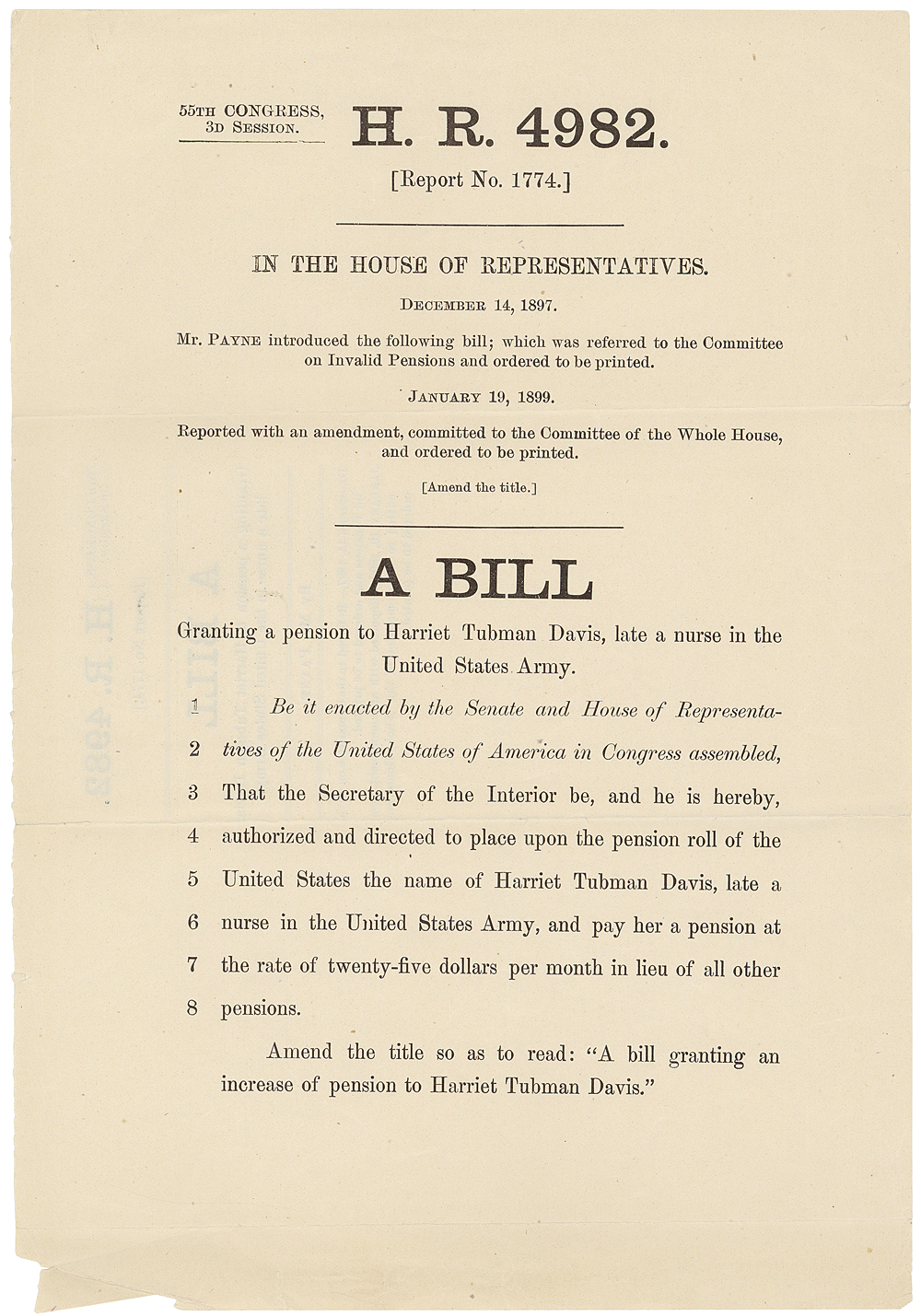
"Granting a pension to Harriet Tubman Davis..."
55TH Congress, 3D Session.
H.R. 4982
[Report No. 1774]
IN THE HOUSE OF REPRESENTATIVES.
DECEMBER 14, 1897.
Mr. PANYNE introduced the following bill; which was referred to the Committee on Invalid Pensions and ordered to be printed.
JANUARY 19, 1899.
Reported with an amendment, committed to the Committee of the Whole House, and ordered to be printed.
[Amend the title.]
A BILL
Granting a pension to Harriet Tubman Davis, late a nurse in the United States Army.
Be it enacted by the Senate and House of Representatives of the United States of America in Congress assembled,That the Secretary of the Interior be, and he is hereby, authorized and directed to place upon the pension roll of the United States Army, and pay her a pension at the rate of twenty-five dollars per month in lieu of all other pensions.
Amend the title so as to read: "A bill granting an increase of pension to Hariet Tubman Davis."